Leveraging telematics to support sustainability initiatives

If you haven’t already been asked the question by a customer, get ready for it. They’ll want to know what you’re doing to reduce their Scope 3 greenhouse gas emissions, so they can count those initiatives toward their own Environmental, Sustainability and Governance (ESG) efforts.
Scope 3 emissions are those generated by the assets a corporation doesn’t own or control (a.k.a. – your trucks). As shipper ESG reporting becomes more complex and runs deeper within a major shipper’s organization, their demands for real data from their transportation providers will increase.

The bad news is, fuel-slashing initiatives can be daunting to accurately calculate. It’s not back-of-the-napkin stuff, nor will a hastily created Excel spreadsheet suffice. The data must be reliable and auditable.
The good news is that many of the more advanced telematics platforms have built in tools to calculate emissions and present the data in an easily digestible format that can be shared with customers.
Yunsu Park is telematics advisor to the North American Council for Freight Efficiency (NACFE). When that organization needed a telematics partner to monitor the trucks entered into its Run on Less – Electric demonstration, he sought a provider that offered seamless access to the data needed.
NACFE posted near real-time performance metrics from the trucks involved in the demonstration.
Accessibility of data key
“The thing we loved about Geotab is that they make it very easy to access data externally through their APIs,” says Park. “Just about any telematics provider is going to be able to give you the same kind of data, but if it’s sitting there in their dashboard, it does me no good. I need to be able to access that data.”
Geotab offers what it calls a Green Fleet Dashboard, a tool fleets can use to monitor their efforts in reducing fuel cost and emissions across traditional diesel-fueled trucks and even electric vehicles.
“Many telematics providers haven’t really done much with EVs at this point, certainly not with some of these new startups,” Park says. “Geotab is willing to get in there and say ‘Yes, tell me which truck it is, we’ll get our people on it.’ They’ve been fantastic.”
For Run on Less – Electric, the results were easy to analyze at a glance, even for those who don’t have a broad understanding of trucking or telematics. With the follow-up version, Run on Less – Electric Depot, Tesla fanboys were able to rah-rah online when the Tesla Semi put in its first 1,000-mile trip, under loaded, with no charging en route.
Park would like to see this kind of transparency embraced by the industry, so shippers can make informed decisions by analyzing data shared by fleets via their telematics platforms.
“For better or for worse, the fleets really treat this data very possessively,” Park says. “They look at it as secret information.”
At the very least, he’d like to see some standards around how various telematics providers generate and present data related to sustainability initiatives. It would also make life simpler for shippers if their trucking providers all presented data in a similar format, regardless of telematics system they have adopted.
Today, Park says large fleets are leading when it comes to tracking sustainability initiatives and making that data accessible to shippers.
“A small fleet is not going to have somebody who’s dedicated to just looking at telematics data,” Park acknowledges. But he’s hopeful telematics will play a big role in making this process easily accessible to small and mid-sized fleets as well.
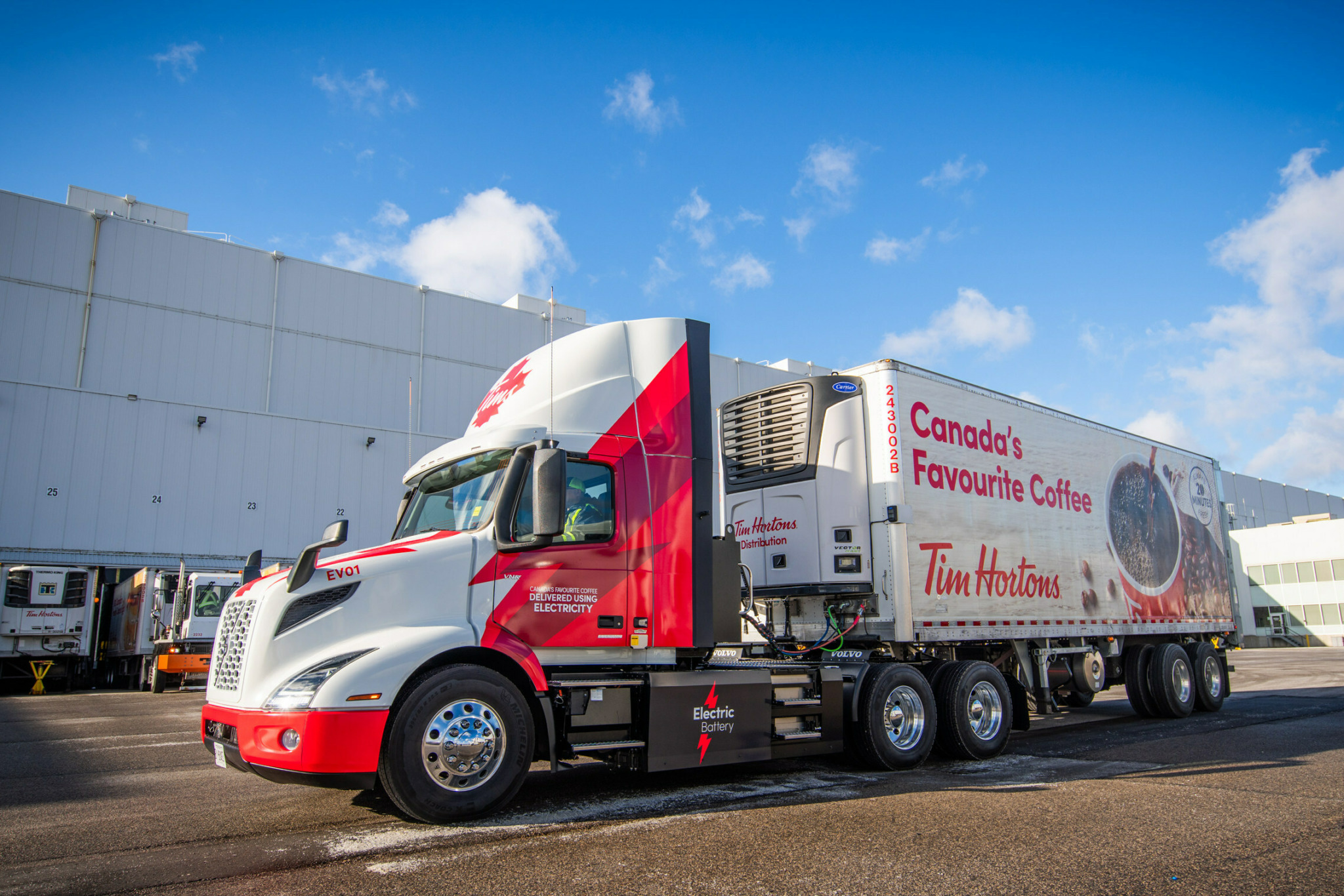
Telematics to assist small fleets in reporting
“I’ve talked to a small fleet recently that has just over 50 trucks and they’ve recently been asked about their emissions for this one customer. And he says, ‘I have no idea where to even start.’ Fortunately, he has a Samsara system so I think we can get him there.”
Fleets must also be sure to factor in elements of their operation that influence fuel economy that may sometimes be overlooked. Idling is a big one, says Megan Allen, senior group product manager at Geotab.
“We know that idling is a significant contributor to excess fuel used by fleets,” she says, adding one hour of idling produces 18 lb. of CO2. “So, a fleet of 25 trucks that cuts down their idling by two hours a day could save 12,000 gallons of fuel annually. That’s significant for the bottom line in terms of fuel consumption, as well as for environmental targets.”
Proper vehicle maintenance can improve fuel economy by 5-10%, Allen says. And driver behavior monitoring is another area that can yield results. “Typically, we look at driver behavior monitoring and we think safety and risk. But that same behavior modification also contributes to a more fuel-efficient fleet,” Allen says.
Isaac Instruments created the Isaac Coach to provide real-time feedback on driver habits right inside the cab. Jean-Sebastien Bouchard, chief product officer and co-founder, says “our data shows that a 1% improvement in the Isaac Coach score improves their fuel efficiency by 0.5%.”
He notes it’s not uncommon for drivers to start out with scores of about 70 when the system is implemented, and then improve due to the constant feedback to a score of 90. “So, that’s a 10% improvement in fuel efficiency,” Bouchard says.
And he says while navigation is a basic telematics feature, there’s great variance in its accuracy across various product offerings. In some instances, a driver will be provided the street address that’s on the front of a building, when the truck entrance is at the back of the yard and requires the driver to take a separate highway exit.
Last-mile navigation a challenge
“Last-mile navigation has been a big challenge for truck drivers who are not used to a certain destination,” said Bouchard.

As fleets do more to improve their sustainability – whether for their own cost savings, or to comply with increasingly stringent customer demands – they’ll want to carefully monitor the significant investments they’ve made in new technologies, such as electric trucks. Allen says Geotab has sought to be a leader in producing reliable data on EVs, so fleets can better understand their performance.
“Fleets can be a little apprehensive when they are switching to a new technology,” Allen says. “So, one of the things that we did pretty intentionally when we started building EV features into Geotab, was making sure they were interwoven with those fuel features at the same time so you can see that shift in transition, instead of having to go to one place to understand the majority of your fleet and then another place to understand this new technology.”

Have your say
This is a moderated forum. Comments will no longer be published unless they are accompanied by a first and last name and a verifiable email address. (Today's Trucking will not publish or share the email address.) Profane language and content deemed to be libelous, racist, or threatening in nature will not be published under any circumstances.