Will carriers get on board Quebec’s mandatory 125-hour training?

Mandatory training for obtaining a Class 1 license came into effect in Quebec on Dec. 15, 2025. Anyone wishing to drive a heavy vehicle must now complete approved training before obtaining a license.
Two pathways are available: a 615-hour vocational diploma program (DEP) offered at specialized schools, or the new Road Safety Education Program (Programme d’éducation à la sécurité routière, or PESR – Class 1). The PESR is delivered by providers recognized by the Société de l’assurance automobile du Québec (SAAQ) and consists of 125 hours of training, including 50 hours of practical driving. But questions remain about what that new program is worth.
Several carriers — including Groupe Guilbault, Transport Grayson and Transport Matte — say they prefer to hire young drivers with a vocational diploma or candidates who already have solid experience behind the wheel.
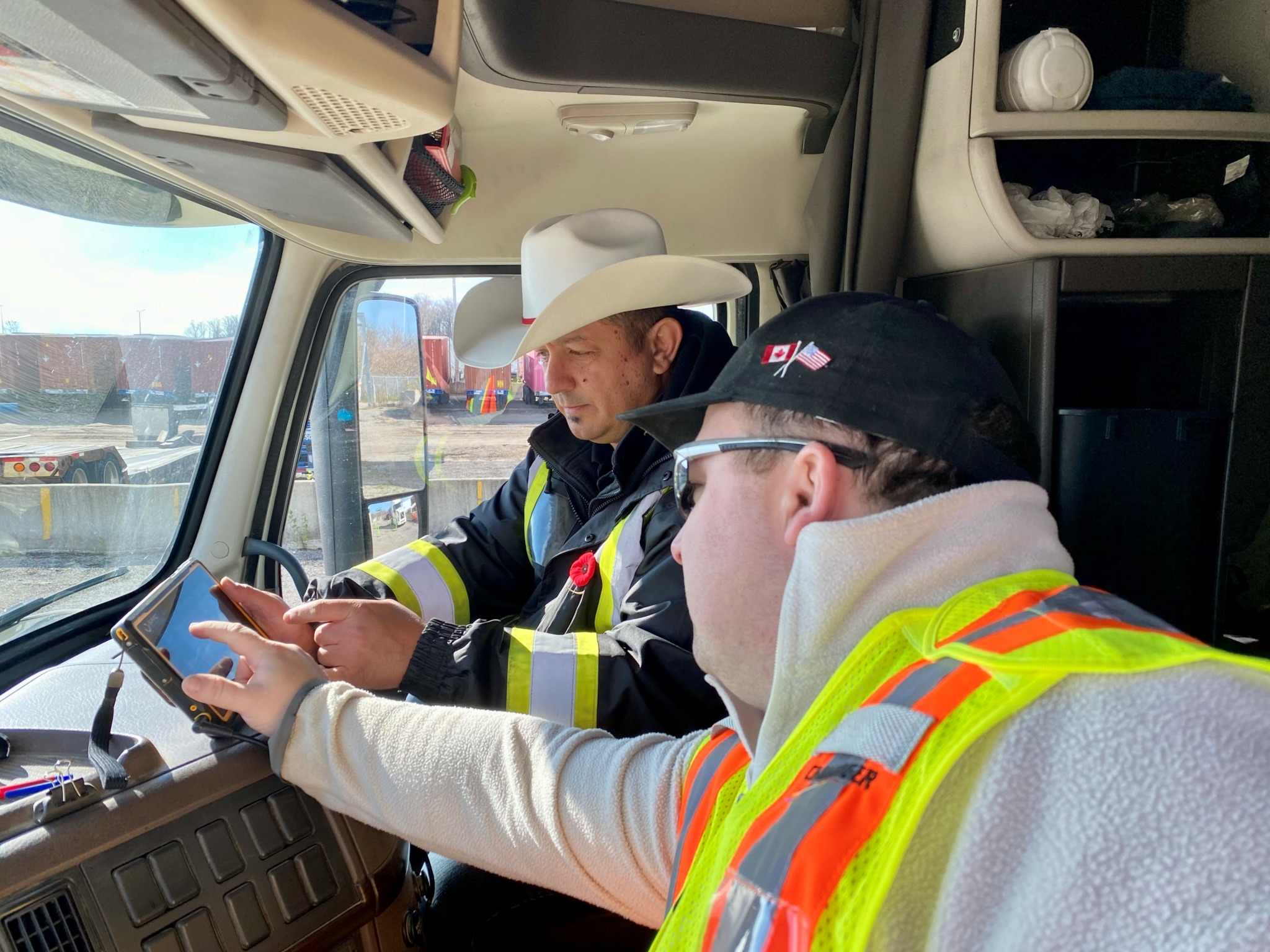
“It really gives us peace of mind knowing that the person has a minimum level of training and skills. And 615 hours is no small feat,” said Mélany Matte, vice president of Transport Matte.
Despite those preferences, the industry is generally enthusiastic about the introduction of mandatory training.
“We’re going to be even more structured. It will help the industry and clean things up,” said Éric Gignac, president of Groupe Guilbault. “It’s imperative that the industry improves. We can’t keep putting trucks on the road with untrained drivers, given the accidents we’ve had — not to mention Chauffeur Inc. (Driver Inc.).”
125 hours of training
Yvan Domingue, director of personnel and hiring at Transport Grayson, also sees the change as a step in the right direction.
“There’s still a long way to go, but it’s already better than someone who can go to any private school, has a little aptitude, and gets their Class 1 licence in 20 to 30 hours,” he said.
Where carriers appear united is in their belief that the PESR – Class 1 program should be longer than 125 hours.
“I would say it’s better than nothing, but it’s not ideal. It could have been more, that’s for sure,” Gignac said.
“It’s better than nothing. It’s a start,” Matte added.
“There will be a lot of theory, a lot of regulations, and a lot of practical training missing,” Domingue said. “The DEP, I believe, has about 230 hours of practical training and extensive regulatory content.”
Lack of ongoing education
While Domingue supports making training mandatory, he believes the biggest gap is the lack of ongoing education.
“Driving a truck is a profession that is unfortunately not recognized, but it is a job,” he said. “There is so much to learn, and it can’t be learned in 125 hours — or even 615 hours. It takes one to two years to fully develop a driver in the right niche.”
That learning curve becomes even steeper when specialized skills such as U.S. regulations or winter driving are considered. Domingue noted his company employs a full-time trainer to provide ongoing instruction for new drivers, a resource many carriers lack.
Accessibility limited by cost
One advantage of the PESR – Class 1 program, according to Matte, is its accessibility for older workers.
“The DEP may not be accessible to everyone,” she said. “A worker in their 40s, with a family, who wants to change careers may not be able to afford to complete a full DEP. They may be able to benefit from the PESR, since they already have some life experience.”
However, that accessibility comes at a cost. The PESR – Class 1 is estimated to cost between $8,500 and $10,000, with $1,425 in government financial assistance, while the DEP is free in some cases.
“People have to pay for it out of their own pockets,” Matte said. “To what extent will people be able to afford it?”
International recruitment concerns
She also raised concerns about international recruitment. Transport Matte employs many foreign workers from France and has relied on the Quebec–France agreement that allows experienced drivers to obtain the equivalent of a vocational diploma through recognition of prior learning. With the introduction of mandatory training, that pathway will disappear.
“Foreign workers will have to complete the DEP and go through several months of training without pay, or pay $10,000 for the PESR – Class 1,” Matte said. “That’s where I see a bit of nonsense.”
Industry pressure is building to secure an exemption or financial assistance equivalent to the DEP. “Otherwise, it will slow down our hiring of qualified French drivers,” she said.
Administrative burden
Gignac added that PESR – Class 1 providers are largely concentrated in Montreal and Quebec City, limiting access in other regions.
“We know very well that there is still a workforce in the regions,” he said.
For Gignac, the main concern remains the administrative burden tied to the program. Providers must meet numerous criteria and undergo investigations by the SAAQ — a process he described as lengthy and costly.
“We’re not ready for that yet. I don’t think schools are either. I don’t think the industry is ready at all,” he said.
While carriers say they will continue to favor vocational diploma graduates, they are not ruling out candidates trained through the PESR – Class 1 program, depending on circumstances.
“We think we’ll have to change the way we do things a little bit and probably look for people with 125 hours of training,” Gignac said. “But we are still wondering what to do first.”
“It will have to be analyzed properly,” Matte added. “If someone has some experience in addition to the PESR, it could possibly be considered on a case-by-case basis. We will have to see the quality of the training. Time will tell.”

Have your say
This is a moderated forum. Comments will no longer be published unless they are accompanied by a first and last name and a verifiable email address. (Today's Trucking will not publish or share the email address.) Profane language and content deemed to be libelous, racist, or threatening in nature will not be published under any circumstances.