Tariffs, uncertainty reshaping North American supply chains: Panel

Tariffs and geopolitical uncertainty are forcing companies to rethink their supply chains across North America — but the disruption is also creating opportunities for businesses able to adapt quickly.
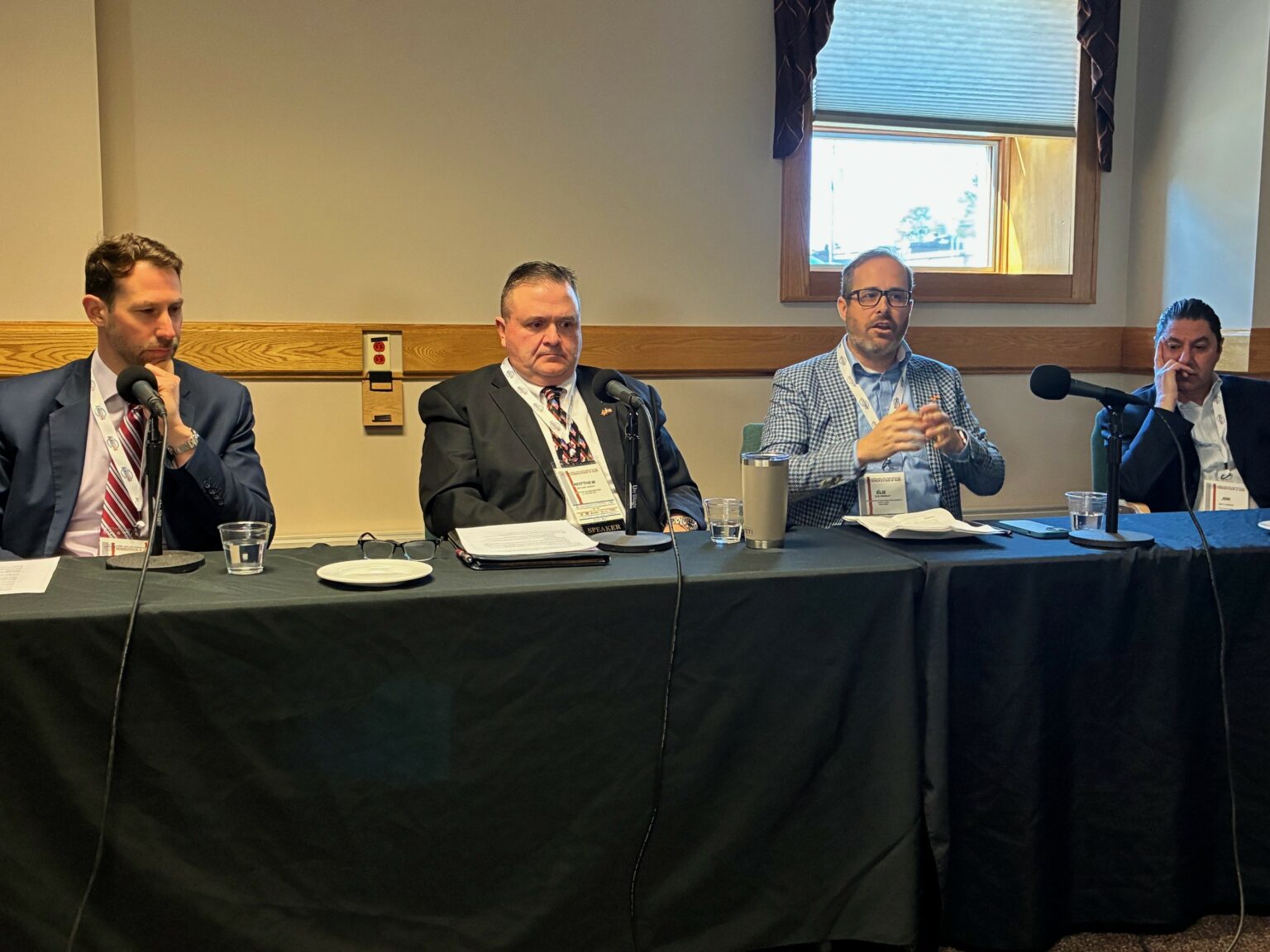
That was the message from a panel titled What’s New in Supply Chains/Managing Tariffs, presented March 10 at the Quebec-New York Transportation Rendez-vous & B2B in Plattsburgh, N.Y.
For many companies — particularly small and medium-sized enterprises — the biggest challenge is not the tariffs themselves, but the uncertainty surrounding them.
“The uncertainty surrounding the tariffs is costing New York State SMEs more than the tariffs themselves,” said Ludovic Ortuno, director of Canadian trade at Global NY.
Ortuno said his organization supports about 50 small and mid-sized companies each year as they explore exporting to Canada. But the nature of that support has shifted.
“Previously, our work mainly consisted of helping companies find distributors, partners, or organizing trade missions,” he said. “Today, we spend much more time helping them understand how to save money in a pricing environment.”
Many small-business leaders juggle multiple responsibilities and lack the time to analyze complex trade rules in detail, Ortuno added.
“The leaders we work with wear many hats. They don’t have time to do all the research, so we analyze their processes and help them build a strategy.”
Canada as a strategic platform
Some companies are increasingly using Canada as an assembly or production platform to navigate tariffs and supply disruptions.
Ortuno cited the example of a mattress manufacturer that sources materials globally.
“He was using yarn from China and wood from Canada, and he wanted to sell in North America and Europe,” he said. “We advised them to use Canada as an assembly platform. That way, he can sell in Canada and export to Europe.”
Tariffs and supply shortages have also pushed trade development agencies into unfamiliar territory.
“We’ve never had to help companies find suppliers before,” Ortuno said. “But now some materials are simply disappearing from the market.”
He cited a manufacturer of lobster traps that struggled to obtain vinyl-coated wire as prices surged and supply tightened.
“These are very concrete examples,” he said. “Companies are trying to survive and adapt.”
Managing tariffs operationally
For manufacturers operating on both sides of the border, the complexity of trade rules remains the biggest challenge.
Élie Tremblay, senior director of strategic procurement and supply chain at bus manufacturer Micro Bird, said the company — which operates plants in Drummondville, Que., and Plattsburgh — has created an internal structure to track tariff changes.
“The first challenge is the complexity,” he said. “The tariffs are layered together, which involves a huge number of calculations.”
Volatility further complicates planning.
“You never know what will happen next,” Tremblay said.
To respond quickly, Micro Bird established a six-person “crisis team” tasked with analyzing tariff announcements and assessing their impact. The company also relies on external consultants to provide additional perspectives.
“These rules are the same for everyone,” Tremblay said. “The question is how we understand them well enough to remain as competitive as possible.”
Having facilities on both sides of the border can also provide flexibility when tariffs shift. Components can move between locations for assembly or modification, helping reduce tariff exposure.
“We can receive materials in one location, assemble them, modify the product, and then ship it back,” Tremblay explained. “Operationally, it’s a challenge, but it can save a lot of money.”
He encouraged companies to focus on strategy rather than viewing tariffs as purely negative.
“Don’t see the rules as something that makes you a victim. Everyone plays by the same rules. The question is how you use them.”
Contract terms could shape tariff refunds
Jon P. Yormick, managing partner of Yormick Law LLC, said potential tariff refunds could begin flowing through supply chains, but how the money is distributed will depend largely on contract language.
Courts have already ordered the reimbursement of some fees imposed in recent years, but the details remain unclear.
“We don’t know exactly when or how these reimbursements will be made,” he said.
Whether companies pass those funds on to customers will depend on the terms in their supply contracts and sales agreements.
USMCA review unlikely to disrupt trade
Despite political tensions, panelists said the scheduled 2026 review of the Canada–United States–Mexico Agreement (CUSMA) is unlikely to threaten the foundation of North American trade.
Matthew Parrott, director of distribution at customs broker AN Deringer, noted that the review — set for July 1 — was built into the agreement from the start.
Governments are expected to revisit familiar issues such as automotive rules of origin, labor provisions, dairy and lumber. But the deep integration of North American supply chains makes abandoning the agreement unlikely.
“We need Canada, and Canada needs the United States,” Parrott said.
He pointed to sectors such as agriculture and energy, where the two economies remain tightly linked.
“The United States imports 85 to 90% of its potash from Canada,” he said. “Without fertilizer, you can’t grow crops. And without crops, you can’t eat.”

Have your say
This is a moderated forum. Comments will no longer be published unless they are accompanied by a first and last name and a verifiable email address. (Today's Trucking will not publish or share the email address.) Profane language and content deemed to be libelous, racist, or threatening in nature will not be published under any circumstances.