McKinsey says TCO gap between EVs, diesel trucks can be reduced

Closing the total cost of ownership (TCO) gap is vital to unlocking zero-emission truck adoption at scale. The main challenge for fleets is that the TCO gap ranges between 30% and 50% compared to internal combustion engine (ICE) vehicles running on diesel.
Analysts from management consulting firm McKinsey & Company noted that there are opportunities for fleet operators, OEMs, and ecosystem partners to act collectively to achieve TCO parity.

Addressing journalists in Anaheim, Calif., Moritz Rittstieg, Dilip Bhattacharjee and Saral Chauhan suggested a three-pronged approach.
Truck OEMs could take steps to incrementally reduce product costs and deliver their offerings in the U.S. market at scale — which, in turn, could unlock opportunities.
Fleet operators could consider evolving their zero-emission vehicle (ZEV) adoption approach from plug-and-play to operations tailored toward optimizing the capabilities ZEV assets can deliver compared to ICE vehicles.
Stuck at pilot programs
Service providers, beyond OEMs and fleet operators, play an important role in reinforcing an ecosystem that supports zero-emission truck adoption at scale. This may include supplying the required charging or fuel infrastructure along freight corridors and developing innovative financing offerings.
A recent McKinsey survey of more than 200 U.S. trucking fleets found that while two-thirds are committed to decarbonization and over half are piloting ZEVs, fewer than 10% see a viable path to scaling the use of ZEVs.
Chauhan said that many fleets are vehicle focused and don’t look at the whole picture. They run into electricity demand pricing and grid upgrade challenges. Fleets need to plan at least five years ahead and must be aware that technology may not be ready, and costs could rise sharply. Fleets then give up, and he added that this is quite common, except for the bigger players in the industry.
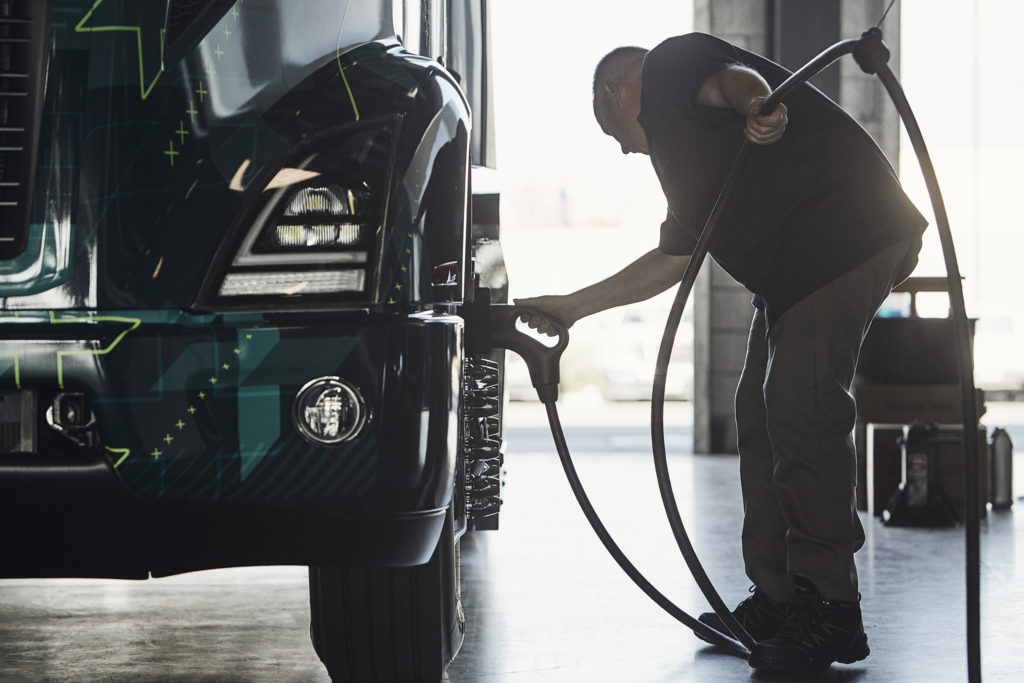
TCO parity exists for light vehicles like vans, but not for heavy-duty trucking.
Predictable local distribution routes may look ideal for electrification, with trucks returning to a depot at the end of a shift. But sometimes vehicles are not run enough to amortize higher ZEV truck costs. The operators may need to increase utilization and raise daily mileage.
Electrification challenges
On the other hand, long-haul full truckload (FTL) carriers may have multishift operations with trucks running more than 500 miles (808 km) daily. Yet, schedules are less predictable, and the time available to charge is limited.
FTL fleets’ high payload density also requires large batteries or hydrogen tanks supported by infrastructure on their routes. Reliance on public fast-charging stations — often during peak electricity rate periods — adds unpredictability and erases much of the variable cost advantages of battery electric vehicle (BEV) trucks compared to ICE trucks.

Beyond lower up-front vehicle costs, a path to parity may require FTL fleets to tailor schedules to allow for charging in off-peak times and to form partnerships to develop electrified freight corridors and reduce on-route charging costs.
OEMs can look for opportunities to reduce BEV costs by improving design, technology, and operational excellence. This could include battery pack sourcing and design, manufacturing and engineering process improvements, economies of scale, and warranty and support reduction.
If such measures are implemented, McKinsey’s bottom-up modeling suggests an up-front cost reduction of approximately $150,000.
Finding the sweet spot
McKinsey identified 24 parameters that impact TCO across different fleet operating models. Fleets can directly influence 13 of these.
For example, maximizing the vehicle’s dwell time during off-peak periods allows for using slower, less expensive chargers in conjunction with lower electricity rates.
Some operating parameters can be optimized to a sweet spot. When considering the daily driving distance, too few miles result in insufficient utilization. On the other end of the scale, too many daily miles lead to increasingly inefficient charging schedules, requiring the use of pricier fast-charging facilities.
The remaining 11 external market parameters that include electricity prices and subsidies can be monitored but not controlled.
An extended ecosystem of industry stakeholders can help support the shift. Two factors stand out – electrified fleet corridors and fleet ownership innovation.
Electrified fleet corridors
Electrified fleet corridors with reliable on-route charging and fueling options may encourage faster EV adoption, particularly for longer-distance hauls. Presently most fleets have neither the scale nor budget to justify deploying their own on-route charging infrastructure. Meanwhile, existing public charging infrastructure demands high prices — two to three times higher than depot charging — to make up for the low utilization.
McKinsey analysts said one possible solution, a consortium comprising U.S. truck fleets and a charging solution provider — potentially with an infrastructure investor — could collaborate, each contributing a key missing piece of the long-haul fleet electrification puzzle.
Fleets participating in the consortium could guarantee a minimum utilization of the on-route chargers, between 5% and 10%, for example, while gaining access to competitively priced $/kWh charging rates and guaranteed charger uptime.
Predictable ROI
The charging solution provider could benefit from a predictable ROI through the pooled utilization of chargers by the participating fleets. An infrastructure investor could underwrite the investment in fast chargers, grid upgrades, and ancillary infrastructure like battery energy storage systems (BESS) and microgrids at the on-route charging locations.
A system orchestrator could plan the deployment of infrastructure along the freight routes most commonly used by the participant fleets, tailoring the plan to align with each fleet’s daily operating patterns.
McKinsey analysis indicates that the consortium model of on-route charging could lead to a 15% to 20% TCO reduction for heavy duty trucking electric fleets.

Have your say
This is a moderated forum. Comments will no longer be published unless they are accompanied by a first and last name and a verifiable email address. (Today's Trucking will not publish or share the email address.) Profane language and content deemed to be libelous, racist, or threatening in nature will not be published under any circumstances.