NACFE report highlights achievements of SuperTruck programs

The North American Council for Freight Efficiency (NACFE) has released a report highlighting achievements from the U.S. Department of Energy-funded SuperTruck programs.
SuperTruck 2: Empowering Future Trucking, focuses on lessons learned from the SuperTruck 2 program. Five teams participated in the program: Cummins and Peterbilt; Daimler Truck North America; Volvo Trucks; Navistar; and Paccar.
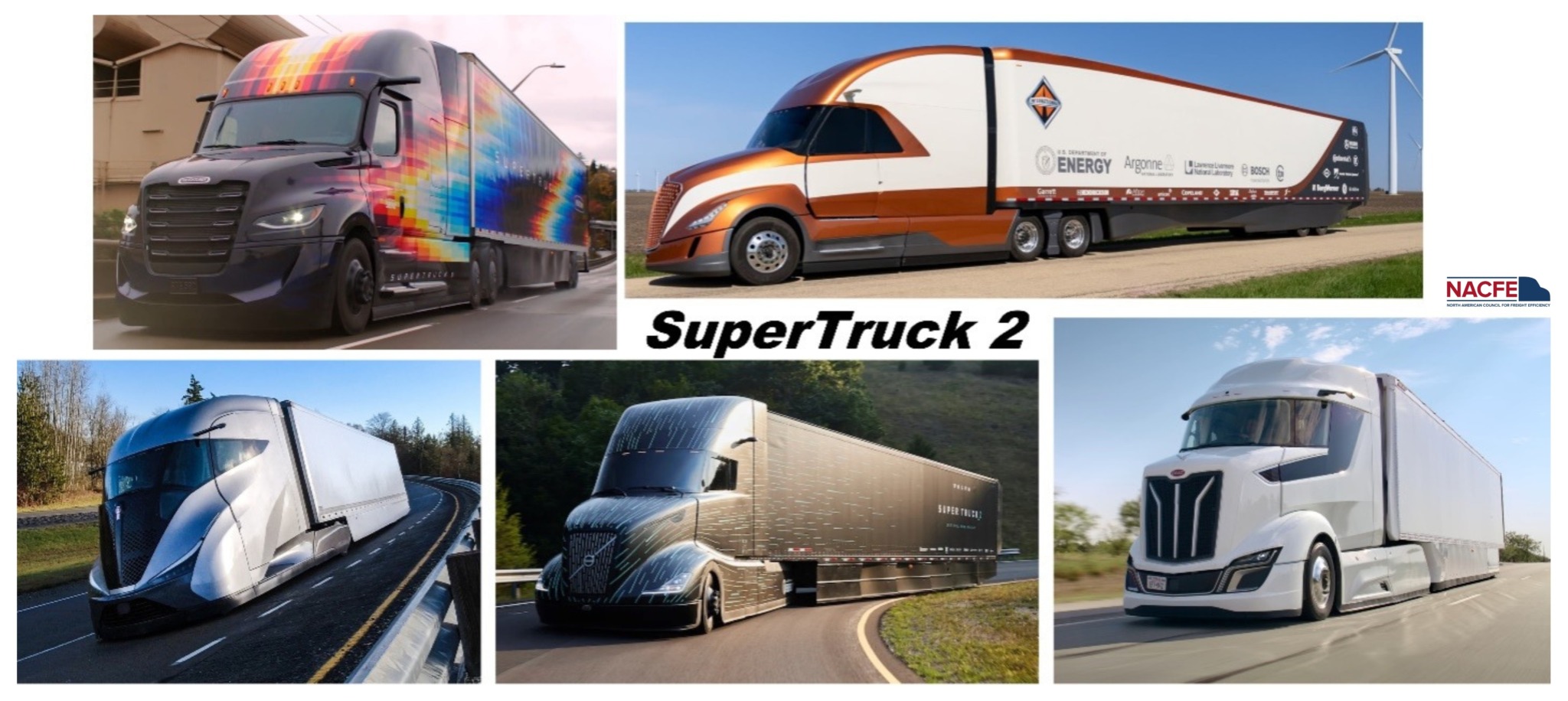
“SuperTruck 2 had the five teams looking at the entire tractor-trailer as a single unit which yielded significantly improved performance benefits vs. a more piecemeal approach,” said Mike Roeth, NACFE’s executive director, speaking at a press conference at the spring meeting of the Technology & Maintenance Council.
“We concluded that the SuperTruck 2 teams achieved great improvements and delivered efficiency technologies to make zero-emission solutions more successful,” added Rick Mihelic, NACFE’s director of emerging technologies.
The report concluded that many tractor-trailer efficiency gains are universally applicable across all powertrains. Mihelic, who authored the report, pointed out zero emissions vehicles shouldn’t steal all the headlines from SuperTruck programs and their ability to improve fuel economy on internal combustion fueled trucks.
“One of the greatest aspects of this program is these are not blue sky projects with research money going into them just for the sake of research,” said Mihelic. “One of the contributing factors of this program is the technology has to have a path to production; some legitimacy that will go into a vehicle at some point in time.”
It also provides engineers with an opportunity to take a complete systems approach to design, including the trailer.
“OEMs build tractors, not trailers,” Mihelic said. “This is a unique opportunity for OEMs to explore some improvements they wouldn’t normally be able to do because they’re looking at too small of the piece of the puzzle.”
He reminded that there are 10 million medium- and heavy-duty trucks on North American roads, replaced at a pace of about 300,000 a year for each segment. This means that there will still be a need to improve the efficiency of existing models as we await the wider adoption of zero-emission vehicles. The report can be downloaded at www.nacfe.org.
Have your say
This is a moderated forum. Comments will no longer be published unless they are accompanied by a first and last name and a verifiable email address. (Today's Trucking will not publish or share the email address.) Profane language and content deemed to be libelous, racist, or threatening in nature will not be published under any circumstances.

Quote…..”OEMs build tractors, not trailers,” Mihelic said. “This is a unique opportunity for OEMs to explore some improvements they wouldn’t normally be able to do because they’re looking at too small of the piece of the puzzle.”….his opinion, while valid, only applies to North America.
European OEMs have for many years sold their power-units mated to a semi- or full-trailer right from factory (by working closely with pre-accredited trailer manufacturers).
In the early days (say 1960 and onwards), the main reasons for European OEMs to market combination units were such issues as braking systems. And it worked wonders, as tractor/semi-trailer (or straight-truck/pup or full-trailer combos spec’d at the power-unit plant, would – for example – ensure that the brake-foundation components on all wheels are compatible, resulting in far less road-side inspection out-of-service orders, when compared to the average annual CVSA results.
It never ceases to amaze me – notwithstanding the selling-price factor – why North American OEMs (even the likes of typically European parent-company makes, i.e. Volvo, Freightliner) never looked deeper into these remarkable differences.
While I was managing the fleet of a Toronto-area based LTL carrier for 8 years, its owner and I tried whenever possible to emulate the European m.o., even though the tractor & semi-trailer manufacturers didn’t “talk to each other”. However, because the majority of our trailer equipment was custom-made, it was far easier for me to spec the brake-components for compatibility in close cooperation with the respective OEMs. The results of 35,000,000 eastern seaboard miles with nary any CVSA-inspections identifying serious or OOS- brake violations was sufficient proof that we were on the right track (mind you, our strict preventive maintenance program and in-depth driver-training also contributed to these results).
Food for thought.