‘Stackable capacity,’ more intermodal and going green all part of Schneider’s strategy

Rather than chase freight rates to the bottom, Schneider National is focused on transforming its operations to move more freight intermodally and “stacking capacity” through various services.
That according to Erin Van Zeeland, vice-president and general manager of logistics and chief commercial officer with Schneider. Speaking at FTR’s annual Transportation Conference, she said the focus through the downturn has been to “control what you can control.”

“We’re very disciplined where we deploy capital,” she said.
Schneider has fewer drivers than it did at the peak and has trimmed its network of third-party carriers from more than 30,000 carriers, to about 22,000. This, Van Zeeland said, has allowed the company to get closer to its third-party carriers and better understand their businesses “so when the freight opportunity is there and we have surges in different pieces, we don’t have problems getting capacity to help us meet the needs of our customers.”
She sees some signs of green shoots emerging in general freight markets, particularly in certain markets and geographies of the U.S.
“We are seeing green shoots in different market areas,” she said. “We are also seeing different opportunities of growth with customers.”
One growing opportunity is intermodal, where Schneider is looking to double its volumes by 2030. It has a deal with rail providers Union Pacific and CPKC, including exclusive lanes at UP yards. The close partnerships with rail providers have improved service performance, Van Zeeland noted. However, she said intermodal is still underutilized.
“We need to expand our network and take more freight off the road,” she said, noting some 7 million truckloads could be shifted to intermodal today, giving an immediate 65% reduction in GHG, generally at a lower cost.
“When a customer has an initiative where they want to take out GHG, the number one thing is getting it on a train,” she said. “Not all companies are embracing what needs to take place on that front.”
That’s where capacity stacking comes into play. Van Zeeland said this involves starting with a dedicated fleet offering, and supplementing it with its own one-way network and third-party carrier capacity as needed. The priority is keeping the dedicated trucks loaded but having alternatives available for exceptions.
Van Zeeland urged shippers to be creative when it comes to developing supply chain solutions. “It has gotten to the point where price is not sustainable,” she said of ways to reduce transport costs. “We really need to help them find other ways.”
While Schneider has trimmed its driver fleet, she said it has also gotten better at managing driver efficiency.
“We don’t want any driver to have to tell us anything,” she said. “We should be able to anticipate what the issue is and where the friction is.”
This is being achieved through technology and in-cab tablets that help drivers pick up and deliver loads most efficiently, with an emphasis on eliminating unnecessary miles.
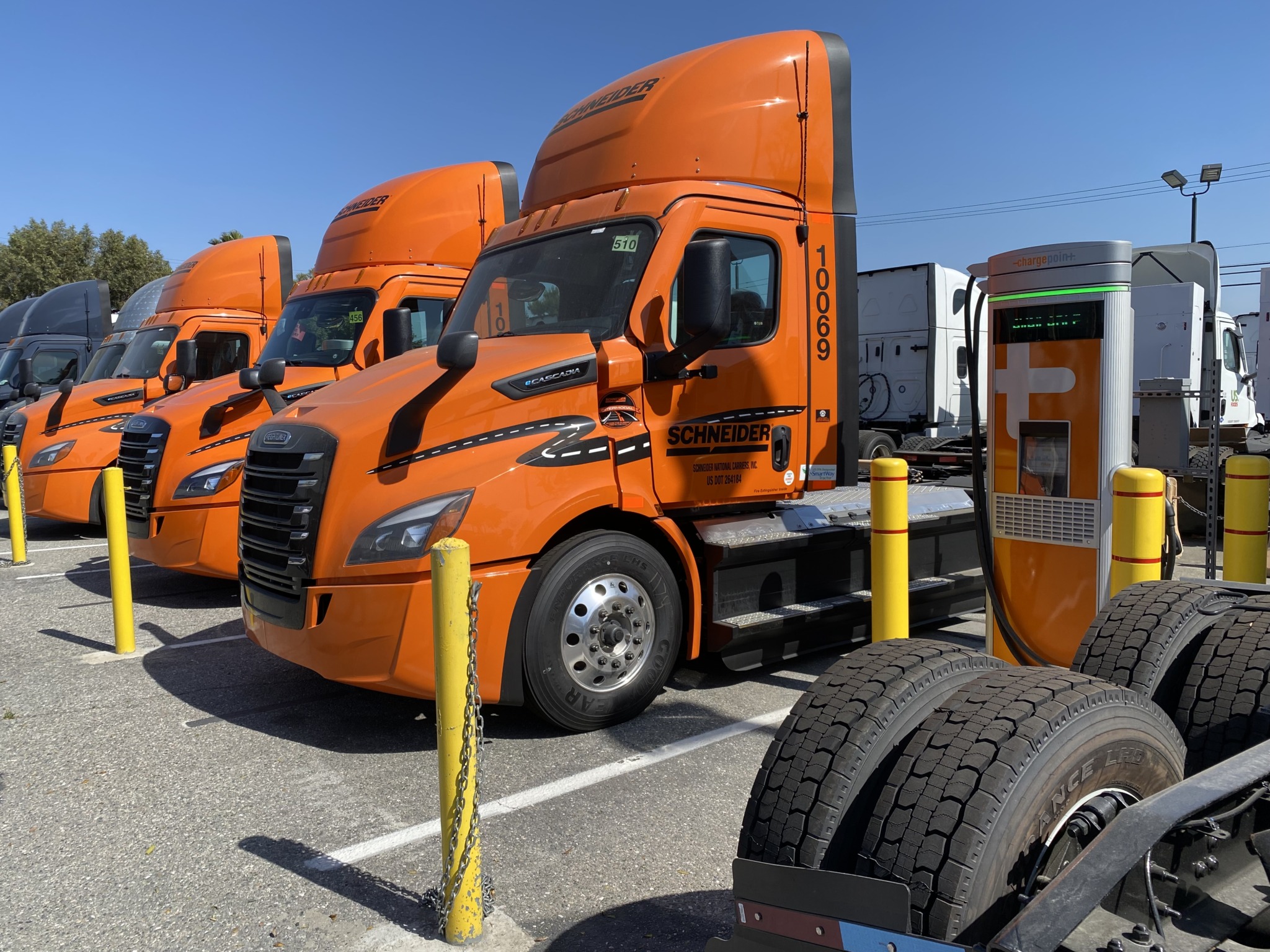
When it comes to environmental regulations and costly impending emissions standards, Van Zeeland said small fleets will struggle to keep up with the capital investments required.
“The amount of investment we have both on battery-electric vehicles and alternative fuels and on biofuels,” she said. “We are working directly with OEMs on engineering.”
She questioned the ability of a small fleet to be able to make those same investments. But those who don’t may be left behind.
“You just can’t wait,” she said of the transition to decarbonization. “It’s going to be necessary you understand how you’re going to navigate through that change.”

Have your say
This is a moderated forum. Comments will no longer be published unless they are accompanied by a first and last name and a verifiable email address. (Today's Trucking will not publish or share the email address.) Profane language and content deemed to be libelous, racist, or threatening in nature will not be published under any circumstances.