Alberta’s new Class 1 training: More in-cab training hours, Red Seal certification

As of next year, new Class 1 drivers in Alberta will require 103.5 hours of mandatory training as a part of broader goal to make truck driving a Red Seal certified job three years from now. This will make Alberta the first province to officially recognize truck driving as a skilled trade.
The existing mandatory entry level training program (MELT) requires 113 hours of training, which includes 57 hours of in-cab training.
“While the new learning program will reduce barriers to Class 1 licensing, it will also require more hours of in-vehicle training than the current MELT system, and opportunities for ongoing competency training will continue throughout a driver’s career, increasing safety,” said Jesse Furber, press secretary of Alberta’s Transportation and Economic Corridors Ministry, in an email to TruckNews.com.
Amid the shortage of truckers in Alberta, only 31% of 149,000 certified Class 1 licence holders are employed as truck drivers.
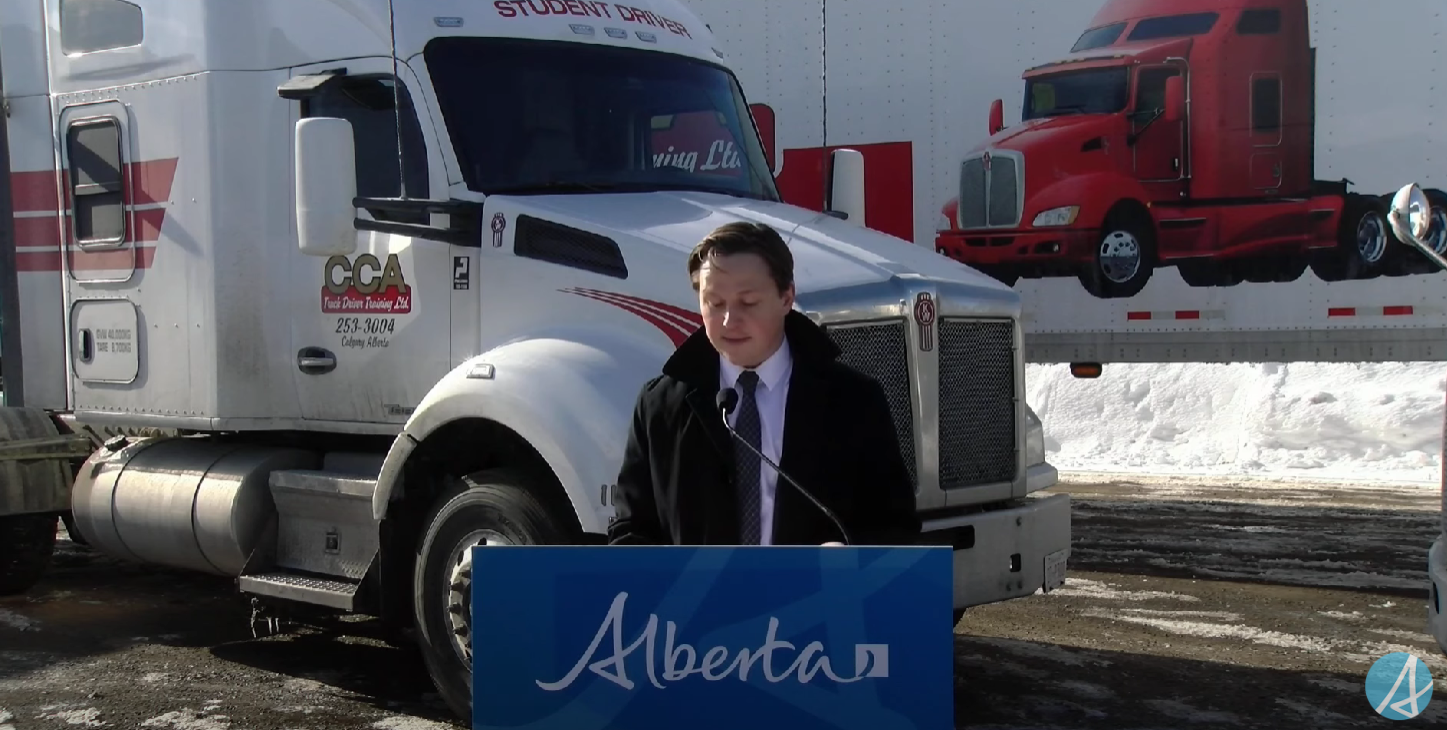
In response, the province worked with stakeholders to understand industry needs and identify the barriers stopping drivers from joining the industry and staying in it, said Devin Dreeshen, Alberta’s Minister of transportation and economic corridors, during last week’s press conference.
Cookie-cutter approach proved ineffective
This led to the re-evaluation of the current MELT program, which provides “some” training, but does not go far enough, Dreeshen said.
“It was structured in a way that did not meet the industry’s need.”
This is why the government is making changes to Class 1 driver training and licensing in favor of a new learning pathway for professional drivers.
“A cookie-cutter-based pre-licensing approach to adult learning simply does not work,” said Dreeshen, adding that the new apprenticeship style model will also provide the opportunity for prospective new drivers to learn about the profession without having to pay a $10,000 fee to do so.
New training
The changes are focused on developing driver competency throughout a driver’s career while ensuring road safety, said Furber.
Drivers will proceed through five phases while training as a Class 1 driver: exploration, apprentice driver, interprovincial driver, advanced driver, and Red Seal certified phase.
Truckers will receive a restricted licence in Phase 2, which will require them to complete approximately 50 hours of training, in addition to air brake training.
The interprovincial Phase 3 will require drivers to receive at least 53.5 more hours of training. After that, truck drivers will receive a full Class 1 licence.
According to Furber, Phases 1 to 3 of the new pathway will be in effect by March 1, 2025. Phases 4 and 5 are estimated to be implemented by 2026 and 2027, respectively.
In its 2024 budget, the province designated $41 million for the new learning pathway and a grant program to support Class 1 drivers for on-the-job competency training. Of that, $5 million will be allocated in 2024-2025, and $18 million will be invested annually from 2025 to 2027.
AMTA welcomes the changes
Robert Harper, the president of Alberta Motor Transport Association (AMTA), said during the press conference that the new program is a major step forward for the transportation industry. He also thanked the government for treating the commercial driver shortage seriously.
“A new made-in-Alberta learning pathway will help train more drivers while securing safety on the province’s highways,” he said.
“Getting the right people with the right training behind the wheel is critical to the province’s commercial transportation industry and economy because nearly 52% of Alberta’s GDP moves on the back of a truck.”
Enhancing training, safety oversight
In addition the training changes, Dreeshen announced last Wednesday that the province is contracting 26 more commercial examiners who will be deployed throughout Alberta starting April 5.
Alberta is also enhancing the monitoring and oversight of driver schools, instructors and examiners that ensure the instruction and examination of commercial drivers are aligned with the curriculum.
Correction: An earlier version of this article misreported the number of required training hours. TruckNews.com regrets the error. The story was corrected on April 4, 2024.
Have your say
This is a moderated forum. Comments will no longer be published unless they are accompanied by a first and last name and a verifiable email address. (Today's Trucking will not publish or share the email address.) Profane language and content deemed to be libelous, racist, or threatening in nature will not be published under any circumstances.
-
Thanks for your comment. The story has been updated with the correct number of the training hours.
-
Agreed! I had less than 20 hours driving before my first test. The school didn’t know how to manage the new program. It’s been a horrible process
Class 1 drivers are not staying in the trucking industry because they are paid low wages , they are treated like crap by employers and customers and the public and towns . I am presently working by the mile which means no overtime long hours and an a**hole manager hired by his best buddy who dosnt even have a class 1 . After 16 years of driving I’m thinking of walmart as a happy substitute to this misery . Don’t become a class 1 driver , it’s horrible.
-
You are 100 percent correct. Good companies that truly care and adequately compensate otr drivers, are rare. Long hours, poor facilities, especially in Canada and low pay for hours spent working, do not make this a viable career choice for many young people. I do know what it’s like to have dispatch constantly pushing you while that ELD has the time running out. Then they pretend to care about safety and you need a clean license, while running against the clock.
To sum it up, all of the above points and more, do not attract prime talent in today’s world. When will it ever change? Glad that I am done.
The interest and concern of the minister towards a better trucking in Alberta is really appreciable. Is there any government or private sponsorship available for class 1 driving licence aspirants so that they do not pay to a driving school from their own pocket especially when they cannot?
-
Borrow the money.no more hand outs
-
Borrow the money.that’s what you do when you want it bad enough,no more free handouts
In 1999 I paid $500 for my class 1 license, I drove all over the US and Canada without any accidents or issues with the law. The amount of money to get drivers trained nowadays is sureal, and still the quality of drivers that come out of it is ridiculous. It seems like the government has its way to squeeze every dollar from everyone. The drivers can hardly afford it and are always away from their loved ones. How long do the drivers have to work with the low wages to even pay for it. The corrupt government is just adding more taxes upon taxes, making it more difficult to even want to stay in this beautiful land, shame on you for making it so hard for the real hardworking Canadians. Very concerning
This is fantastic, I’ve been saying since I got into the industry that this should be the way it is taught. The best advice I got in the beginning was to spend a year in the city figuring out how to back up and operate in traffic. New drivers should spend at least 3 months backing up in a yard before hitting the road.
My big question is how will this affect us old guys, will we be grandfathered into red seal?
Money grab, all started with a bus full of hockey players. Paying >$10k to be a truck driver is insane. You used to learn by swamping or as the jr driver running team then move to your own truck if you were ready and trustworthy. Classroom training beyond some mechanical knowledge and law review isn’t necessary.
And drivers don’t make money anymore because they can’t fudge log books.
So will current drivers automatically receive a red seal designation or?
The low pay for drivers needs to be addressed. They can receive a heavy sentence for wrongful actions but they’re paid so little.
What type of Grandfathering will there be for experienced drivers to get red seal
Wondering if the insurance industry is on board with these changes? The Alberta only license appears to be issued to drivers with less training than the MELT program. The on going training seems to be available only to those drivers working for the large self insured carriers
A total rethink is needed here. MELT has a need improvement but this new approach does nothing for road safety especially in Alberta.
This is a good start. After that training a new driver should have to drive for 6 more months with a qualified driver who has at least 5 years experience. I’ve been a truck driver for 55 years and have seen a lot of mistakes due to improper training. IE the Humbolt crash. Also being fluent in speaking and writing English so they understand.
What is the actual total time spent in training. 103. hours for first phase??? or what. Comment was “Not needing to spend $10.000.00 ” for training. what now is the cost and how is it financed.
The MELT program is a joke. There is way too much emphasis put on theory and not enough put on actual over the road training. An example of this is the air brake course. You don’t need to know how to disassemble the entire system on the side of the road. This is way too complicated for a new driver. Just show a new driver the basics. And they just drive around till they can pass their test after a certain amount of hours of on the road training. Then if they fail the driven just take it again and again till they pass. And then they are good to go to BC with a fully loaded super B with no mount experience. Please feel free to correct me if I am wrong
I truly believe that this is a step in the right direction just as long as the trainers have had more than 5 years of driving in wide variety of situations not just local position and with the red seal certification the wages need to reflect that certification and not just over minimum wages.
I’ve been driving truck for over 10 years and really love to see this structure put into place, but that being said the minimum hours to be done in each phase is way too low, should be more like 200 hours for each phase, there’s so much to learn to be a good driver and you can’t pack all that into one week of training
What happens to drivers that have their license already? Do they get an automatic redseal? It does not say anything in the article about older drivers
What happens with a driver that currently holds a class 1? How do they obtain their red seal?
Will this mean we will be required to be paid a minimum hourly or mile rate then as well? Or is this only meant to make the trucking job even more less bareable? Whats with the drivers that have been driving for the past decades? Will we be able to get our certification as well?
Truck drivers are true heroes, dedicating countless hours away from their loved ones and bravely navigating tough road conditions, often for low pay. This contributes to the ongoing truck driver shortage.
To become qualified instructors, candidates must pass both a written test and a road test. Examiners should face the same challenges as the instructors and adhere to the curriculum’s rules and policies during the evaluation process. It’s essential for examiners to assess students honestly and fairly, without bias, ensuring that all candidates are treated equally, regardless of their background or experience.
-
The so-called truck driver shortage is a manufactured narrative. In reality, many trucking companies are simply refusing to hire newly licensed Class 1 drivers. Instead of investing in mentorship or training programs, these companies are now pushing to tap into government funding meant for driver training.
The solution isn’t complicated: pair new drivers with experienced ones for three months of team driving during a probationary period. That’s enough to make them road-ready and safe to drive solo. But the industry resists practical solutions in favor of practices that benefit a few and exploit many. It’s a cycle driven by greed and a lack of regulation in an already corrupt system that routinely underpays and overworks drivers.
When drivers are underpaid, it creates real safety risks. These are people spending weeks away from their families, often driving on icy and dangerous roads, all while worrying about making ends meet because their per-kilometer rate doesn’t match the rising cost of living. That level of stress is a hazard behind the wheel.
If the government truly wants to support the trucking industry, it should start by regulating key variables like fuel prices and insurance rates. By creating a standardized framework, companies can better manage their margins and drivers can have consistent, fair compensation. Right now, businesses still expect last year’s transport rates, even though fuel costs have jumped 30%. That pressure trickles down to the driver who ends up working harder for less. And that’s not just unfair. It’s dangerous.
“Amid the shortage of truckers in Alberta, only 31% of 149,000 certified Class 1 licence holders are employed as truck drivers” What needs to be answered is “why” only 31% of Class 1 license holders are employed! Do you not think that the LMIA program creates an unfair advantage for new drivers that don’t meet the criteria of the program? If you want to see blatant discrimination in the hiring of drivers, look at the “Drivers wanted” ads! “Positions open for LMIA drivers only”!
-
LMIA truck drivers are paying up to $30 000 for a job (permit) plus will to work on payroll at $21 per hour or $24 per hour to a Corp. driver Inc. account a truck driver born here with 5 yrs in Canada wants $30 to $35 per hour on payroll with overtime after 40 hours per week or 10 hours per day plus medical if they cross the border and speak English.
A bigger problem with our industry is companies undercutting each other to the point they can’t afford to pay drivers a decent wage. I understand when I was a new driver I expected a lower wage to match my skill level but I still made enough to feed my family. Today’s drivers can’t survive on the starting wages offered. As an owner operator or lease operator most are not starting with enough cash on hand to make it through a hard spot. When the carbon tax rises to 61 cents a litre in 2025 it going to shut down a lot of independents and small trucking firms. I’m not saying that subsidies are in order as the money rarely gets to the ones who need it but some sort of incentive program is needed to attract drivers and help companies. I like the idea of a graduated apprenticeship program because the best way to develop a driver is time behind the wheel. Important side note is there should never be more than two students and one instructor training in a truck at any time. The schools that are following this rule are turning out good drivers but some are treating the students like a money machine and pushing through as many as possible and are producing greater problems down the road. It’s not the students fault but trying to police the schools has to improve or our industry will continue to get worse as our skilled drivers retire.
As a company based in Alberta/Saskatchewan working in the oil field industry all over western Canada operating Bed Trucks, Winch Trucks, Boom Trucks and Cranes moving oilfield equipment around which consist of heavy, over dimensional and over weight loads running specialized trailers including jeeps, boosters and escort vehicles etc. We have swampers that spend countless hours in the jump seat learning driving, load securement skills etc. They know when they have to stop and throw a set or two of tire chains on for icy or muddy conditions. This kind of training cannot be taught in a driving school. These hrs they spend should be documented in a blue book like mechanics, plumbers, electricians and crane operators etc and should count against there 103 hrs. There still should be some class room and practical courses etc but they cannot afford to take the money and time off work when you are trying to support a family.
It’s about time this comes into affect I have been a CDL driver since the day after my birthday 1975. I was an instructor for the ATA in Alberta and loved it ,went through my career as a truck driver and a coach. I moved to Vernon changed to a BC operator and attempted to get a part time job her in town with the local transit and was turned down with the excuse of I didn’t meet their qualifications and did not even get an interview. Funny thing is I was an instructor for Diversified TRANSPORTION in Alberta teaching people how to operate coaches.So this training will come in handy if the company’s can wait witch is far and between. I am scared to run on the roads any more as most of the people out there have no idea of what there doing, I offered a drive some advise to make his day better and I was told to take a hike. I have operated the largest trucks in the world, and I just want to say about 3 million miles accident free so I do know how to drive. Thanks for letting me vent
It should also be mandatory to be able to speak understandable English should be law that it is the only language used in radio communications whether it be two ways or cb’s . The airways are being tied up with jabber .
The sad part is that the industry has a shortage while so many licensed class 1 drivers cannot get a trucking job at all. Most places require 2 years experience due to insurance. But how do you get 2 years experience when no one will hire you because you do not have 2 years experience? I was a farm kid, drove many big machines and vehicles, I have operated many large haul trucks, been driving for 25 years with a 5 star class 5 license before acquiring my class 1 last year and still cannot find a job…. Maybe we should look into ways to help the currently licensed drivers that paid their fees and can’t find work.
Again, I believe the government has missed the mark altogether. I’ve been a driver since 1995 professionally trained. I’ve seen there be a lot of changes in the requirements to become a class one driver. The only thing the government has not adjusted is rate control. As they’re telling you, we need more drivers. I beg to argue with them what we need more controls to control the amount per mile And per hour of operations. I have seen funding for some groups by government that has driven the rates down as these groups can do it for cheaper. I can totally understand why young people do not want to get involved with Trucking. The pay is absolutely horrible and how professional drivers are treated is disgusting.
Quebec driver program CFTR is the only legitimate training system available in Canada. Alberta is to be commended for improving their own current inadequate and frankly dangerous requirements. Apprenticeship to class 1 is the only way to enforce the safety and pride truck driving requires.
-
No Sir Not the only One, G.W Driver Training a School in New Brunswick,and Tag logistics in Alberta For LCV Training all the Best Stuff Dosen’t Come From Just Quebec.
I went to a Driving School in 2010 and had 6 weeks of Training ,that amounted to over 200 Hrs of in classroom and in Tractor Training. And I was Constantly being evaluated and Critiqued in order to become a better operator, by the staff of the School.Since then I moved to Alberta and in 2016 took My Long Combination Vehicle course or (LCV)Certificate and this course took another 60 plus hours, and had a Coach Drive With Me for another 30 Hrs until I was Competant behind the Wheel.so as You can see,Inexperience Was not a Problem for Myself.I Can’t Understand that If I had to have that Kind of training why others did Not,and to say that this Trade is not Skilled Now? I am a Professional Driver not a Truck Driver I have 15 years of Driving without an Accident of Any kind.and for anyone who would say that the Trade is Not Skilled Now Can get their Heads Examined,I have and Can haul and Combination of Trailers on the Road minus Large Over dimentional loads I don’t Care to do that ,it Takes Hightened Skill awareness to do this For a long time and Be Safe to Yourself and others on the road,Maybe the People Writing on this Subject Should Re-evaluate their Ideas and Dialog,I Myself am so Far beyond a RED seal it is Ridiculous,and For People to say that it isn’t a Skilled Trade Right Now Should Really stop and Think about What comes out of their Mouth before they open it,I am Very Skilled at My Trade and Have been ever since my ass landed in a Seat,don’t catigorize all Drivers into the Same Group.There are Already tens of Thousands of Qualified operators out there,try to be more respectfull about Our trade,Maybe you Should Stop bringing in immigrants and Giving them Licenses out of a Boxes of Cracker Jacks,all People outside of Canada Should have to Take a Mandatory Driving School Program,and In the Winter,how Can Someone From Africa or India understand how to operate in Snow if they Don’t have any?Common Sense is not that Common anymore,Remember We the Professional Drivers are the ones Hauling all of your food ,Drinks,Medical Supplies,cooking,cleaning,Petrolium,personal Items across this Country,Try to Be a Bit More Respectfull when referring to Us in this Fashion,If the Goverenments were near sighted with all of this ,well I’m glad it is going to be fixed,But we have been telling the Industry about this for Decades,I guess the Governments are Just too Slow to Act.Such a Shame an Awfull Fatal incident, could have all been avoided if The Government Would have listened to the Operators.
Beginner drivers need to first ride along with an experienced driver then transition to driving with a certified class one driver. Thats how we often operate on a farm. This would be the BEST experience. The fees would be covered by the student.Thankyou

This is factually wrong! There is no discussion to increase the hours. It’s the opposite. Alberta after all Cut the red tape and make it easier to do business not make it harder.
The author should have done more research!