Chicago interchange tops ATRI’s worst truck bottlenecks list

The interchange of Interstate 294 and Interstates 290/88 in Chicago is the most congested bottleneck for trucks in the United States, according to the American Transportation Research Institute.
This Chicago bottleneck has overtaken the intersection of I-95 and state Route 4 near the George Washington Bridge in Fort Lee, N.J., which had been atop ATRI’s annual list for seven years.
ATRI’s report compiles the top 100 truck bottlenecks across the United States. Three of the top six are located in the Atlanta area, with two in Houston and one in Nashville, Tenn., rounding out the top eight on the 2026 list.
Texas has the most total bottlenecks on the list with 12, followed by Georgia with nine and California and Tennessee with eight apiece.
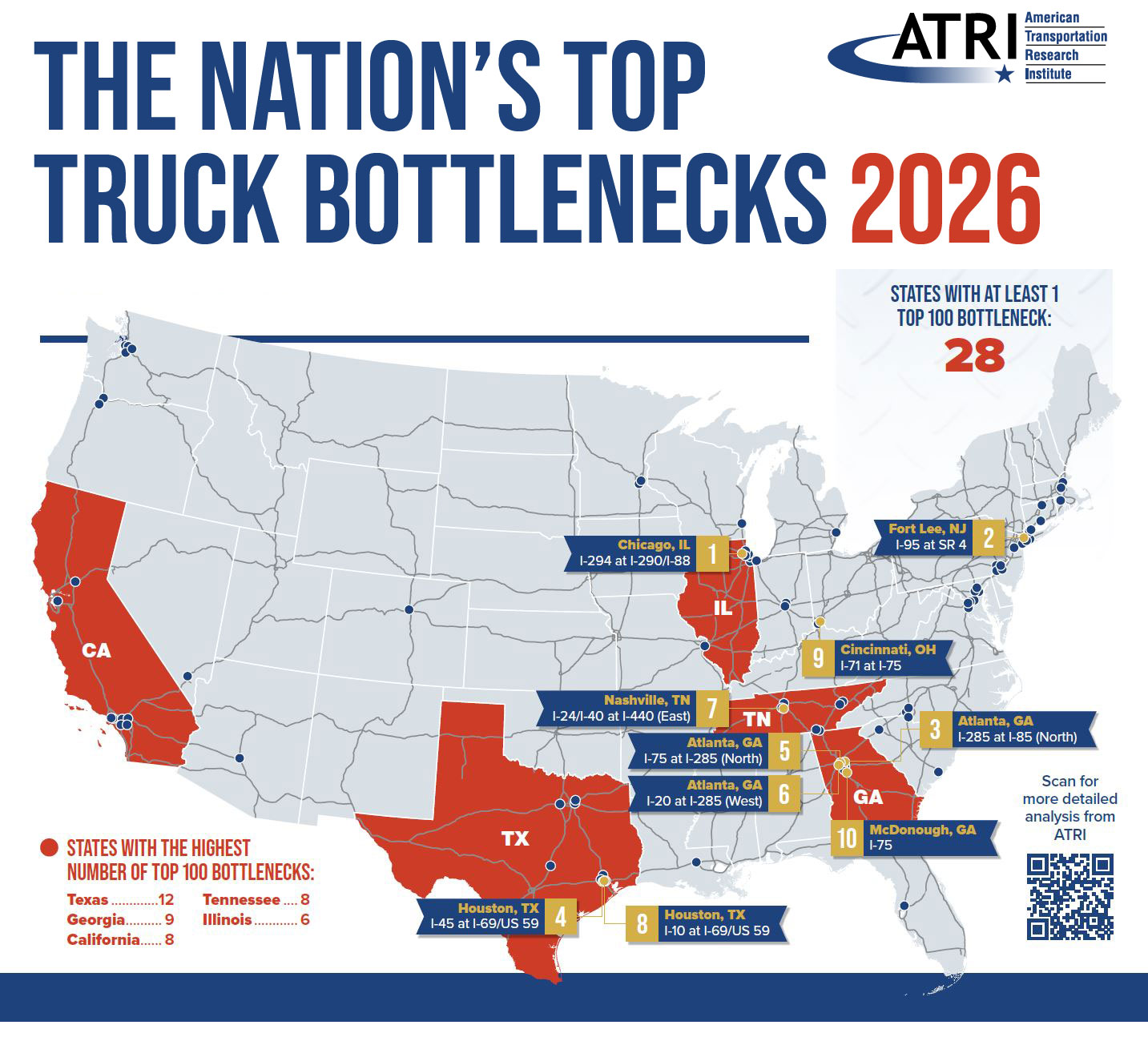
The 2026 report, based on 2025 data, found that the average peak-hour truck speed was 33.2 mph, down 2.8% from the prior year. Three-quarters of the top 100 bottlenecks have an average speed below 45 mph, and 28 states have at least one bottleneck on the top 100 list.
“Congestion delays inflicted on truckers are the equivalent of 436,000 drivers sitting idle for an entire year,” said Rebecca Brewster, ATRI’s president and chief operating officer. “While these congestion metrics are getting worse, the good news is that states do not need to accept the status quo. Illinois has been home to the country’s top bottleneck before, but following a sustained effort to expand capacity, its previous No. 1 bottleneck at the Jane Byrne Interchange no longer ranks in the top 25.”
A recently completed interchange at the Jane Byrne Interchange has improved rush-hour truck speeds by nearly 25%.
ATRI’s report measures truck-involved congestion at more than 325 locations. The analysis is based on an extensive database of freight truck GPS data, several customized software applications, and data from trucking operations.

Have your say
This is a moderated forum. Comments will no longer be published unless they are accompanied by a first and last name and a verifiable email address. (Today's Trucking will not publish or share the email address.) Profane language and content deemed to be libelous, racist, or threatening in nature will not be published under any circumstances.