Purolator’s EV fleet expands with emphasis on safety protocols and measured adoption

Purolator’s electric vehicle (EV) fleet has surpassed 150 units, marking significant progress in its environmental goals. However, the company’s “slow and measured” approach to EV adoption emphasizes enhanced safety measures, protocols, and driver training, ensuring a smooth integration while awaiting clearer government regulations.
TruckNews.com sat down with Chris Henry, fleet director at Purolator, to gain insight into the safety aspect of EV operation as the transportation industry navigates considerations tied to lithium-ion batteries.
Recent incidents, such as a September 2024 fire at the Port of Montreal involving lithium-ion batteries stored for transport, and the Escondido fire in California, where a Semi Tesla caught fire in 2023, underscore the challenges of managing these risks.
Both fires were attributed to thermal runaway, a chain reaction in which overheating in one battery cell causes neighboring cells to ignite. These events have raised some concerns about the storage, transport, and operation of EVs, which predominantly use lithium-ion batteries.

Vehicle testing
As one of the early EV adopters, Purolator conducts thorough testing on a small number of vehicles, typically one to five from each manufacturer, before committing to large-scale EV purchases. Henry says these tests evaluate range, carrying capacity, drivability, and overall operational compatibility.
While not all tests have been satisfactory, Purolator has never rejected a vehicle due to safety concerns.
“Some simply don’t match what we’re looking for. There hasn’t been any [EVs] that we would look at so far that we brought in [and] we would say, mechanically or technically those could not do the job in terms of the motor and electric components working effectively. Typically, it’s because they don’t match our use case to be able to match our delivery profile,” Henry said, adding that safety is a cornerstone of this evaluation process. “We ensure all vehicles meet Canadian safety standards before we ever consider bringing a vehicle in. We’re not going to risk any of our people or any of our communities with a vehicle that has not been certified and safe.”
Safety training
Purolator’s EV fleet includes vehicles from several manufacturers, each requiring specific familiarization training for drivers. “For every vehicle that we deploy now that’s an EV, we give a separate — what we call familiarization — training for each vehicle,” Henry noted. “We want them to become familiar with the vehicle and aware of what the vehicle is and what it can do.”
Training involves classroom sessions to teach safety basics, such as identifying high-voltage components marked with orange coating and practicing driving to help operators adapt to the quieter and different handling of EVs.
Enhanced protocols
Purolator has also enhanced safety protocols to address EV-specific risks in efforts to protect not only employees but also communities and first responders.
Heny says Purolator alerted all the fire departments in the areas it deployed electric trucks to ensure they know we have EVs both at facilities and on the road. While fire risk is low, the company equips vehicles and facilities with fire extinguishers designed to manage battery fires. Drivers are trained to follow standard procedures during thermal events: “Remove themselves from the vehicle or the building, call the fire department, and let the authorities handle it.”
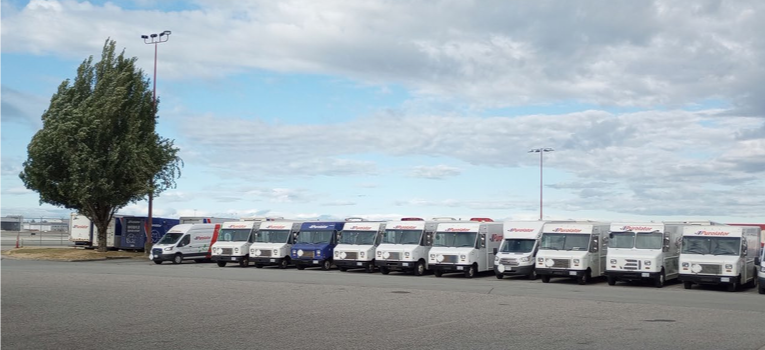
Despite some high-profile incidents involving EV fires, Henry said these events are rare: “The likelihood is significantly lower, I mean, tremendously lower than an ICE [internal combustion engine] vehicle catching fire. But when it does, I mean, it is a big event.”
When asked if insurance companies flagged safety or liability concerns to Purolator, Henry says they haven’t. Even though insurance premiums for EVs are about 10-15% higher, he says, the increase is driven primarily by the vehicles’ higher costs rather than liability concerns.
“They haven’t come back yet and told us that liability is a significant component of that increase,” Henry said. “When you look at the time and the kilometers and the range that these vehicles drive without incident versus ICE vehicles, it is significantly, significantly lower. So that’s why we’re not seeing tremendous liability issues come up at this point in time.”
Purolator’s cautious approach to EV adoption has been a ‘very good, successful’ journey, Henry said, praising the environmental and financial benefits of EVs, noting that the company is achieving GHG reductions, fuel savings, and all of the electrification promises.
Driver reception has also been overwhelmingly positive. “Our staff and our drivers welcome the vehicles. They drive them. They’re excited to drive them,” Henry said. “I think it just bodes well for our future.”

Have your say
This is a moderated forum. Comments will no longer be published unless they are accompanied by a first and last name and a verifiable email address. (Today's Trucking will not publish or share the email address.) Profane language and content deemed to be libelous, racist, or threatening in nature will not be published under any circumstances.