Readers speak out on… telematics trends

Telematics is delivering measurable benefits in safety and compliance for fleets, but the technology still comes with trade-offs around privacy and usability.
In our latest Pulse Reader Survey conducted in March, more than half of respondents (52%) said telematics is used across most or all vehicles in their organizations, while another 9% report partial adoption. Meanwhile, nearly one-third (31%) said it is not used at all.
Readers frequently pointed to safety improvements as one of telematics’ most tangible benefits.

“As a driver, it keeps me focused on driving (i.e., not speeding, not hard braking…),” one respondent wrote. Others emphasized the role of telematics in enforcing standards and reducing risk, calling telematics a way to ensure compliance.
About 44% of respondents said telematics has helped reduce collisions or unsafe driving, while 53% cited improvements in compliance. While 25% of respondents said telematics made no noticeable difference in operations, roughly the same percentage reported that telematics helped improve fuel efficiency and operational visibility, as well as reduce insurance costs.
When asked what purpose telematics is primarily used for, 70% reported using it for GPS tracking and dispatch. Almost 60% pointed to driver safety monitoring, with nearly 40% of fleets saying drivers receive regular and constructive feedback based on telematics insights, and another 27% receiving feedback occasionally. 53% said they use telematics for compliance and ELD functions, while 47% cited video-based safety systems like dashcams. Just over a third of respondents use telematics for maintenance diagnostics and planning.
This is a comment from one of the readers who sees ‘significant value’ in telematics and AI-powered tools: “Myself and drivers [are] aware of fuel consumption, saving money for the owner operators, and [we see] efficiency in laying out dispatch, on-time deliveries and notification of timing to our clients.”
‘Big brother’ concerns among drivers
And yet, concerns about surveillance and driver stress remain a recurring challenge when it comes to telematics adoption. While 37% of respondents said drivers are generally receptive to telematics, nearly one-third report mixed attitudes, and about 22% say it is viewed as intrusive or creates tension. Another 32% said the perception of telematics amongst drivers is mixed, with some seeing the benefits and others being skeptical.
One reader believes the technology caused some of the older and experienced drivers to retire prematurely. “That’s caused a driver of 48 years accident-free, moving violation-free drivers to retire, they won’t put up with the electronics reporting to big brother, telling them what to do, or taking control of the vehicle,” they wrote.
Over a third of open-ended responses we received cited negative impacts on driver experience, including privacy concerns, resistance to monitoring and increased stress.
“Big brother always watching, [this] creates anxiety,” one respondent said.
“The biggest frustration is that some staff are actually using the GPS location for monitoring driver times on site and contacting them when they stop for a quick break. This was not the corporate goal for these devices and it reinforces the negative attitude the drivers have,” the other wrote.
Another reader wrote, “Telematics is generally installed without any driver training or explanation, drivers have no clue what it will be used for so they assume it is just another way to “get” drivers they want to get rid of.”
Another comment cited frustration with lack of consultation with drivers. “The requirement of an in-cab camera is very intrusive and was forced upon us without input. The infractions listed are often incorrect and based on pre-programmed information, not on real-time driving requirements. There are several other issues that I have but those are the main two.”
A comment from another reader supports the sentiment, “Drivers often feel that the results given are not a true measure of their driving.”
“They installed it to crackdown on distracted driving, following too close etc. But it seems to be more distracting than the distractions they are supposed to stop,” a respondent wrote. “For example, you get too close, or too fast, it talks to you, beeps and/or both. So you spend more time worrying about the thing and really not actually focusing on your driving because you’re constantly thinking about them, waiting for you to mess up.”
But there is positive feedback, too.
Another echoed that sentiment while acknowledging some advantages: “Big brother is always watching. Happy that dash cams record what is actually happening, especially when it comes to 4 wheelers and other vehicles creating incidents.”
“It brings visibility to many unknown/hidden challenges and helps both drivers and organizations to work together to address them. The dashcams with AI features are the best friend to both drivers and management these days to avoid false claims and bring peace of mind,” wrote another reader.
An operator that has used the same telematics provider for six years wrote, “I do like the paperless logs, printed bills of lading. Don’t really care about the GPS tracking; I think Google Maps does a better job. There’s distractions with every (AI) device i think.. as a driver, O/Os , we are faced with all kinds of tech to help make our jobs easier, its not as easy as it seems, what looks good on paper doesn’t allways play out in real world senerios..but for the most part it’s how you adapt to it all.”
Beyond privacy concerns, readers also pointed to practical challenges with the technology itself.
“Frustration is a lack of customer service,” one respondent said. Another one added that in cases with devices powered by artificial intelligence, AI does not know what it sees: “In-cab AI does not always understand what it’s seeing, though (ie: speeding infractions when it reads a speed limit sign on a street that runs next to a major highway, etc).” One reader eched, “It is a great tool, [but] sometimes too intimidating to drivers — very sensitive, with too many alerts for even small movements.”
Others referenced system limitations, complexity and administrative burden — particularly when managing multiple platforms or dealing with unreliable devices. “Network connectivity [is a challenge] – once the entire system is down, we are noncompliant for the entire fleet,” reads one of several comments citing connectivity challenges.
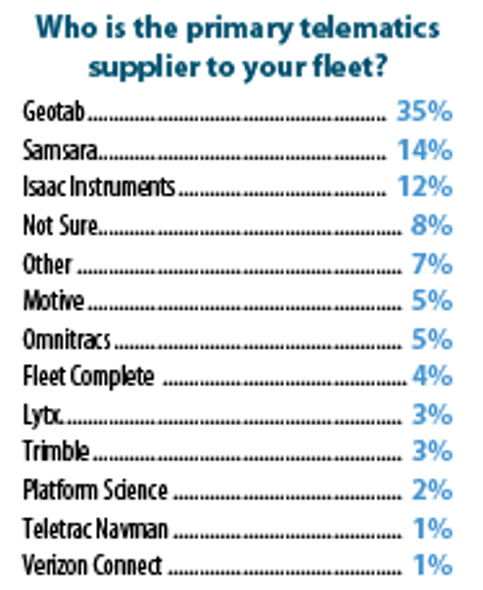
Yet, only 10% of respondents said they are likely to change their telematics provider next year. With nearly 80% reporting to only use one telematics provider, 35% of or respondents said they use Geotab as their primary supplier, with Samsara and Isaac Instruments following (14% and 12%, respectively).
For the full results of the survey, check out our April issue of Today’s Trucking.

Have your say
This is a moderated forum. Comments will no longer be published unless they are accompanied by a first and last name and a verifiable email address. (Today's Trucking will not publish or share the email address.) Profane language and content deemed to be libelous, racist, or threatening in nature will not be published under any circumstances.