AI poised to become fleet managers’ co-pilot

Artificial intelligence is expected to take on a larger role in fleet operations in the coming years, helping automate routine tasks, analyze growing volumes of data and acting as a “co-pilot” for fleet managers, fleet officials said during a panel discussion at the Green Truck Summit in Indianapolis.
Panelists said AI will increasingly handle repetitive administrative work and routine operational analysis, allowing fleet leaders to focus on higher-value strategic decisions.
“I think it’s going to be more of a co-pilot, more of a thought partner,” said Samantha Thompson, vice president of customer success and fleet telematics at Penske Transportation Solutions.
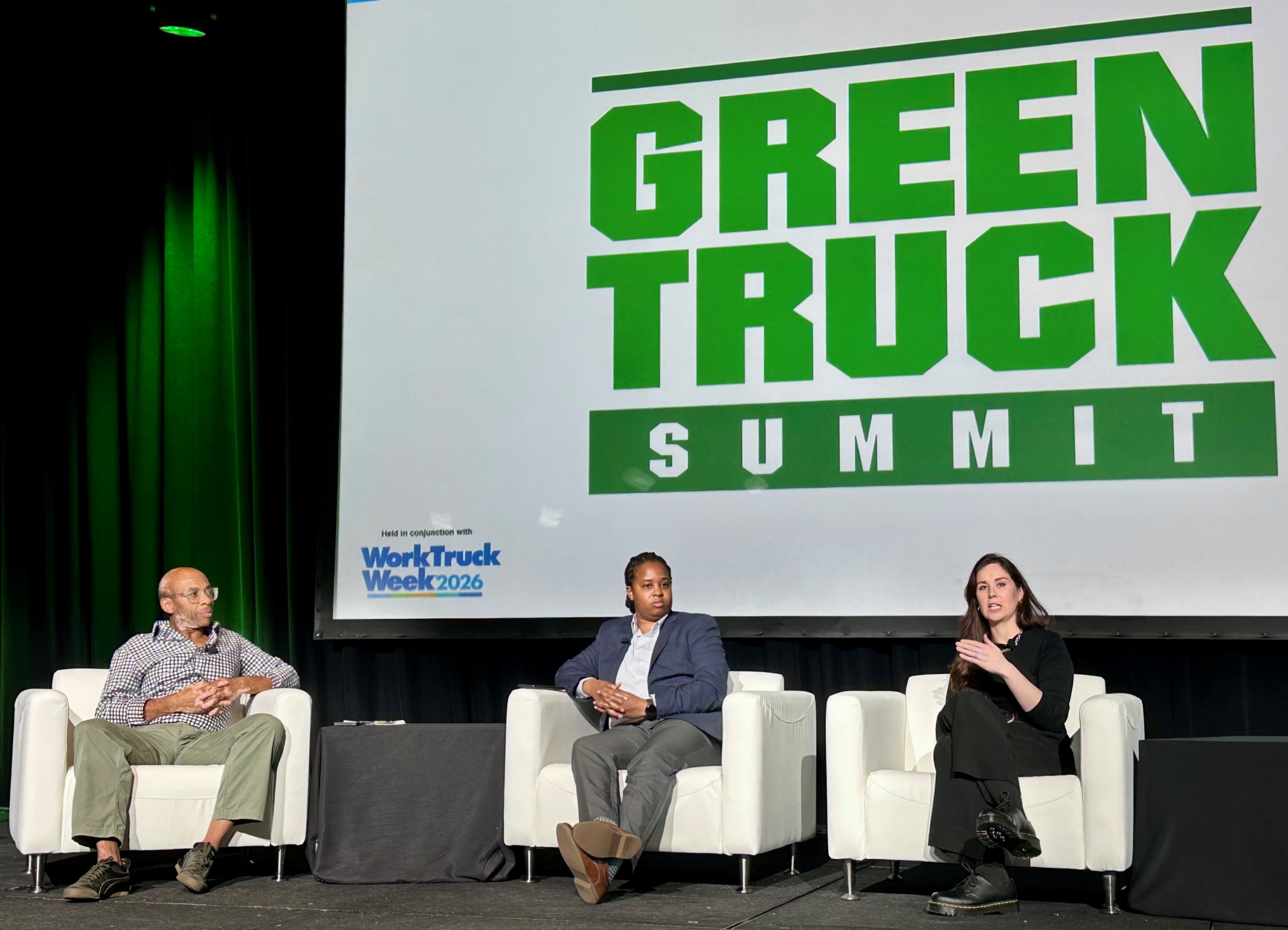
Brianna Perry-Lang, product marketing manager at Fleetio, said automation could free fleet managers from manual processes and allow them to focus on more meaningful work.
“If software starts to take over some of the manual tasks and process management, it frees fleet leaders to focus on higher-value decisions,” she said.
While much of the conversation focused on the future potential of AI, panelists emphasized that the technology is already widely used in fleet operations.
Detecting patterns for maintenance
Thompson noted that Penske has been applying AI internally for several years, particularly in maintenance operations. By analyzing decades of service records alongside real-time vehicle data, AI systems can detect patterns that indicate when failures are likely to occur.
The technology enables fleets to shift from reactive maintenance toward predictive strategies.
Rather than waiting for a breakdown, fleets can analyze combinations of fault codes, sensor data and historical maintenance patterns to identify problems before they disrupt operations.
“If we can identify scenarios, we’ve seen hundreds or thousands of times before, we can proactively solve that problem before it results in something as disruptive as a road call,” Thompson said.
Analyzing fleet characteristics
AI is also being used to help fleets better understand their performance compared with similar operations.
Penske’s Catalyst AI platform analyzes fleet characteristics and assigns what Thompson described as a “similarity score,” allowing fleets to benchmark themselves against others performing similar work.
Comparing fleets with different vehicle types, operating conditions or duty cycles can lead to misleading conclusions, Thompson said.
“You have no business benchmarking fleets that are not like each other,” she said.
Identifying opportunities
Identifying comparable fleets allows operators to better understand their performance relative to peers and identify opportunities for improvement.
For many fleets, the first step toward AI adoption is simply digitizing operational records.
Perry-Lang said she still encounters fleet managers transitioning from paper records or spreadsheets to digital fleet management systems.
Fleetio introduced an AI-based feature called Smart Uploads to simplify that transition. The tool extracts data from images or scanned documents and converts it into structured digital records, allowing fleets to quickly upload historical service data.
Recommending actions
Once information is digitized, AI tools can begin identifying patterns, surfacing insights and recommending actions within fleet management workflows.
Another role for AI is helping fleet managers deal with the increasing volume of operational data generated by modern fleets.
Connected vehicles, telematics platforms and maintenance systems generate large amounts of information that must be interpreted and prioritized.
Reducing unnecessary alerts
AI tools can surface the most important issues and automatically prioritize maintenance tasks, reducing the amount of manual analysis required by fleet managers.
For example, when a maintenance issue is entered into a system, AI can automatically assess its urgency and assign priority levels.
The goal is to reduce unnecessary alerts while highlighting issues that require immediate attention.
“Reducing noise and surfacing context is one of the most powerful things we can do for fleet managers,” Perry-Lang said.
Adoption varies
Adoption of AI tools varies widely depending on fleet size, resources and technological readiness.
Large fleets often have more technical resources and may experiment with emerging technologies earlier. However, smaller fleets can benefit significantly from automation because they operate with fewer staff.
A single breakdown, for example, may have a much greater impact on a small fleet than on a large operation.
At the same time, smaller fleets often require a clear return on investment before adopting new technology.
“If they don’t see that value up front, they’re not going to invest the time and effort,” Thompson said.
Focus on usability
Technology providers must therefore focus on usability, ease of implementation and features that deliver immediate operational benefits such as automation and time savings.
Trust remains one of the biggest challenges in adopting AI-driven tools. Fleet managers must be confident that automated recommendations are accurate and supported by reliable data.
Perry-Lang said transparency is critical when introducing automated insights. Systems may include confidence ratings or display the sources behind a recommendation.
If there is not enough information to produce a reliable recommendation, the system should clearly indicate that rather than offering an uncertain suggestion.
Rigorous validation
Both companies’ AI tools undergo rigorous validation and testing to ensure they deliver reliable results.
Panelists said the most effective AI implementations may be those that remain largely invisible to the user.
Rather than presenting AI as a standalone feature, software developers are increasingly embedding it directly within existing workflows.
“The best AI is subtle,” Thompson said. “Very powerful under the hood, but not necessarily in your face in the day to day.”
In many cases, users may benefit from AI-driven insights without needing to interact directly with the underlying technology.
As fleets collect more data from telematics systems, connected vehicles and maintenance platforms, AI is expected to become a more central component of fleet management.
Future systems could automate routine workflows, analyze large datasets and surface operational insights more quickly.
Panelists said the technology has the potential to simplify complex fleet operations while helping managers make faster, more informed decisions. Rather than replacing human expertise, they said AI will increasingly function as a support tool that helps fleet leaders interpret data and manage increasingly complex operations.

Have your say
This is a moderated forum. Comments will no longer be published unless they are accompanied by a first and last name and a verifiable email address. (Today's Trucking will not publish or share the email address.) Profane language and content deemed to be libelous, racist, or threatening in nature will not be published under any circumstances.