Maintenance costs dip slightly but remain elevated, Decisiv data shows

Maintenance costs for heavy-duty trucks eased slightly in the fourth quarter of 2025, but long-term trends show fleets are still dealing with significantly higher service expenses than just a few years ago.
That was the message from Decisiv during a press briefing at the Technology & Maintenance Council’s annual meeting, where the company shared results from its latest Decisiv/TMC Parts & Labor Service Benchmark report.
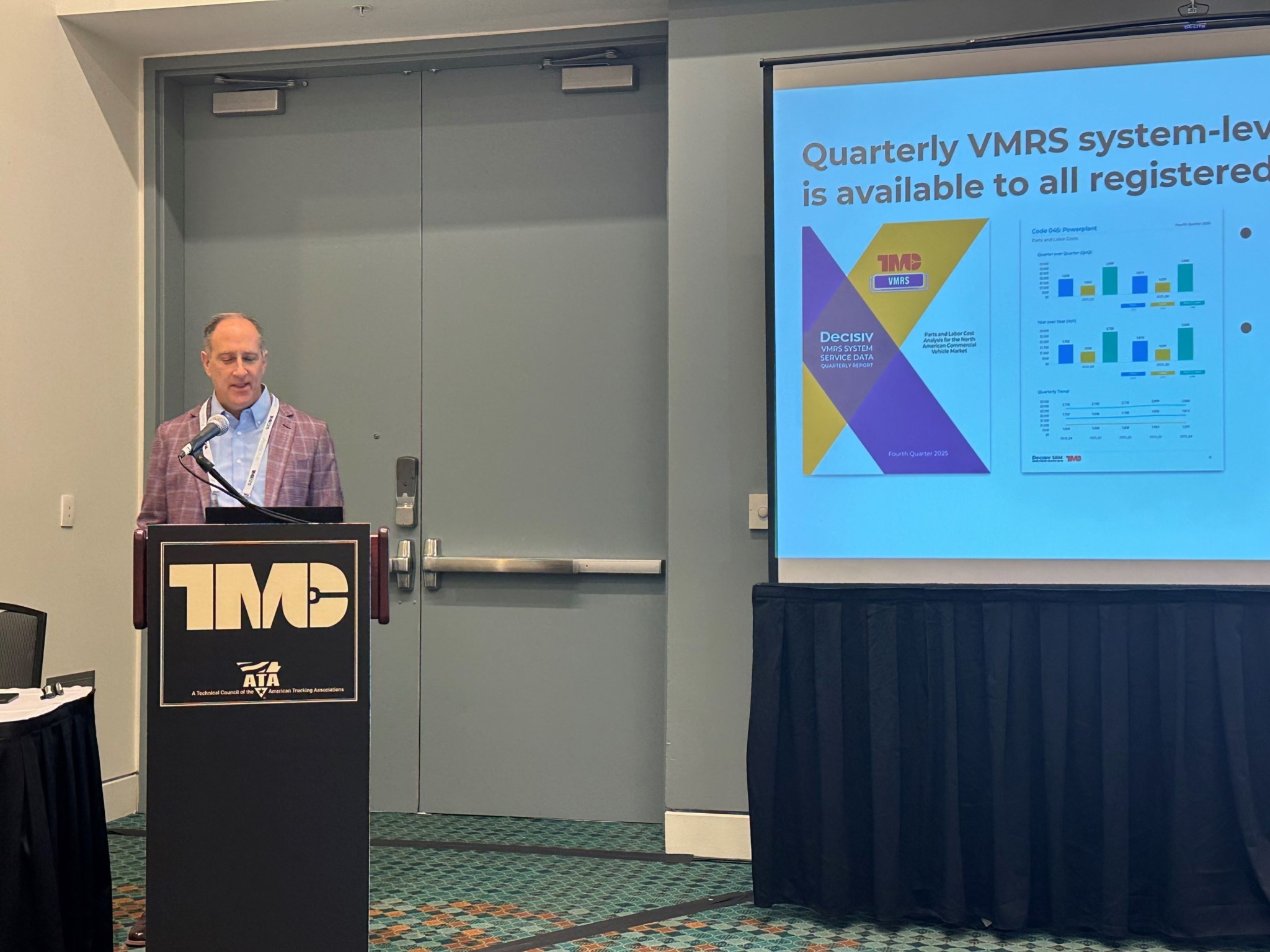
Combined parts and labor costs declined 1.3% quarter over quarter after rising 3.8% in the previous quarter, said Rob Ziemba, vice president of marketing at Decisiv.
Parts costs fell 0.4% while labor costs declined 2.6%.
“Given the long-term trend in labor costs, which has been going up, this is certainly a swing in the positive direction,” Ziemba said.
Despite the quarterly improvement, year-over-year data shows maintenance costs are still climbing. Overall parts and labor costs increased 2% compared with the same period in 2024, driven largely by a 3.7% increase in parts costs, while labor costs edged down 0.4%.
The report suggests softer freight activity may have contributed to the quarterly decline. The American Trucking Associations’ seasonally adjusted For-Hire Truck Tonnage Index fell 1.8% from the third quarter and was down 0.3% compared with the final three months of 2024, reflecting weaker manufacturing and construction activity.
Much of the remaining cost pressure continues to come from parts.
“Across many of the systems, parts are what’s driving the increases,” Ziemba said.
Costs increased in 10 of the 25 VMRS systems tracked in the benchmark report, seven fewer than in the previous quarter. Year over year, however, costs increased in 16 systems.
Parts costs rose in 19 systems while labor costs increased in 11 systems.
Tim Hardin, president and CEO of Decisiv, said the data highlights how fleets and service providers are working to manage maintenance costs despite fluctuating conditions.
“The moderation in costs seen in the current Decisiv/TMC Parts & Labor Service Benchmark report illustrates how this is being addressed at shops using effective management practices,” Hardin said.
Trucknews.com asked whether tariffs may be contributing to the rise in parts costs.
Hardin said the company cannot directly measure tariff impacts within the dataset but believes raw material tariffs may have contributed to higher component prices.
“We’re not able to directly see the tariff impacts,” Hardin said. “But what we are seeing are elements such as raw material costs — steel and aluminum, for example — that began increasing around the time tariffs were introduced.”
Looking at the longer-term trend, Decisiv’s data shows maintenance costs have risen sharply since 2020.
Combined parts and labor costs increased 27.4% over the six-year period, with parts costs rising 23.8% and labor costs climbing 33.5%.
The steep increase in labor costs reflects ongoing technician shortages and rising wages across the industry.
“The technician shortage and other workforce factors have really driven labor costs over that time,” Ziemba said. “Anything that improves efficiency in the service process is going to help drive those numbers down.”

Have your say
This is a moderated forum. Comments will no longer be published unless they are accompanied by a first and last name and a verifiable email address. (Today's Trucking will not publish or share the email address.) Profane language and content deemed to be libelous, racist, or threatening in nature will not be published under any circumstances.