Mentorship, responsible practices could prevent trucks from hitting B.C. overpasses

Commercial vehicles have hit overpasses, bridges and infrastructure on 29 occasions in British Columbia this year. There was at least one incident a month, with March witnessing a whopping five such crashes.
And according to the B.C. Ministry of Transportation and Infrastructure, every one of them was due to driver error. Investigations revealed a lack of — or improper — permits, failure to follow an approved route, unsecured or incorrectly measured loads, equipment not lowered and failure to obey traffic signage.
It is easy to blame drivers, who are ultimately responsible for their actions. It is also easy to demand more training. So, should schools train students not to crash into bridges or does this responsibility fall on the shoulders of carriers?
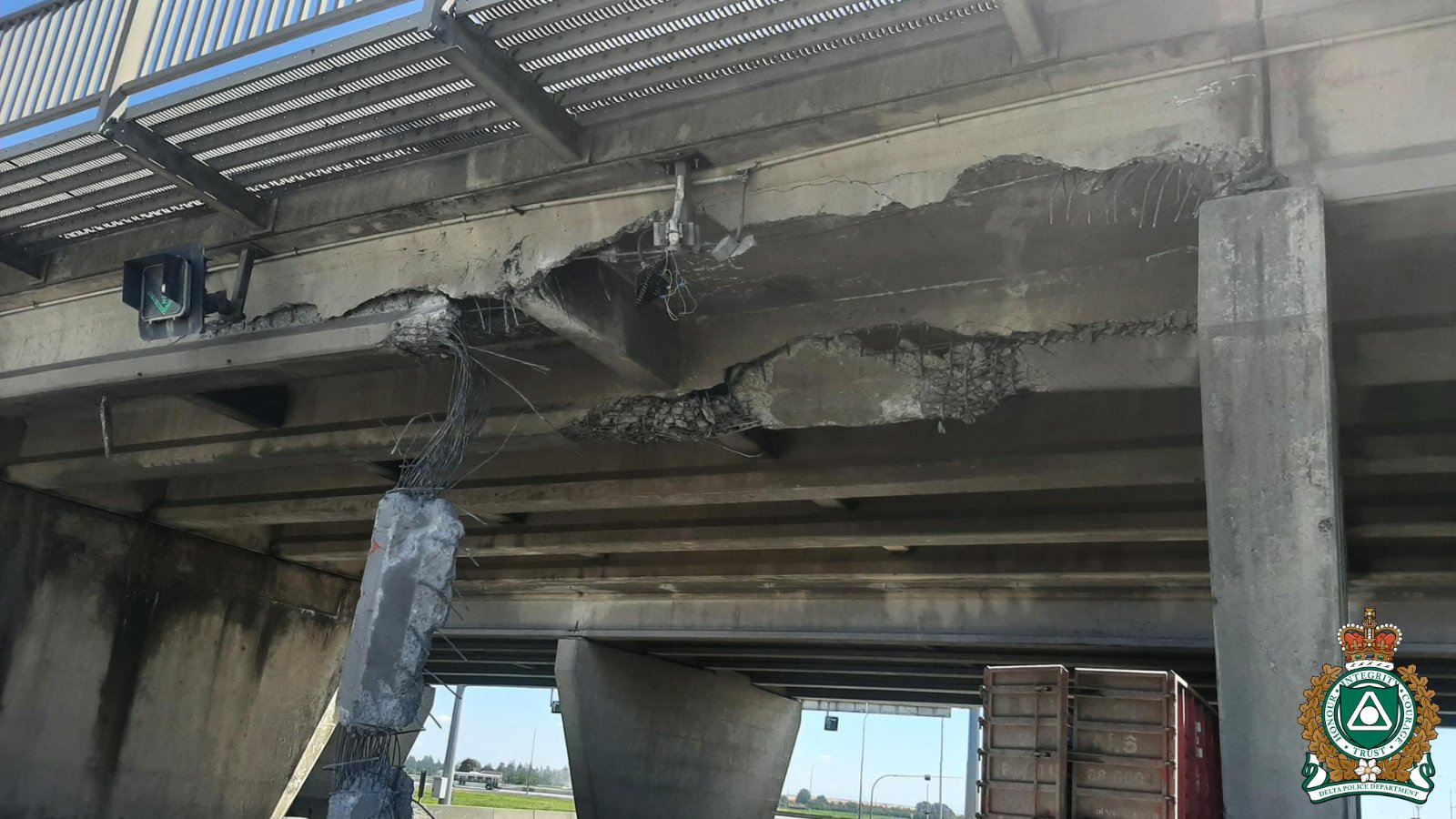
Typically, an entry-level driver is not going to be given an oversized load straight out of driving school.
Andy Roberts, president of Mountain Transport Institute in Castlegar, said students are overwhelmed with knowledge imparted to them during training.
“If we went deeper at that level, how much is going to be remembered?” he asked. “Schools don’t have the time to teach all that stuff, and the student will never retain it anyway.”

His instructors show students how to use a height stick to measure the height of trailers and freight.
“That’s not a mandatory entry-level training requirement. We do it because it plants the seed about tools that can be used once you start your trucking career,” he added.
Roberts said shippers are also to blame. Sometimes they contract out a load to the carrier with the lowest price. With oversized loads, shippers should make sure that when the freight leaves their yard it is legal and the driver knows the actual height and width.
“Common sense is a dying thing these days,” he added.
In February, the B.C. government issued a formal cancellation notice to Chohan Freight Forwarders, the carrier that crashed six times in two years into the province’s infrastructure.
“Everybody has a role to play.”
Dave Earle, president and CEO of BCTA
Dave Earle, president and CEO of the B.C. Trucking Association called the numerous overpass crashes “a not caring problem.”
The customer must give accurate information to the carrier, he said. “The guy who writes the cheque has a role to make sure he knows who he’s hiring. Carriers and drivers also have a role to play, but ultimately, everybody has a role to play,” he said.
Earle noted it does not take long to measure the load, but sometimes the paperwork and actual dimensions don’t match. Some carriers continue to haul these loads as they don’t want to lose business.
“It’s a holistic problem and starts with conversations that carriers have with customers. If a customer is hiring you to do something illegal, that’s not business, it’s criminal activity,” he said.
Training less experienced drivers
In the past, senior drivers would help train rookies, and new people were slowly absorbed into the industry. There were also experienced dispatchers who could respond to questions and doubts. As older drivers retire and younger people are reluctant to get behind the wheel, this knowledge is vanishing quickly.
But there are some companies, like Arrow Transportation System — which employs about 650 drivers — that are using mentors to train less experienced drivers.
Matt Cook, the company’s director of HSE and operational risk, explained how this works.
Entry-level drivers spend six months mostly hauling containers in Edmonton. They then start doing local deliveries in the area for about another six months. They begin longhaul highway driving after a year.
For example, when driving from Edmonton to Vancouver, they’ll follow an experienced driver on the route to learn the ropes. Before winter, they’ll spend a day with a mentor brushing up on driving in the snow.
Lisa Savage, Arrow’s director of people systems, said the time mentors spend in the cab with a driver depends on skill levels – sometimes it’s three days and on occasion it’s been six weeks. They provide daily progress reports to supervisors.

These mentors must have a minimum of five years accident-free driving. An ability to teach and loads of patience are part of the job description. They also undergo training at the Mountain Transport Institute, sharpening their skills.
Cook said every truck is equipped with a measuring stick and drivers are provided with a load check sheet. Drivers measure the height of the load, record it on the sheet, take a picture and send it to dispatch. The dispatcher cross-checks the information and the driver can proceed if there are no issues.
“If you deviate 1% from the expected, it becomes a norm. It’s called normalization of deviation,” he said.
Savage and Cook noted that although this training costs time and money, the company has benefited in terms of customer confidence, insurance costs and driver retention.
And their trucks, sometimes carrying oversize loads, roll smoothly under bridges and overpasses without damaging infrastructure in the province.
Have your say
This is a moderated forum. Comments will no longer be published unless they are accompanied by a first and last name and a verifiable email address. (Today's Trucking will not publish or share the email address.) Profane language and content deemed to be libelous, racist, or threatening in nature will not be published under any circumstances.
Usually the problem is not enough driving experience in Canada in a car. Too many come from countries with very different safety philosophies and step right into a truck with minimal training. Need to make it mandatory to have a full year experience with an unrestricted car license in Canada before we give someone a truck to wreck. We need immigration but we also need to be responsible.
-
John, you’re spot on.. driving, any vehicle, used to be a skill and people were proud of their driving skills.. now, we have so many people, all over North America, and Europe too, who don’t come from a ‘driving culture’. no courtesy, consideration, respect for other road users or the general rules of ettiquete.. never mind even a little patience.. see the speeding, tailgaiting (it’s like Nascar on the roads) or both of those together, lack of parking skills, no lights in the rain, snow, fog, dawn, dusk, etc..
I blame the driving schools, both car and truck, most of the instructors now, also don’t come from a ‘driving culture’ , and the vehicle makers, so many new features designed to make driving easier and safer?, but then taking away the drivers skills, making them into automated, non thinking morons! I don’t see it getting any better any time soon until we see a big change in people’s attitudes, more patience and less stress in our lives. BTW, I’m (semi) retired, 30yr, 2mil+ miles otr, so I’ve seen it all, or most of it anyway.. cheers-
Well, Colin Lee, your semi-retired comment is also “spot-on”! Well done. At 75 years young and fully-retired this year, I’m so glad to be done. The “big car” drivers coming in from other lands have no idea what our driving culture is in Canada. We talk about their lack of assimilation into our country regarding religion, politics, and family life but a good dose of assimilation into our “general driving” culture is completely needed. Get the “general driving” understood and then you get the “big car” to drive. Sadly, it is not going to change. In 45+ years of “big car” driving, I have seen it all. Well, as Colin Lee said, “… or most of it anyway…!”
-
With the new trucks with automatic flashing at at bridge under 14 feet should become the standard. The big trucking companies don’t want to pay a wage to keep higher quality drivers in Canada in my opinion
-
-
It is really hard to follow directions or instructions when so many of these drivers can not read or speak English. Remove them off the roads in all classes of license make them choose to learn the English language properly or stay with their language if no change no license simple.

More recognition for mentorship programs and accomplished mentors. Well done , Arrow and MTI. I would live to hear about more successful mentorship programs across the country.
I would also like to hear that a change of product handling requires mentorship as the driver with established driving skills is a rookie when encountering different commodity and equipment. Very good article.