TFW permits for truck drivers quadruple since 2010: Teamsters report

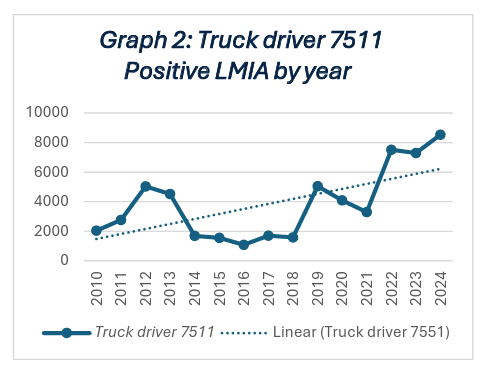
The number of Temporary Foreign Worker (TFW) permits approved annually for truck drivers in Canada has more than quadrupled over the past 14 years, according to a new report from Teamsters Canada.
The report, Trends in Approvals for Temporary Foreign Worker (TFW) Positions in the Trucking Sector (2010-2024), argues the increase reflects a structural shift in how some trucking companies staff their operations, relying more heavily on migrant labor rather than improving wages and working conditions to attract domestic drivers.
“For more than a decade, the industry told governments that there is a driver shortage in Canada,” said François Laporte, president of Teamsters Canada, in a release. “What the data actually shows is that Canadians are not lining up for jobs that don’t pay enough to live on and have seen labor standards eroded year after year.”
Laporte said employers are increasingly turning to overseas workers instead of addressing those underlying issues.
The report describes what it calls a “downward spiral” within the industry.
According to Teamsters Canada, stagnant wages and challenging working conditions are discouraging Canadians from entering or staying in trucking. Employers, rather than improving those conditions, are turning to the TFW program to fill vacancies, reinforcing the cycle.
Because TFW permits are typically tied to a single employer, the union argues migrant drivers can be left vulnerable to exploitation, including wage theft and misclassification under schemes such as Driver Inc.
The report also notes that some companies have been approved for hundreds of permits over multiple years, suggesting the program is being used as an ongoing labor strategy rather than a temporary solution to shortages.
The concerns echo criticism from international organizations. A 2024 report from the United Nations Special Rapporteur on contemporary forms of slavery described Canada’s TFW program as a “breeding ground” for modern slavery, while Amnesty International raised similar concerns in 2025.
Teamsters Canada emphasized that responsibility lies with policy decisions rather than individual workers.
“Don’t blame immigrants,” Laporte said. “Blame the politicians for believing everything companies say, and for allowing the trucking industry to use migrant labor as a substitute for paying far more competitive wages.”
The union is calling on the federal government to reduce the use of closed work permits in trucking, establish a meaningful wage floor, and enforce pay rules that compensate drivers for all hours worked.
It is also urging Ottawa to provide clearer pathways to permanent residency for TFWs already in Canada, while stepping up enforcement against misclassification and fully implementing Driver Inc crackdown measures announced in Budget 2025.
Finally, the union is renewing its call for truck driving to be formally recognized as a skilled trade — a move it argues would help raise standards across the industry.
The report can be found here.

Have your say
This is a moderated forum. Comments will no longer be published unless they are accompanied by a first and last name and a verifiable email address. (Today's Trucking will not publish or share the email address.) Profane language and content deemed to be libelous, racist, or threatening in nature will not be published under any circumstances.