Infrastructure, scale shape fleets’ decarbonization choices

Fleets are being forced to weigh multiple, competing paths to decarbonization without a clear roadmap for which technology will dominate.
For years, fleets could rely on a predictable cycle; new emissions rules would arrive, OEMs would respond, and purchasing decisions would follow.
“It was pretty simple,” said Ken North, emerging technologies consultant at the North American Council for Freight Efficiency, as he was moderating a panel at the Truck World show in Mississauga, Ont., on April 16. “Today, a lot of those regulations have either weakened or completely disappeared or are not as relevant as they once were. So, it leaves our industry today in a state of flux, in a state of somewhat confusion, not understanding where we go next…What is the future of transportation? Is it battery-electric? Is it hydrogen?”
That lack of clarity is showing up in the growing number of technology options fleets are now being asked to evaluate, with no single offering emerging as a clear fit across operations.
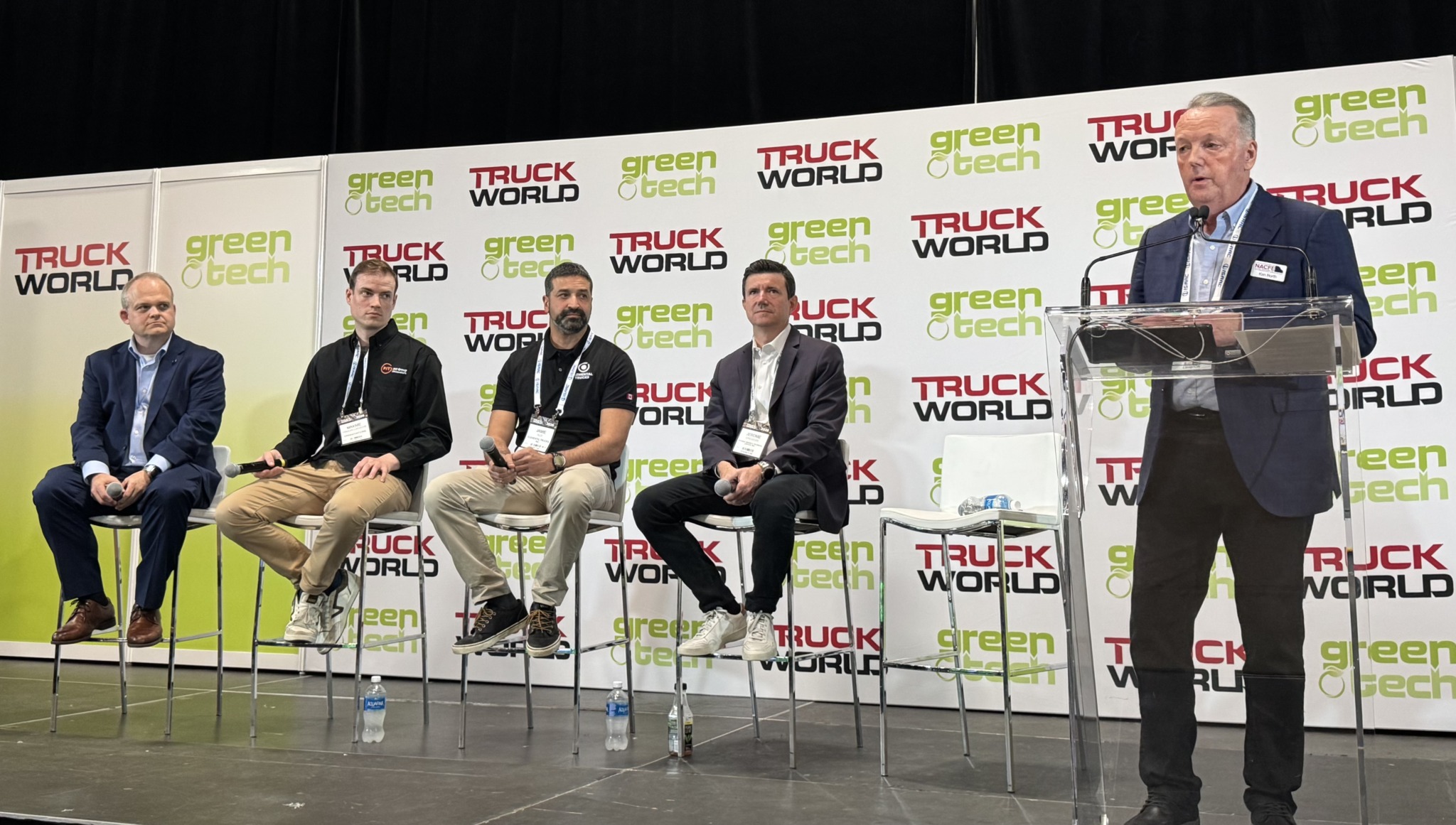
“I wish I could sit here and say, ‘This is the solution for you going forward,’” said Johan Agebrand, director of product marketing at Volvo Trucks North America (VTNA). “I would say it’s a little bit more of ‘all of the above’ solutions that’s going to happen.”
This is evident in VTNA’s decarbonization strategy, which includes advanced internal combustion engines running on renewable fuels, battery-electric systems, and hydrogen fuel cell technology. All powertrains are being developed by the OEM at the same time, each suited to different duty cycles.
Infrastructure readiness drives the decisions
While much of the conversation around decarbonization focuses on vehicle technology, panelists pointed to infrastructure as the bigger constraint.
“It’s not technology that doesn’t exist. It’s the infrastructure,” Agebrand said. “What infrastructure exists where you’re at — that’s going to be the decision for whatever technology you’re going for in the future.”
Battery-electric trucks are already proving viable in urban and regional applications, particularly where fleets can rely on overnight depot charging. But expanding beyond those controlled use cases remains challenging. Scaling from a small pilot to a larger fleet requires significant power capacity — often at the megawatt level — along with upgrades to local grid infrastructure.
Hydrogen, meanwhile, presents a different challenge. While it avoids some of the grid limitations, it requires enough vehicles in operation to justify fueling infrastructure, said Elemental Trucks CEO Jamie Ally.
He compared the two options, saying that while with electric, “a one-truck pilot is relatively inexpensive and easy,” but costs climb when scaling, hydrogen technology works in an opposite way.
“If you want to do a one-truck pilot with one fueling station, it’s prohibitively expensive. It’s kind of crazy expensive,” Ally said. “You need to run five or 10 or 20 trucks, and then you’re amortizing the cost of that station across many trucks.”
That makes hydrogen a difficult entry point for fleets looking to test the technology with a single unit, but potentially more viable for those ready to commit at scale.
Real-world performance gap adds pressure
Operational data suggests the gap between theory and real-world performance remains a key consideration, particularly in Canadian conditions.
Research from FPInnovations found that battery-electric Class 8 trucks operating around Montreal saw about about 35% increase in energy consumption in winter compared to summer, said Maxime Tanguay-Laflèche, senior researcher in telematics and advanced data at FPInnovations, adding that driver behavior played a role in range reductions.
“The impact of the driver on a battery-electric trucks is greater than on a diesel,” Tanguay-Laflèche said. “A driver that uses zero regenerative braking is losing 10-15% of the range.”
Downtime is another factor fleets are watching closely. Electric trucks in the study spent ‘a little bit less than twice as much as the ICE trucks’ at dealerships, reflecting early-stage challenges with parts availability and service readiness.
“The technology works. There’s a bunch of those trucks in operation. It works. However, it is still an emergent technology, and with that comes some growing pain,” Tanguay-Laflèche said.
Hydrogen tech gains ground
Those limitations are pushing fleets to consider alternatives, particularly for longer-range and heavier-duty applications.
Hydrogen fuel-cell-electric trucks are increasingly part of that conversation, though panelists stressed the economics differ from BEVs. Ally said battery-electric trucks aren’t always the lowest-cost option once real-world electricity prices and infrastructure costs are factored in, and in some cases hydrogen can be cheaper.
“There’s this common misconception that electric trucks are cheaper than hydrogen trucks,” said Ally. “The truth is that electricity is cheap… what’s expensive is power.”
“And to charge electric trucks, you need megawatts of power. We’ve seen prices of 80 or 90 cents per kilowatt hour. When you look at the cost of power to install the megawatt charges that you need for electric trucks, those are real prices. And [at that level], $12 per kilogram of hydrogen is actually cheaper,” he said, adding that the commonly cited $8 per kilogram of hydrogen needed for “diesel parity” is outdated and under current conditions, hydrogen can remain competitive with diesel at closer to $12 per kilogram these days.
But as with electric, infrastructure — not the vehicle — is shaping how and where the technology can be deployed.
“We hear a lot about the chicken and egg,” said Jerome Gregeois, director of commercial vehicle development, Hyundai Kia America Technical Center. “We like to joke that we want to bring the farm instead.”
Gregeois pointed to Hyundai’s hydrogen-powered logistics operations at its Savannah, Ga., plant, where the company built what he described as an integrated ecosystem to support the trucks.
In that case, hydrogen production, fueling, and vehicle deployment were developed together as part of a privately funded ecosystem designed to support daily operations.
In British Columbia, Hyundai has deployed trucks through a series of regional projects, including operations in the Greater Vancouver Area and northern parts of the province, working with partners and existing hydrogen initiatives rather than a single centralized system. Other deployments have relied on different models — from building dedicated stations for specific projects to using public fueling networks or even mobile refueling units to support early operations.
Conventional powertrains stay in the mix
That shift is putting more responsibility on fleets to determine which zero-emission technologies fit their operations. But in the meantime, internal combustion engines continue to offer a more immediate path to emissions reductions at lower costs compared to hydrogen fuel cells or BEVs.
Volvo’s Agebrand pointed to renewable diesel as one of the most accessible tools available today, requiring no changes to existing equipment.
“It’s seamless,” he said. “The engine will never know the difference.”
Agebrand pointed to the scale of the existing diesel fleet, noting that even incremental efficiency gains can have a significant impact.
He noted deploying some 250,000-300,000 new VNLs, which is 10% more fuel-efficient than its predecessor, is equal to putting 25,000 to 30,000 electric or net-zero trucks on the road each year.
“So I think many times the combustion or the regular technology gets a bad rap, because it’s not truly net zero. Well, it’s the biggest contributor to get there right now,” he added of more efficient diesels.

Have your say
This is a moderated forum. Comments will no longer be published unless they are accompanied by a first and last name and a verifiable email address. (Today's Trucking will not publish or share the email address.) Profane language and content deemed to be libelous, racist, or threatening in nature will not be published under any circumstances.