Readers speak out on…Driver Training

Mandatory entry-level training (MELT) was designed to raise the bar for Canada’s truck drivers. But eight years later, our readers say the bar may still not be high enough — with most reporting no noticeable improvement in driver quality and fewer than 40% believing new drivers are ready for the job.
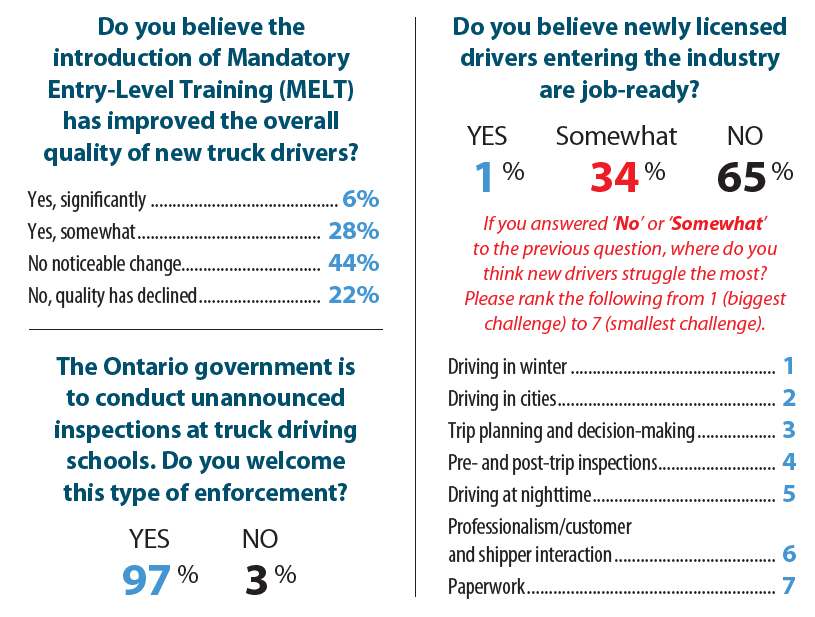
In our latest Pulse Reader Survey, just 6% of the 235 respondents said that MELT has “significantly” improved the overall quality of new truck drivers. Forty-four per cent reported “no noticeable change,” while 22% said quality has declined since MELT’s introduction more than eight years ago.
Just 35% believe newly licensed drivers are job-ready upon completing their training.
The findings reflect the views of industry professionals directly involved in hiring, training, and supervising drivers. Forty-two per cent of respondents identified as fleet owners or managers, 30% as truck drivers, and 15% as safety or training managers.
When asked where new drivers struggle most, winter driving was ranked as the biggest challenge, followed by city driving and trip planning. Many written responses reinforced that concern.
“Schools often teach just the training required by the government, resulting in students who learn only what is needed to complete the exam. Students are often taught how to deal with the area they reside in and not the country they then find themselves driving in, particularly B.C. and mountain terrain,” one respondent wrote. “Find a number of drivers who have driven in Eastern Canada and are completely caught off guard by chaining and how to drive a long grade, both found on main highways through B.C.”
One reader said that when they started their career in 1970, they had to drive in the city or locally for three years prior to getting on the highway.
“Driving around a town does not prepare a driver for the highways and out-of-city driving,” another reader echoed.
Another one wrote, “New drivers need real winter exposure. Driving schools’ MELT [is] a joke!”
“I believe truck driver training schools teach them enough to get their licenses but not the reality of trucking with loaded trailers and trucks,” another respondent said. This reader agrees: “You can’t teach ‘trucking’ in 110 hours. You can teach someone to maybe pass a test, but they are not a ‘truck driver’.”
Graduated licensing
Some readers suggested that graduated licensing be implemented before a full A/Z or Class 1 license (CDL) is given.
“I believe the biggest gap lies between getting a CDL and having the experience needed to be safe. I believe solutions would be in the following. Firstly, fraudulent driving schools would be eliminated by having the final drive test done by government drive test centers, not the driving school,” one reader wrote. “Secondly, a graduated licensing system of at least five weight/configuration classes, with verifiable ELD covering at least one winter season per level, followed with a successful drive test at each level, would give commercial drivers the adequate experience needed to progress to the next size and weight of commercial vehicle safely, minimizing the risk of being involved in catastrophic accidents.
“Weight classes of 15,000, 28,000, 36,500, 46,000, 56,000, and 63,500 kg in progression would give drivers the experience needed to maneuver these weights safely on our highways and streets. It is my experienced opinion that no newly licensed commercial driver should ever be allowed to drive an A/Z unit fresh out of driving school. Less people would get killed when these new drivers get involved in accidents with a 15,000-kg vehicle than a large 50,000-kg vehicle.”
Testing facilities, schools are taking the heat
Despite the criticism of the MELT program, 28% of respondents said MELT has “somewhat” improved driver quality, suggesting the program’s framework is not completely dismissed. “The MELT program is a good program. The problem is with the schools that don’t deliver it as they should,” one reader said.
The sentiment echoes what the industry has been dealing with for a while now – in late 2025, Alberta shut down several unsafe truck driving schools, and Ontario shut down one of the schools in December for the same reasons.
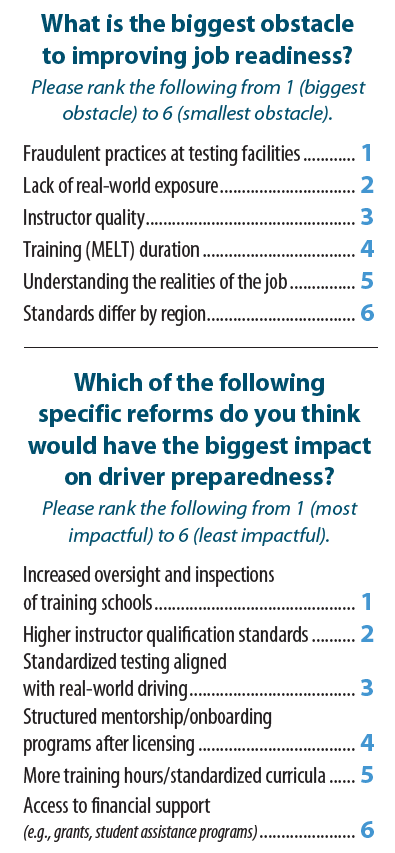
Fraudulent practices at testing facilities and a lack of real-world exposure ranked as the top obstacle to improving job readiness. Just in September 2025, trucknews.com reported on the Ontario Ministry of Transportation suspending truckers’ licences due to uncovered dishonesty during the Class A testing and/or training processes.
Hence, increased oversight and inspections of training schools ranking as the most desired reform should not surprise many.
When asked if they ever had a first-hand experience with dishonest testing or improper truck driver training, 87 respondents (37%) answered ‘Yes’.
And an overwhelming majority of respondents (97%) said they support unannounced audits and inspections at truck driving schools, just like the ones Ontario will be conducting across the province.
Written comments frequently referenced concerns about inconsistent training, arguing that standards vary too widely across provinces.
“[We] need to standardize training, should consider the Red Seal.”
Others cited ‘unregulated substandard driving schools,’ calling for stiffer penalties for fraudulent practices.
Instructor quality and qualification ranked third on the list of things affecting the quality of drivers. It is only logical that increasing instructor qualification standards was ranked as the second most welcomed reform.
Mentorship might be the missing link
Structured mentorship programs after licensing ranked fourth among the best potential reforms, and several respondents talked about the value of supervised real-world experience.
“Mentoring is the most effective way I have seen to prepare drivers for the real world. Schools can teach the basic principals of the game but nothing I have seen will replace a couple months ‘breaking the new guy in’ by a seasoned pro.”
In practice, however, most mentorship programs are implemented by fleets after hiring recent graduates — placing much of the responsibility for operational readiness on carriers rather than training institutions.
“Carriers must be compensated to train new drivers and get them ready to work,” one reader suggested.
Interestingly, when asked who holds primary responsibility for ensuring the quality of truck driver training, respondents were divided. Forty-one per cent said government regulators, 35% pointed to carriers and fleets, and just 24% said training schools.
Language and communication skills also emerged as recurring concerns in written responses, with several readers emphasizing ability to fluently speak and comprehend communication in English as foundational to safety. One respondent even suggested that English test should be a part of driver testing.
Some other readers added that current testing standards emphasize passing an exam rather than demonstrating operational competence.
One reader suggested that the testing process itself needs a complete overhaul. “Testing must meet the requirements of the industry. Testing should take two days and cost over $500 per day. Day 1 should include pre-trip inspection, coupling, chain up, multiple backing skills (straight line, angle, offset, including site side and blind side, sliding 5th wheels and trailer axles.) Day 2 would be a 4-hour on-road driving evaluation, including city, highway, freeway and mountain driving…All driver training schools must be accredited with mandatory annual three-day site visits… Oversight should be through Transport Canada.”

Have your say
This is a moderated forum. Comments will no longer be published unless they are accompanied by a first and last name and a verifiable email address. (Today's Trucking will not publish or share the email address.) Profane language and content deemed to be libelous, racist, or threatening in nature will not be published under any circumstances.