Alberta fleets push beyond compliance to build safety culture

Safety culture in trucking fleets must be driven from the top and reinforced at every level of an organization, fleet executives said at the Alberta Motor Transport Association annual conference in Calgary on April 22.
Safety programs focused only on compliance and documentation fall short. Speakers at a panel discussion said stronger results come when leadership empowers employees, listens to feedback, and integrates safety into everyday operations.
Matt Cook, director of HSE and operational risk at Arrow Transportation Systems, said safety begins with leadership but must extend throughout the organization, including supervisors, drivers and front-line workers. Employees need the authority to respond to changing conditions, particularly in unpredictable environments, without fear of discipline. He said companies should focus less on assigning blame and more on identifying system failures.
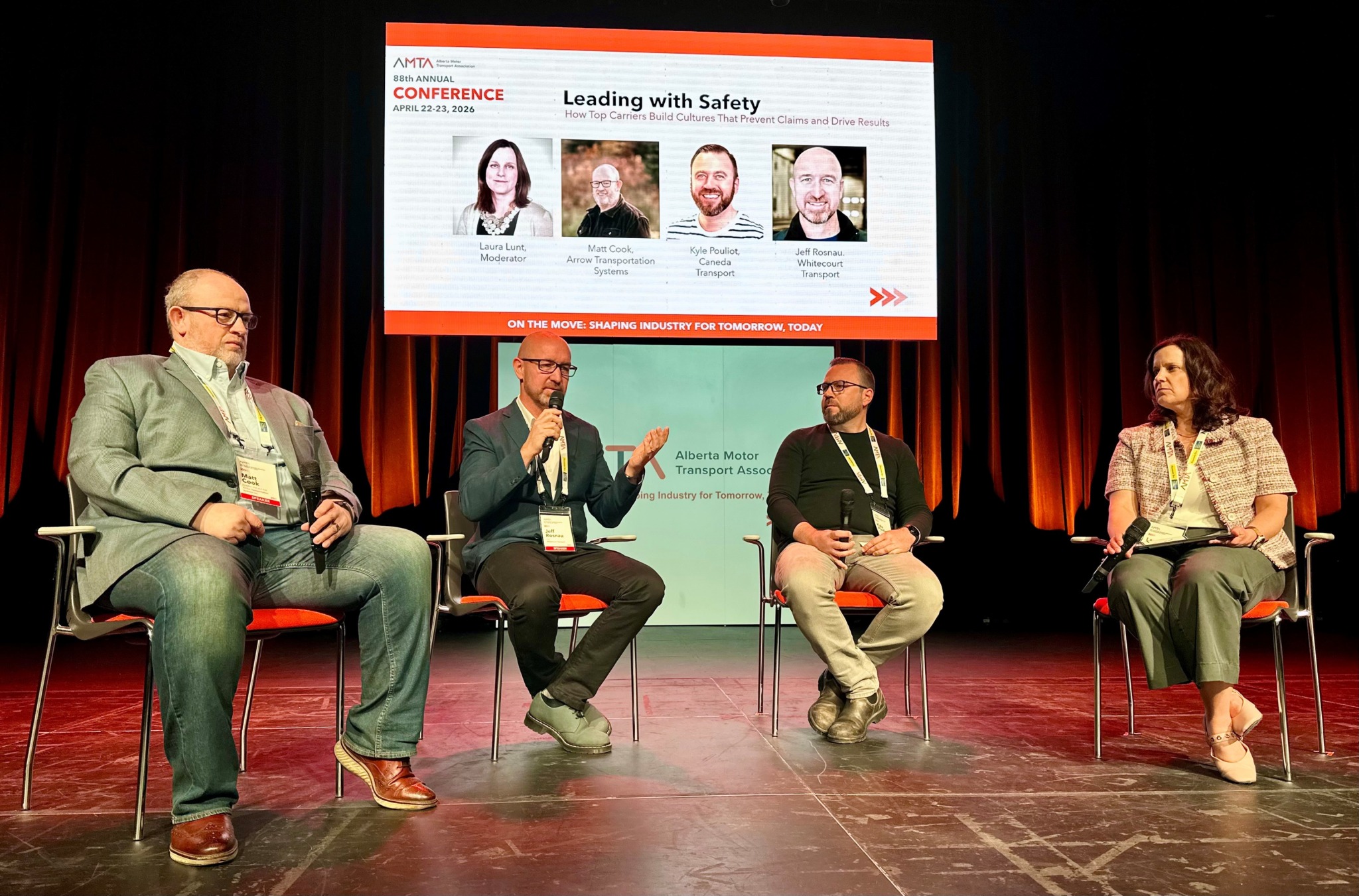
Jeff Rosnau, CEO of Whitecourt Transport, said safety culture depends on trust and engagement. He said companies must create an environment where employees feel comfortable providing feedback and participating in safety programs.
Panelists said fleets often treat safety as a compliance exercise, focusing on audits, manuals and regulatory requirements rather than real-world practices. While compliance is necessary, they said it should be viewed as a baseline rather than a final objective.
Use simplified processes developed with worker input
Cook said compliance is only the starting point, and organizations must build beyond it to achieve consistent safety performance. He said larger fleets face additional challenges in shifting culture, given the time and resources required to move away from paper-based systems to more practical, employee-driven approaches. Lengthy safety manuals, he added, are often ineffective and should be replaced with simplified processes developed with input from workers.
Rosnau said smaller carriers can be especially vulnerable to relying on compliance due to limited resources. He said companies may complete audits and paperwork but fail to engage drivers in meaningful safety discussions, resulting in a gap between documentation and actual practice.
Kyle Pouliot, director of operations at Caneda Transport, said safety must be a two-way process, with drivers and employees treated as subject matter experts. Programs that rely on top-down directives without input from workers are unlikely to succeed, he said, adding that involving employees improves buy-in and accountability.
Visible and consistent leadership
Panelists also stressed the importance of visible and consistent leadership. Pouliot said executives must be present in operations and demonstrate commitment to safety through their actions. Standards that are ignored or inconsistently applied can undermine safety programs.
Cook said leadership engagement sends a clear message across the organization. At Arrow, regular safety calls include executives and managers across business units, reinforcing that safety is a priority and helping embed it into daily operations. He said strong safety performance supports broader business outcomes, including productivity and efficiency.
The panel highlighted the role of communication and feedback in maintaining engagement. Cook said supervisors must follow up with employees who raise concerns, even when solutions are not immediate, as a lack of response can erode trust.
Using gamification to encourage improvement
The speakers also pointed to the growing role of data and technology in safety programs. Pouliot said fleets now collect large volumes of data through electronic logging devices and telematics systems, but must establish clear performance indicators to make the information useful.
Some fleets are using gamification to encourage improvement, recognizing drivers for progress rather than only top performance. Pouliot said this approach can increase participation and engagement across the workforce.
Health and wellness initiatives are also being incorporated into safety strategies. Pouliot said Caneda has introduced programs addressing fatigue, physical health and mental well-being, particularly for longhaul drivers. He said management must support drivers who report fatigue, even if they are within legal hours, to reinforce that safety takes priority over schedules.
Mentorship programs
Mentorship programs were identified as another key tool. Rosnau said pairing new hires with experienced drivers creates accountability and provides a support system that helps reduce risk. Mentors can also make it easier for new drivers to ask questions and build confidence.
Cook said Arrow’s mentorship program includes structured feedback, allowing new drivers to share their experiences and identify areas for improvement. He said this approach provides insights that may not surface through direct conversations alone.
Industry collaboration and available resources can support fleets of all sizes. Cook noted that companies should share best practices and use tools available through industry associations, rather than trying to build programs independently.
Adapting proven approaches
Rosnau said fleets can adapt proven approaches rather than starting from scratch, helping them move more quickly toward effective safety programs.
Building a strong safety culture requires sustained effort and continuous improvement. Cook said progress can take years, particularly for larger organizations, but incremental gains can lead to long-term results.
He added that safety should be integrated into all aspects of a business rather than treated as a standalone function, becoming part of how the organization operates on a daily basis.
Have your say
This is a moderated forum. Comments will no longer be published unless they are accompanied by a first and last name and a verifiable email address. (Today's Trucking will not publish or share the email address.) Profane language and content deemed to be libelous, racist, or threatening in nature will not be published under any circumstances.

I’m glad to see that the bigger outfits are taking this seriously. How do we get the smaller ones & O/Os to buy in? I’ve been retired now for 2 years, and the BS I see out there is beyond the pale.
I’m thinking that EVERY outfit should force their drivers to take a “load securement” course. And teach them that taking short cuts has ramifications.