Mack’s Pioneer/Anthem combo delivers a wider cab, a bigger sleeper, and a more complete highway lineup

An additional nine inches doesn’t sound like a lot of extra room in an already spacious Class 8 truck cab.
That’s how much wider Mack made the cab on its new Pioneer and Anthem highway and regional haul tractors. But climb out of a legacy Anthem and into one of the new trucks and the difference is immediately noticeable.
You feel it before you put your first mile of asphalt under the rubber.
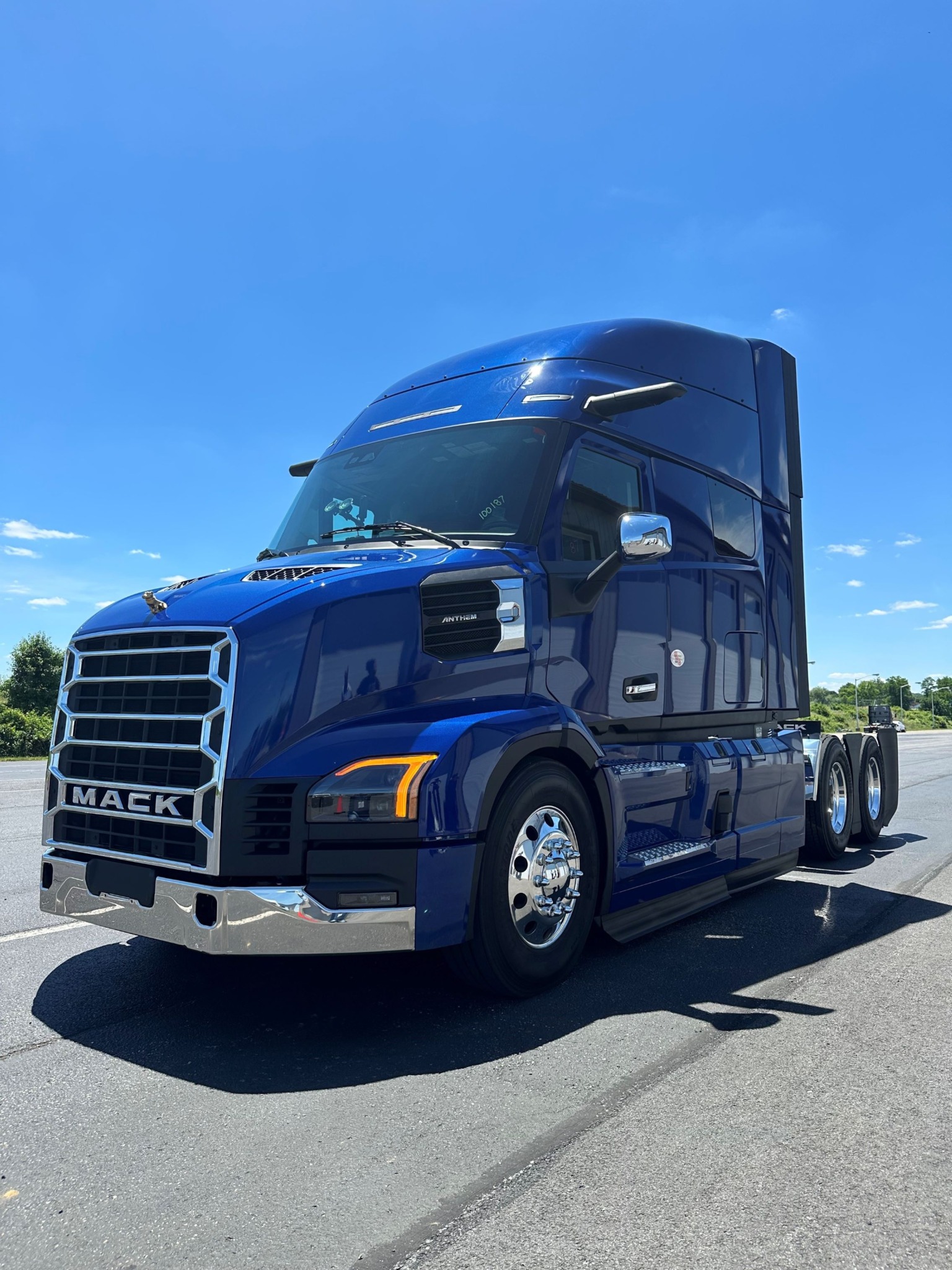
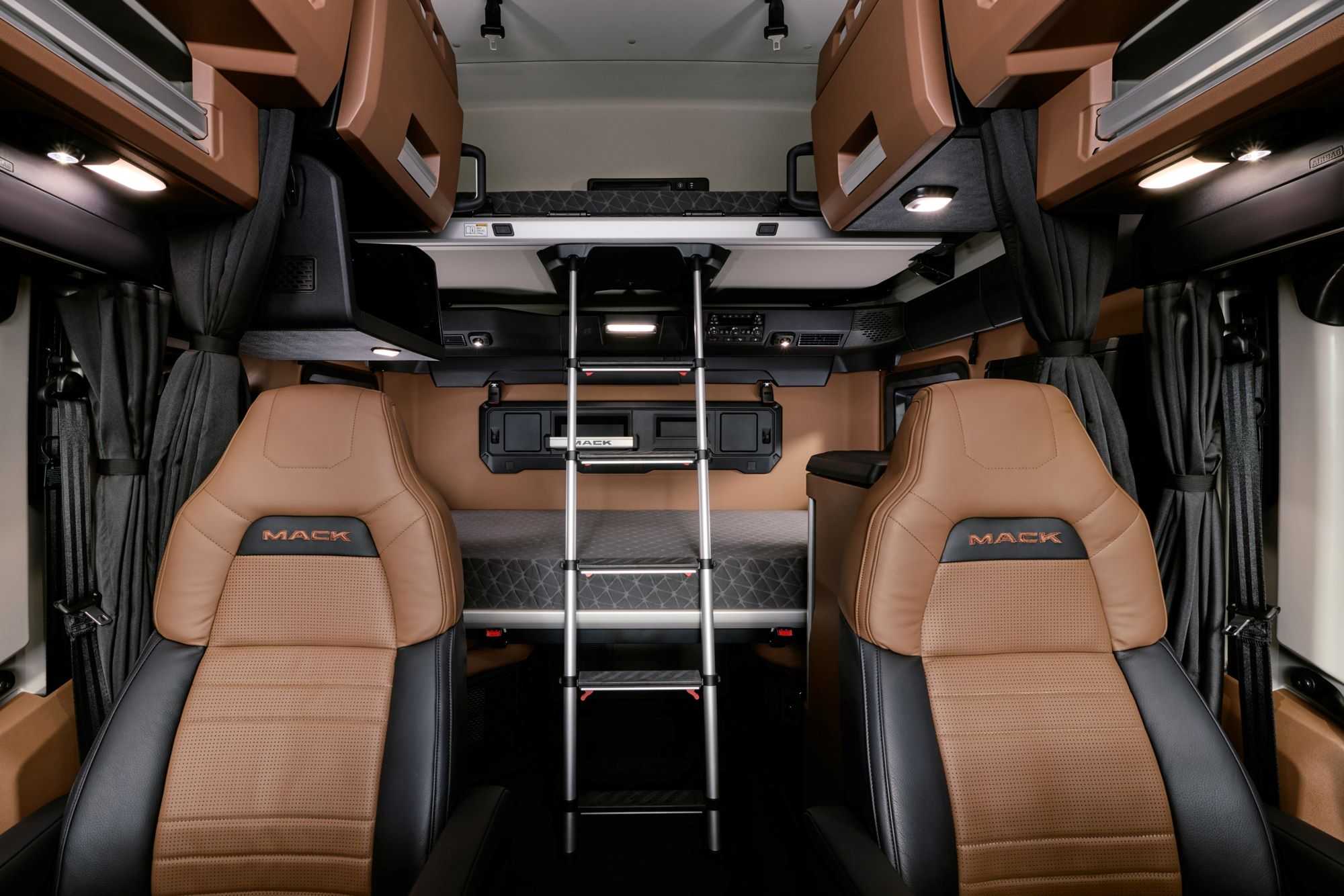
There’s more room between the seats. More shoulder room. More space to move around. The cab feels open in a way the previous Anthem never quite did. It even afforded designers the room to add a second armrest on both seats.
“It’s pretty drastic,” Mack senior product manager for highway products Blake Routh said of the difference, while I rode along with him on Allentown, Pa.-area roads June 16.
After spending a day driving the Pioneer on the company’s Customer Center track and crawling around inside both trucks, it’s hard to disagree.
The wider cab may not be the headline feature Mack wants everyone to talk about. That distinction probably belongs to the truck’s aerodynamic redesign and fuel-efficiency improvements. But from the driver’s seat, the extra space is what leaves the strongest first impression.
The real story from a Mack perspective is that its new one-two punch gives it a more complete highway lineup that it is confident will allow it to break into, or reestablish a stronger presence in, new applications.
For years, Mack essentially had one answer to every highway application: the Anthem. It was a capable truck, but one could argue it was asked to do too much. It wasn’t the best fit for every highway application.
Even so, whether customers were hauling freight across the continent or making regional deliveries with frequent stops and tight turns, the Anthem was the truck. It did a lot of jobs reasonably well, but it was still one truck trying to satisfy very different customers.
Now there are two.
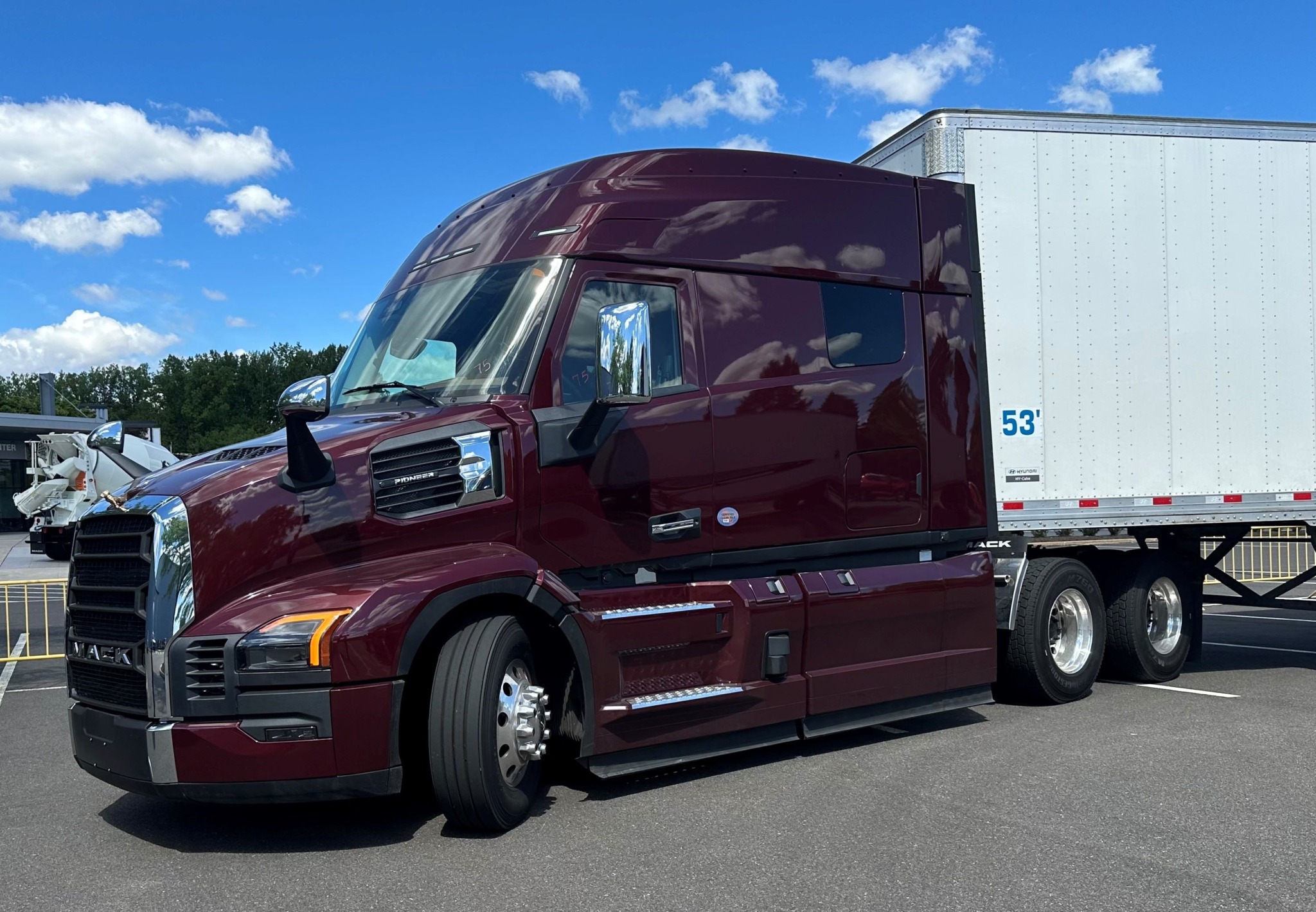
Mack’s new highway tandem
The Pioneer becomes Mack’s flagship over-the-road tractor while the new Anthem shifts into the role of a shorter, more maneuverable regional-haul truck, while retaining all the driver comforts and amenities associated with the legacy Anthem.
“We moved from one truck with just the Anthem to now two trucks with the Pioneer and the new Anthem,” Routh explained.
The strategy is evident in the dimensions.
The Pioneer carries a 125-inch bumper-to-back-of-cab (BBC) measurement. The new Anthem comes in at 113 inches. The outgoing Anthem split the difference at 117 inches.
Put another way, Mack stretched the lineup in both directions.
The Pioneer grew longer and more aerodynamic for longhaul efficiency, while the Anthem became shorter and more maneuverable for tighter urban deliveries.
That four-inch reduction in BBC compared to the previous Anthem may not sound dramatic, but Routh noted it can make a meaningful difference for fleets operating in congested environments.
Think foodservice distribution, beverage delivery, and other operations where drivers spend their days navigating tight city streets and cramped customer yards.
Meanwhile, longhaul fleets now get a purpose-built over-the-road truck rather than a single model built to do both jobs. Both models share much of the same driver comforts, safety systems and tech.
Much carryover between the two models
That includes the cab structure, technology packages, trim levels, safety systems, and sleeper options up to 64 inches. The differences largely begin at the front bumper and continue through application-specific offerings.
The Pioneer alone gets Mack’s new 76-inch sleeper, which immediately elevates the truck’s credentials as a serious longhaul contender.
That’ll be appreciated by fleets focused on driver recruitment and retention.
The sleeper is larger, the cab is roomier, and the overall environment feels more premium than anything Mack has offered in this segment before. It also retains the distinctive Mack DNA as seen throughout the cab in the form of subtle design cues like brushed metal touchpoints.
Such attention to detail becomes increasingly apparent once you spend some time inside.
Mack’s upgraded seats are more comfortable and can even be spec’d with massage capabilities.
A a large pull-down sunshade received repeated praise from early customers, according to Routh. Those are the sorts of details drivers will appreciate every day they’re behind the wheel.
The same philosophy seems to have guided much of the interior design.
Mack integrated dedicated mounting provisions for electronic logging devices, eliminating the need for fleets to drill into dashboards and improvise mounting options. There are USB-C charging ports throughout the cab, a wireless charging pad, wireless Apple CarPlay, and an optional secondary display mounted on the passenger side.
The result is a cleaner, more organized workspace.
During the ride-and-drive event, Mack representatives continuously referred back to the driver’s experience rather than the truck’s specifications.
Conversations focused on comfort, visibility, ergonomics, and ease of use. That seems intentional.
The reality is that most modern Class 8 tractors are highly capable machines. Competitive advantages increasingly come from making drivers happier and more productive rather than adding another few horsepower.
Improved visibility
Visibility is a good example.
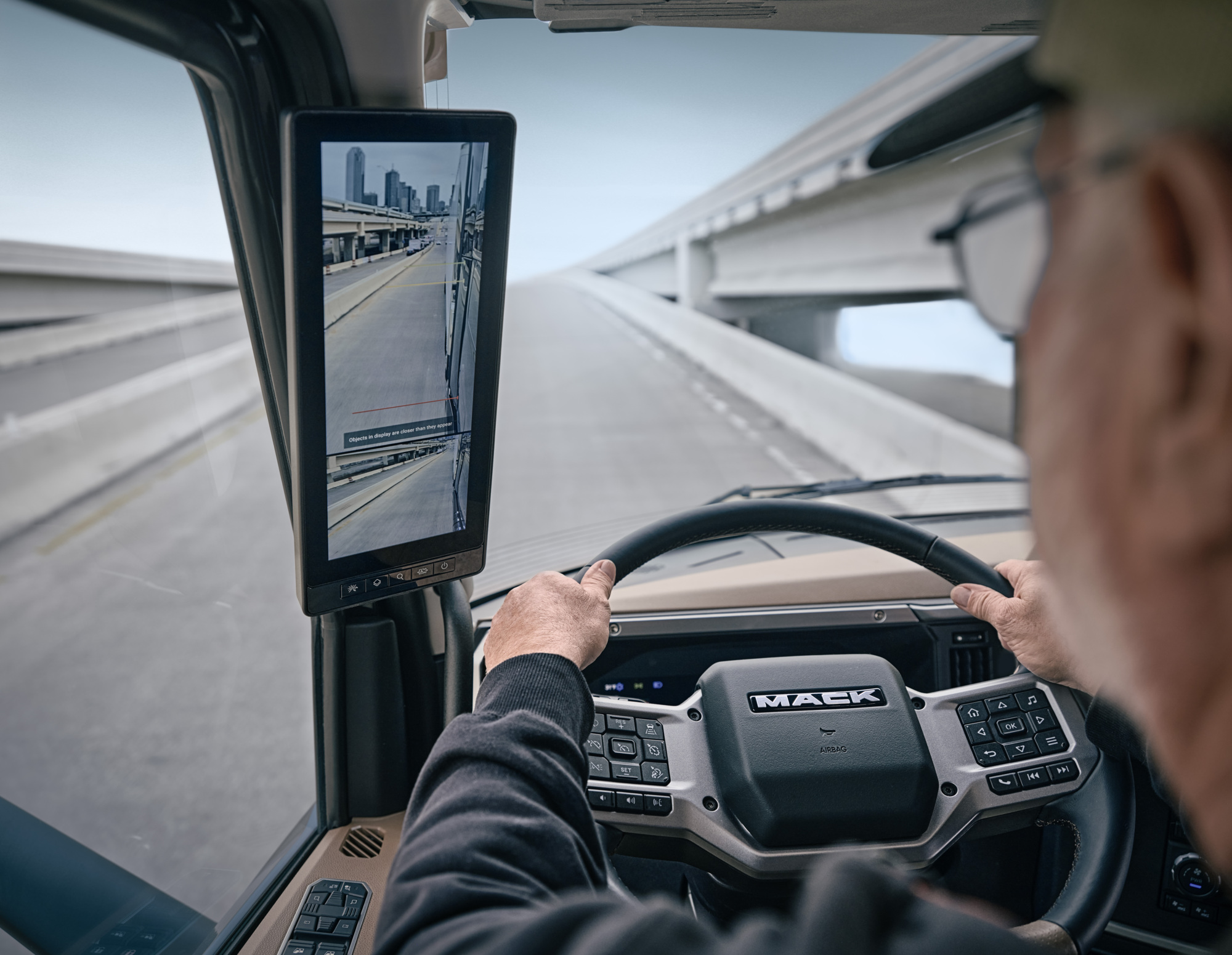
The Pioneer can be equipped with digital mirrors, a technology that’s gradually gaining acceptance across the industry. Yes, they take some getting used to. But after some time experiencing the camera mirror system on the track, the benefits become clear.
Take rates remain below conventional mirrors, but Mack says interest has been strong.
Routh compared the technology’s adoption curve to automated transmissions.
At one time, many drivers swore they would never give up manual gearboxes. Today, most fleets wouldn’t consider ordering them – if they even have the choice.
Digital mirrors may follow a similar path, though it will take time.
The system provides excellent visibility and integrates with the truck’s broader camera ecosystem, which includes blind-spot monitoring and backup-camera functionality.
The cameras aren’t simply technological novelties. They address real operational challenges and improve visibility around the vehicle. The same can be said for the truck’s electronic braking system.
Among its capabilities are automated parking-brake functions designed to reduce the risk of rollaway incidents and other driver errors. These aren’t flashy features; they’re practical ones.
Mack’s engineers appear to have focused on solving problems drivers and fleets actually encounter.
Even the redesigned steering column reflects that approach. In addition to traditional up-down and in-out adjustments, the system adds another degree of adjustability, making it easier for drivers to find a comfortable position.
Drivers will appreciate that.
Of course, all the comfort and convenience features in the world won’t matter if the truck can’t deliver a compelling business case. Fuel economy remains central to the Pioneer’s value proposition.
The truck’s longer hood, redesigned front end, and aerodynamic refinements were all developed with efficiency in mind. As diesel prices fluctuate, even small percentage improvements can have a significant impact on operating costs.
Routh acknowledged that rising fuel prices only strengthen the value proposition. Mack also deserves credit for taking customer feedback seriously and pivoting where necessary. Initially, the company said the Pioneer could not be spec’d without full chassis fairings. Customers pushed back against that and Mack adjusted – they can now be removed if the customer, for whatever reason, doesn’t’ want them.
Being flexible is increasingly important for OEMs, as carriers increasingly demand custom spec’s that maximize performance in their specific duty cycles.
Customers appear to be buying into the strategy. In some cases, perhaps more enthusiastically than expected.
Routh said some fleets have surprised Mack with their purchasing decisions. Some customers the company expected to gravitate toward the Anthem selected the Pioneer instead. Others moved in the opposite direction. Some fleets are ordering both models.
That’s one of the benefits of having two clearly differentiated products. Customers can evaluate each truck against their specific operational needs rather than forcing every application into a single model.
Well-received by drivers
Perhaps the most encouraging feedback Mack has received involves drivers.
Routh said fleets have reported that drivers don’t want to give the new trucks back once they’ve had a chance to spend time in them. Every manufacturer hears stories like that at launch events, so they should be viewed with a healthy dose of skepticism.
But, after spending some time in the Pioneer and repurposed Anthem, it’s easy to understand why drivers would appreciate the changes.
The wider cab is noticeable. The sleeper is larger. The seating position is improved. As is the seat itself. The controls are thoughtfully arranged. The technology feels integrated rather than added as an afterthought.
Most importantly, the truck feels like it was designed around the people who spend their lives inside it.
Mack now has a highway lineup that doesn’t ask customers to compromise. The Anthem can be a regional truck. The Pioneer can be a longhaul truck. Each can excel at its intended mission. Both are capable of the other job if and when required. Versatility is built into both models. And purchasing decisions won’t be driven by price; Routh said the two trucks are not being positioned as a premium vs fleet spec’ — both are high-end vehicles that will be priced similarly.
Judging by customer response, that’s exactly what many Mack buyers have been waiting for.
The company’s order books for the new trucks are already filled through the end of the year, Routh said, attributing that demand in large part to early customer reaction to the products.
That’s not proof of long-term success. The trucks still have to prove themselves over millions of miles in real-world service. But after a day spent with the trucks, it’s clear Mack has done more than launch a new model.
It has built a much more complete highway offering than it has ever had before.
Have your say
This is a moderated forum. Comments will no longer be published unless they are accompanied by a first and last name and a verifiable email address. (Today's Trucking will not publish or share the email address.) Profane language and content deemed to be libelous, racist, or threatening in nature will not be published under any circumstances.

Last new Mack I drove was a 2021 in 2021.
I did enjoy the truck in all aspects. Pictures look nice. Bravo