Trailer orders continue to rebound despite market uncertainty

North America’s trailer market showed further signs of stabilization in April, with both FTR and ACT Research reporting stronger-than-expected order activity despite ongoing concerns about tariffs, freight demand and economic uncertainty.
FTR reported U.S. net trailer orders reached 19,953 units in April, up 11% from March and 100% higher than April 2025 levels. Orders also exceeded the 10-year April average of 15,474 units.
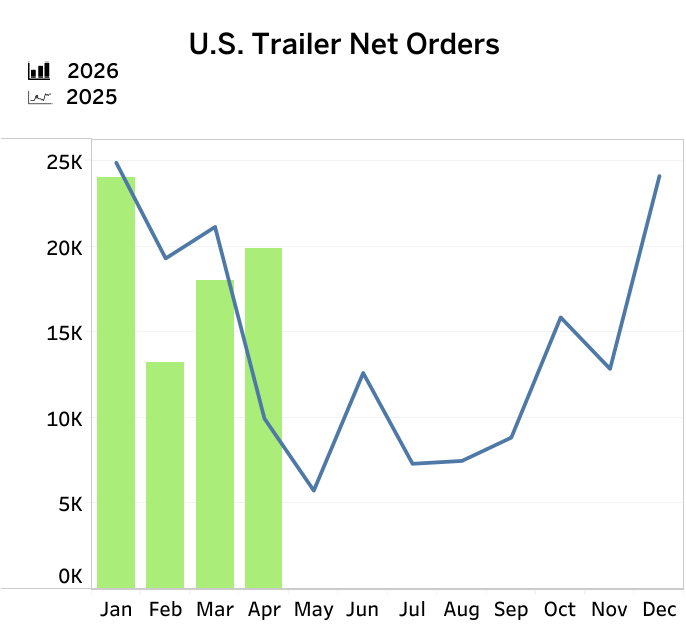
ACT Research reported preliminary April net trailer orders of 19,400 units, up 3% month over month and nearly 127% year over year. On a seasonally adjusted basis, ACT pegged April orders at 26,800 units, up almost 43% from March.
The gains surprised analysts because April typically marks one of the weakest periods of the annual trailer order cycle.
“Overall, the U.S. trailer market appears to be moving from deterioration toward stabilization and modest improvement,” said Dan Moyer, senior analyst, commercial vehicles, with FTR.
Moyer said improving freight conditions and replacement demand are helping support the market, though trailer demand still trails the stronger Class 8 truck segment.
“Trailers should therefore continue to lag Class 8 in the near term with improvement concentrated among stronger fleets, aged-equipment replacement, and dry van normalization,” he said.
Jennifer McNealy, director of CV market research and publications at ACT Research, said the industry’s seasonal order cycle appears delayed this year.
“This year’s cycle seems to have been delayed a few months, as the order upticks that should have started in September or October of last year didn’t actually happen until December,” McNealy said. “Regardless of the timing, the order upticks certainly are welcome.”
Despite the stronger order activity, both firms cautioned that uncertainty remains elevated.
FTR pointed to volatility tied to Section 232 steel and aluminum tariffs, as well as the ongoing antidumping and countervailing duty investigations involving van trailers.
“April trailer demand was better than expected, but a durable upcycle will likely require stronger fleet margins, higher trailer utilization, further absorption of excess capacity, and clearer visibility into trade-related costs,” Moyer said.
ACT also noted concerns about backlogs and broader freight-generating sectors of the economy.
McNealy said net orders exceeded production for three of the first four months of 2026, helping boost trailer backlogs modestly in April. However, year-to-date backlogs remain more than 13% below the year-ago levels.
“Concern is mounting about how quickly trailer OEMs will build down the relatively still-thin backlog,” McNealy said, citing worries about freight demand and higher petroleum prices weighing on fleet purchasing decisions.
Trailer production remained relatively flat in April. FTR reported U.S. trailer builds totaled 17,576 units during the month, essentially unchanged from March and up 1% year over year.

Have your say
This is a moderated forum. Comments will no longer be published unless they are accompanied by a first and last name and a verifiable email address. (Today's Trucking will not publish or share the email address.) Profane language and content deemed to be libelous, racist, or threatening in nature will not be published under any circumstances.