Spec’ing and maintaining refrigerated trailers for optimal thermal performance

Many lessons are learned the hard way in this business. Try to save a few bucks. Try to save a few pounds. Try keeping the truck or trailer on the road a few years longer. Unless you go in with eyes open, they will likely be yanked open for you sometime over the life of a piece of equipment. There are always trade-offs, often unanticipated.
There are tons of trade-offs with refrigerated trailers, like skimping on the trailer insulation to increase the cubic capacity of the wagon, or to save weight and cost.
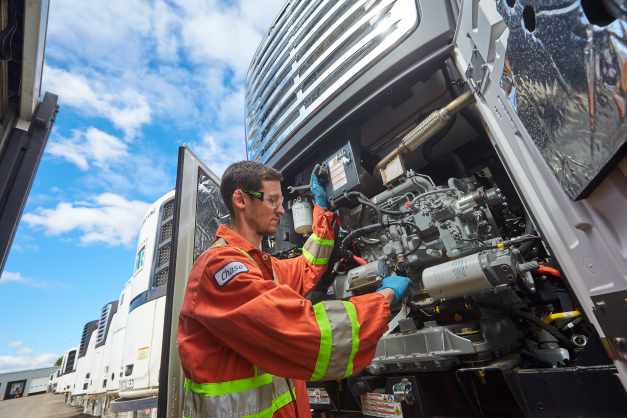
It seems like a great idea until you discover the refrigeration unit works double-time to make up for the loss in thermal performance.
From the refrigeration unit up front to the doors at the back and everything in between, the way you spec’ and operate that trailer will have maintenance and cost implications throughout the trailer’s life.
Best to get it right from the start. You’ll be dragging that trailer around for a long time.
The Technology & Maintenance Council of the American Trucking Associations hosted a panel discussion on refrigerated trailer spec’ing and thermal maintenance during its annual meeting in March.
Tim Schmeits, product director for Great Dane’s Everest reefer trailer, told attendees everything begins with analyzing the application for which you’re buying the trailer.
Is it intended for food service applications with multiple stops, lots of door-open time, multiple temperature zones, etc., or a truckload operation running coast to coast where it’s loaded and unloaded only a couple of times a week?
What about the temperature range of the product you plan to carry? Is it deep frozen, with a -20°F (-30°C) operating range, as with ice cream for example, or somewhere around 0°F (-17°C) for more general frozen commodities?
Products such as vegetables and fruit need only be chilled and protected from freezing. These trailers operate in the 35-50°F range.
With that in mind, a multitude of spec’ing options come into play, each with its own thermal performance maintenance considerations.
“The installation package is the first and foremost. The more insulation you put in there, the colder you’re going to be able to keep the interior with the least amount [of] energy consumed by the refrigeration unit (TRU),” says Schmeits. “The obvious trade-off with thinner insulation is more interior volume and less weight, but you lose thermal performance and heat transfer can become a problem not just through the walls, but through the posts as well.”
Schmeits says aluminum has an extremely high thermal conductivity rate. In the case of the trailer body with a sheet-and-post sidewall, any aluminum exposed to a temperature differential will transfer heat from the outside through the aluminum post and even the fasteners, to the interior of the trailer.
Testing by Great Dane has shown that a typical over-the-road trailer with two-inch thick insulation and one-inch thick posts with any typical TRU can achieve about 30% excess capacity for deep reservation.
“If we take that same sidewall post and increase the sidewall insulation to three inches, it’s possible to get up to 75% of that excess capacity, which means your TRU runs quite a bit less,” he says.
The benefits of thicker insulation are significant: better thermal performance, lower TRU cycling, less maintenance required, and less fuel consumed.
Schmeits noted that heat transfer is a concern anywhere metal can be a thermal conductor, such as the fasteners used to attach scuff plates, cargo tracking, etc. Each screw or rivet is a pathway to heat loss. This same thinking applies to the number of posts you spec’. And while there’s usually a good reason to add posts, “Commonly, post spacing is about 24 inches, and so that’s going to be approximately 60 throughout the entire trailer,” Schmeits notes. “If we have 12-inch centers, for whatever reason, we’re increasing that to approximately 100 posts, 36 extra compared to our 64 total, and therefore the heat loss associated with those posts.”

Downstream maintenance
Trailer condition deteriorates with age and mileage and general wear and tear from load and unloading, forklift damage, etc. This isn’t necessarily a death sentence for the trailer, if you stay on top of the degradation.
Maintaining the integrity of the insulation is critical. Schmeits recommends spec’ing the trailer with a metal film liner to prevent insulation off-gassing and to resist water permeation.
“Metal film will effectively extend the life of the trailer, because your insulation will not degrade,” he says.
Any external damage when the sidewall is compromised should be repaired as soon as possible to avoid water incursion. It should be noted that water incursion can also occur during trailer washouts using high-pressure washers.
Door seals demand attention, too. Ensure they are not worn or damaged, and the door hinges or roll-up doors are adjusted properly to achieve a good seal.
And then there’s the TRU itself. You don’t want it working any harder than it has to because all the cold air it makes in leaking out through holes in the trailer or crappy door seals.

TRU maintenance
Diesel engine maintenance is pretty well understood, and TRU engines are no different. Matt Srnec, principal engineer of electrification at Thermo King, strongly recommends following the manufacturer’s service guidelines for basic maintenance, such as oil and filter changes, and any necessary adjustments to drive-belt tension and engine-speed settings.
“On a more frequent basis, perhaps as a thorough pre-trip, run the TRU, listen for any unusual noises, and make sure it’s not generating any alarm codes,” Srnec says. “Do a basic visual inspection of the crankcase area of the engine, looking for leaks and anything out of place. Have a look at the battery terminals, electrical lead and connections. This is pretty typical for a diesel engine.”
As for the specialty equipment of refrigerated trailers, Srnec recommends checking the air chutes to make sure they are not torn or blocked. Inspect solar panels on the roof of the trailer for damage.
“Everybody knows trees jump out and hit trailers all the time,” he joked.
Since refrigerated trailers are festooned with sensors, they’ll need to be checked periodically and possibly calibrated. Door sensors are notorious for being disconnected, cut, damaged, and door sensors are probably the biggest contributor to the possibility of operational inefficiency. Whenever the doors are open, the refrigeration system should be off.
“There should be no air exchange when the doors open and turning that TRU off can be done simply by having a door switch,” he says. “When you have multiple door switches in the case of a multiple-zone unit, it really helps contribute to efficiency by reducing defrost events.”
Door maintenance and adjustment
Doors, either swing or roll-up can be significant sources of heat loss in a refrigerated trailer. With swing doors, the culprits are damage of misalignment of the door itself, or door seals in poor condition, notes Schmeits.
There’s considerably more to maintaining roll-up doors. Joe Olszta, national account manager, Whiting Door Mfg., noted TMC’s Recommended Practice RP 761 (available to TMC members), addresses roll-up door maintenance guidelines.
“You want to make sure that your top panel of the door is properly adjusted and seals tightly against the header,” he says. “You should have proper lock engagement at the bottom of the door so that it doesn’t bounce up and down when the vehicle is in motion. As well, the side seals should contact the edge of the door.”
He stressed that the individual panels should interlock properly when the door is closed and there should be no damage along the mating edges of the panels.
“Lastly, I want to talk about automatic door opener systems,” Olszta threw in at the end of his presentation. “These systems reduce the time the door is left open thereby minimizing the exchange of cold and warm air in the body.”

Have your say
This is a moderated forum. Comments will no longer be published unless they are accompanied by a first and last name and a verifiable email address. (Today's Trucking will not publish or share the email address.) Profane language and content deemed to be libelous, racist, or threatening in nature will not be published under any circumstances.