Cargo theft grows more organized as US ranks among hardest hit countries

Cargo theft is becoming more organized and technologically driven, with criminals expanding beyond trucks to target rail shipments and exploit digital freight platforms in the United States.
Globally, Brazil accounted for the highest share of cargo theft incidents at 22%, followed by Mexico at 15% and the United States at 13%. Canada accounts for just 1%.
This is according to the 2025 global report on cargo theft from BSI Consulting, risk management advisors, and TT Club, a logistics transport insurance provider.
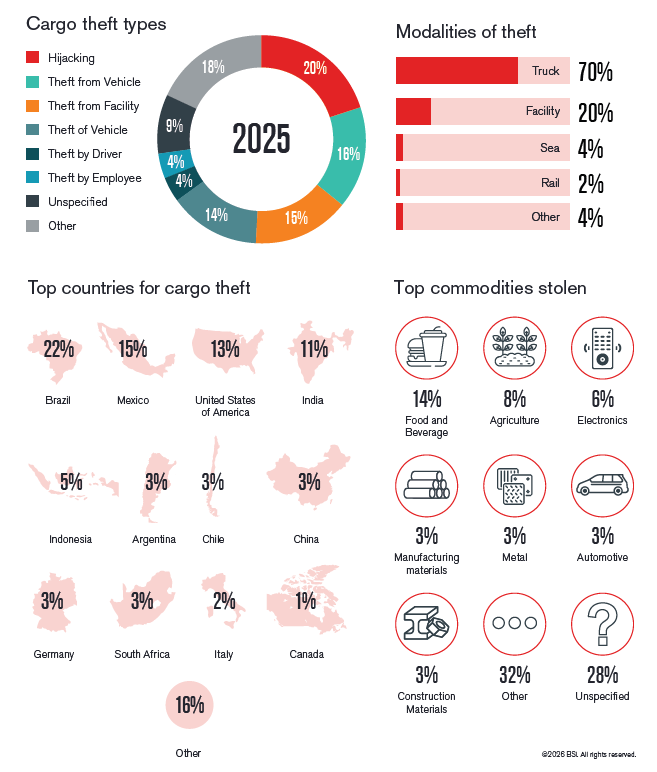
Hijacking, driven heavily by persistent activity in Mexico, remained the dominant theft type, followed by theft of a vehicle, theft from a vehicle, and fictitious pickups. In-transit environments, freight, and warehouse facilities, parking lots, and production sites continued to represent the most frequently targeted locations.
Trucks remained the primary target, accounting for about 70% of cargo theft across the globe. But even though trucks and facilities are still the primary targets, rail-related incidents — while accounting for just 2% of theft in the world — have increased in North America, rising from 6% in 2024 to 10% in 2025.
Specifically in the United States, cargo theft is concentrated in major logistics hubs, with California accounting for 31% of incidents and Texas 15%, driven by high freight volumes, port activity, and proximity to border crossings. Other high-risk states include Illinois (7%), Florida, Pennsylvania, and Tennessee (5%). Reflecting global trends, electronics, food and beverage products, footwear, pharmaceuticals, automotive parts, and apparel were the most commonly stolen goods in the U.S.
When it comes to rail threats, the report says that organized criminal groups, including networks tied to cartels operating out of Sinaloa, Mexico, carried out highly coordinated attacks on freight trains across rural areas of Arizona and California, sometimes sabotaging signal systems or cutting brake lines to stop trains and access cargo. The report warns that rail theft will remain a significant threat for logistics and the transportation industry in 2026.
Shifting types of criminal activity; load boards now a threat
There’s been a major shift from opportunistic theft to coordinated operations carried out by organized, and in some cases transnational, criminal networks. Throughout 2025, American law enforcement dismantled several large theft rings – including groups responsible for widespread tractor-trailer thefts and long-running diversion schemes across California.
These groups are using increasingly advanced tactics, including cyber-enabled fraud, identity impersonation, and double- and triple-brokering schemes to intercept freight. Once a fraudulent carrier takes possession of a shipment, the cargo can become untraceable within hours, the report reads.
At the same time, insider involvement remains a growing concern. While still relatively low in the U.S. at about 6%, it has doubled year over year.

Mexico continues to face some of the most volatile conditions, with cargo theft often involving violence. Criminal groups frequently rely on hijackings, driver kidnappings, and “narcobloqueos” — road blockades involving arson and looting — to disrupt freight movement and target shipments.
Digital freight platforms also pose a growing risk in the industry. While load boards now play a central role in the North American trucking ecosystem, with an estimated 75–80% of shipments moving through these platforms, they have also become a key entry point for fraud, the report says.
Read the full report here.

Have your say
This is a moderated forum. Comments will no longer be published unless they are accompanied by a first and last name and a verifiable email address. (Today's Trucking will not publish or share the email address.) Profane language and content deemed to be libelous, racist, or threatening in nature will not be published under any circumstances.