Manual processes, supplier disruptions stall dock automation progress: C3 report

Manual workflows, supplier disruptions and implementation challenges continue to slow modernization in dock and yard operations, even as most organizations explore automation, according to a new report from Montreal-based C3 Solutions.
The 2026 report, based on a survey of 149 supply chain professionals in senior roles, highlights a gap between the industry’s modernization efforts and its ability to execute. While most respondents in the survey, almost 73%, indicated they are exploring dock and yard automation, only 12.9% said they have a defined plan in place, down from 19.4% last year.
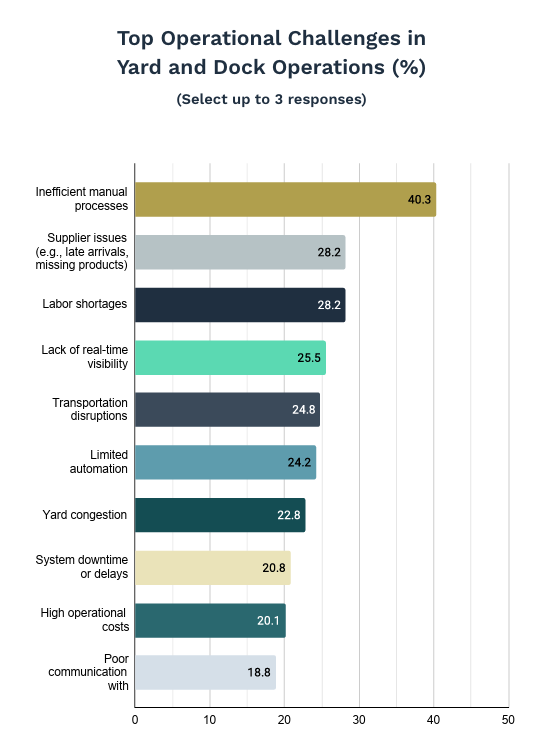
Inefficient manual processes remain the top operational challenge, cited by 40.3% of respondents — up from 35.9% in 2025. Many operations continue to rely on spreadsheets and human workarounds between systems.
That reliance is reflected in how companies manage disruption. According to the report, during peak periods, 51% of respondents said they rely on overtime, 50.3% on temporary labor, and 34.2% on technology.
Labor shortages, cited by 28.2% of respondents, have declined a bit from 32.4% a year earlier, but remain an issue. “A lower percentage does not necessarily mean labor is readily available; it may mean companies have normalized around chronic scarcity by leaning more heavily on overtime, temporary workers, and tighter scheduling discipline,” the report reads. “That keeps operations moving, but often at the cost of fatigue, training inconsistency, and higher unit costs.”
Supplier-related issues emerged among the top challenges as well, also cited by 28.2% of respondents.
Late arrivals, missing products and inbound inconsistency are increasingly disrupting schedules, forcing door changes and creating uncertainty around labour and equipment needs. Combined with transportation disruptions (24.8%), the findings suggest resilience is becoming just as important as efficiency, the report says.
But there are other operational issues that continue to affect performance — lack of real-time visibility was cited by 25.5% of respondents, limited automation by 24.2%, and yard congestion by 22.8%. Congestion declined from 34.1% in 2025.
And operational responses to disruption remain mostly reactive, the report found. For late carrier arrivals, companies most often rely on rescheduling and stakeholder communication (49%), contingency planning (37.6%), buffer time (35.6%), and manual adjustments (34.9%).
Fragmented tech implementation
The report also highlights fragmentation across supply chain technology implementation.
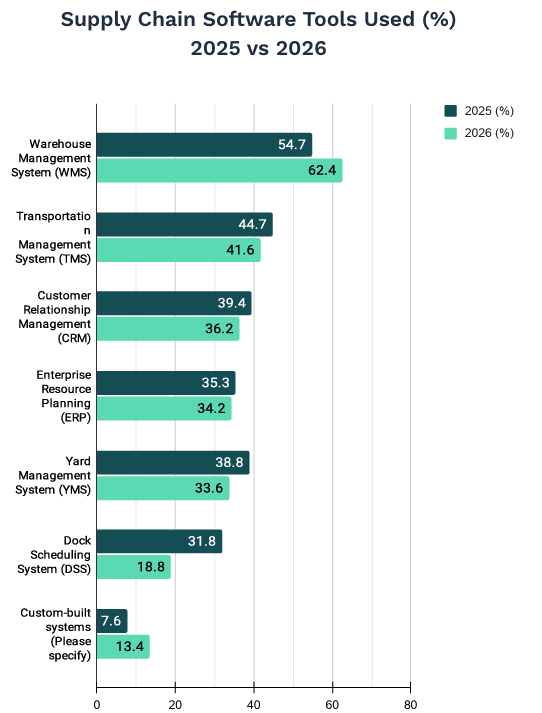
Most respondents use a combination of systems, such as warehouse management systems (62.4%) and transportation management systems (41.6%), yet many still experience limited automation, disconnected workflows, and weak disruption support.
Customer relationship management, enterprise resource planning, and yard management systems each sit in the low-to-mid 30% utilization range. Dock scheduling remains an issue, as only 18.8% of respondents use a dock scheduling system, even though 30.9% identify automated scheduling as a key feature they want in a dock and yard management solution.
Ease of use, implementation drive software satisfaction rate
Overall, the satisfaction rate with current systems is mixed. A combined 53.2% of respondents describe themselves as satisfied or very satisfied, while 35.5% are neutral and 11.3% are unsatisfied.
Implementation effectiveness has emerged as the top driver of satisfaction, cited by 55.7% of respondents, followed by usability (52.3%), key feature functionality (41.6%), and vendor support and responsiveness (35.6%).
When it comes to specific feature preferences,real-time yard visibility remains the most important feature, selected by 59.1% of respondents. However, the report found a shift towards more integrated systems, as demand for integration with existing systems rose to 43%, while scalability and customization nearly doubled to 23.5% from 12.4% in 2025.
Automated dock scheduling was cited by 30.9% of respondents, while reporting and analytics were named by 29.5%.
Vendor selection criteria
When it comes to selecting a vendor, yard managers said cost and affordability remain the leading vendor selection factor at 54.4%, followed by ability to customize solutions, range and quality of features, ease of integration, and vendor reputation.
When asked about the barriers to selection, the most common reasons were budget constraints and a mismatch between offerings and needs, as well as a lack of internal alignment.
Sustainability is now also a mainstream consideration in vendor selection, with 95.7% of respondents identifying it as important or extremely important.
Driver experience is also gaining importance, cited by 87.1% of respondents.
Read the full report here.

Have your say
This is a moderated forum. Comments will no longer be published unless they are accompanied by a first and last name and a verifiable email address. (Today's Trucking will not publish or share the email address.) Profane language and content deemed to be libelous, racist, or threatening in nature will not be published under any circumstances.