Readers speak out on pressures from rising fuel costs

Rising diesel prices continue to pressure fleets and owner-operators, with many struggling to recover costs through fuel surcharges, according to our latest Pulse Reader Survey.
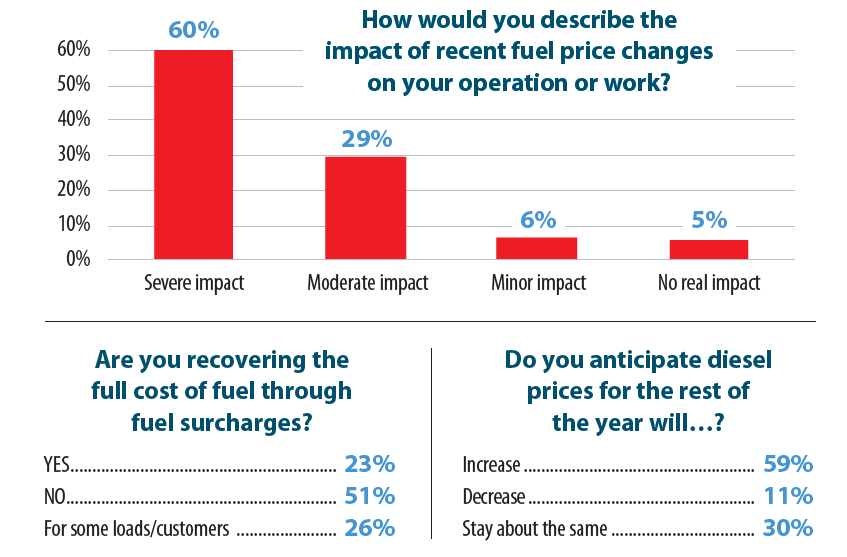
More than 60% of the 260 respondents described the impact of recent fuel price increases on their operations as severe, while another 29% described it as moderate. Just 11% said fuel costs had minimal or no real impact. Most identified their roles as fleet managers (47%) and owner operators (31%), with the rest of the surveyed readers working as company drivers, or in dispatch/operations and other sectors of the industry.
“Fuel costs have been climbing, pushing up expenses across our trucking operations and squeezing the bottom line,” one of the comments reads. “To fight that, we’ve started converting our fleet to natural gas trucks. They’re cleaner, more efficient, and help us keep costs in check while staying reliable for our customers.”
But the most popular strategy among the fleets is to recover costs through surcharge programs. Though 26% of respondents specifically referenced difficulties with that due to competitive pressures, contract limitations, or customer resistance.
More than half of respondents said they are not recovering the full cost of fuel through surcharges, while only 23% said they are fully recouping costs, and another 25% said they are recovering costs only partially.
Fuel costs vary by region
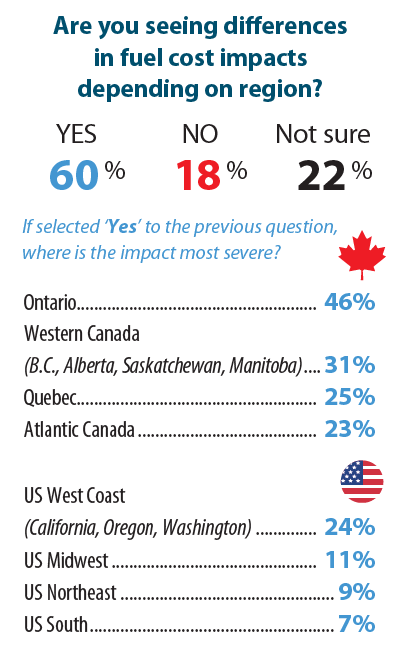
In Canada, Ontario was reported to face the most severe fuel-related impacts, identified by nearly 46% of respondents, followed by Western Canada at 31% and Quebec (25%). The U.S. West Coast — California, Oregon, Washington — was also highlighted as a major pressure point by 25% of respondents. One reader specifically commented they are actively trying to stay off the West Coast.
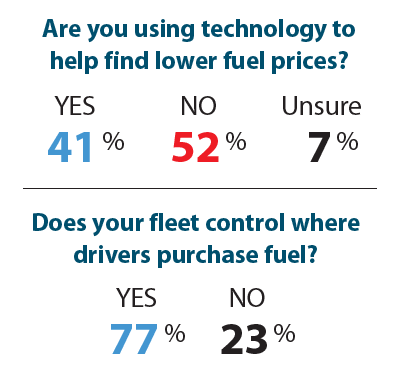
Nearly 80% of fleets are tightening fuel management policies and monitoring where drivers purchase their fuel.
“We have given our drivers a very simple economics lesson. They have been shown what one less mile per gallon costs the company,” one respondent wrote. “With the exception of our local trucks, we are buying absolutely no Ontario fuel.”
“We have implemented fuel surcharges where possible, but not all customers will accept them. Even with an FSC, our fuel costs have risen by 6%,” another fleet manager wrote. “We are directing drivers where to fuel in the area they are operating based on the fuel prices we analyze early in the day.”
Many other respondents described shrinking margins, worsening cash flow and mounting uncertainty around day-to-day operations.
“At the verge of going bankrupt,” one wrote.
Another said, “Added operating costs that were not anticipated at beginning of fiscal year [are] making budgeting interesting.”
“As a local municipality, although fuel costs are budgeted through increased taxation, the impacts are still felt. This is not only through fleet usage fuel costs, but associated increases in costs for additional goods and services delivered throughout all tasks and activities,” one reader wrote.
Owner-operators, small carriers struggle
Another one added, “As a smaller mobile repair business, fuel prices are absolutely ridiculous.”
One of the owner-operators said larger fleets are gaining an advantage through fuel purchasing power, “Being a one-truck owner-operator makes it very hard to compete with larger carriers that have the ability to lock in lower fuel prices, which allows them to offer lower freight rates.”
“There’s not a lot of profit anymore. A trip out to California and back [incurs a] fuel increase of almost $2,000,” another respondent wrote.
Another owner-operator added: “Thinking of selling truck. Challenges are getting bigger every day with all the cost and cheap rates. Can’t afford anymore.”
Broker-related frustrations also surfaced repeatedly in responses. “We are very fortunate to be able to charge a fuel surcharge on our shipments leaving Canada,” one fleet wrote. “For the shipments returning to Canada, we are at the mercy of freight brokers…the cost at this time has increased by 28% since the beginning of the war.”
Others confirmed that surcharges do not fully cover actual expenses.
“Although fuel surcharges are being charged to customers, as an owner-operator, we are not getting 100% of that. So our fuel expense is much higher since the war,” one respondent wrote.
But not all respondents reported losses tied to surcharge programs. “We are fortunate that our fuel surcharge, coupled with fleet discount, is more than covering our increased cost,” one fleet respondent wrote. “Current surcharge is 87 cents per mile, while fuel costs are around 63 cents.”
Others said rising fuel costs are beginning to affect freight volumes and driver hours.
A company driver wrote: “We’re just delivering smaller quantities of product than we normally would. My hours have been cut a little, as a result.”
Outside traditional freight operations, one driving school said fuel increases are especially difficult because tuition pricing is regulated.
“Increasing fuel prices are huge extra cost and a dead loss to our business,” the respondent wrote. “We are a driving school in Alberta with a government price cap on tuition fees and the inability to introduce a fuel surcharge due to the tuition structure.”
Overall, about a fifth of the respondents mentioned broader impacts on the supply chain, inflation, and the competitive landscape within the industry. Rising fuel prices are seen as contributing to higher costs for goods and services, reduced demand, layoffs, and increased pressure on smaller operators, with some expressing frustration about regulatory or political factors.
While some fleets said they are trying to adapt by optimizing routes, reducing idling and using technology to improve fuel efficiency, many respondents expressed concern about long-term sustainability if prices remain elevated.
One of the readers summed up the common sentiment: “The problem is, one does not know where it will go or where it will end. The evil clowns that run the White House are destroying the world economy. One would hope that the earth would open up and swallow them!”
Nearly 59% of respondents also expect diesel prices to increase further through the remainder of the year.

Have your say
This is a moderated forum. Comments will no longer be published unless they are accompanied by a first and last name and a verifiable email address. (Today's Trucking will not publish or share the email address.) Profane language and content deemed to be libelous, racist, or threatening in nature will not be published under any circumstances.