Resilience, data and leadership key for trucking executives: Panel

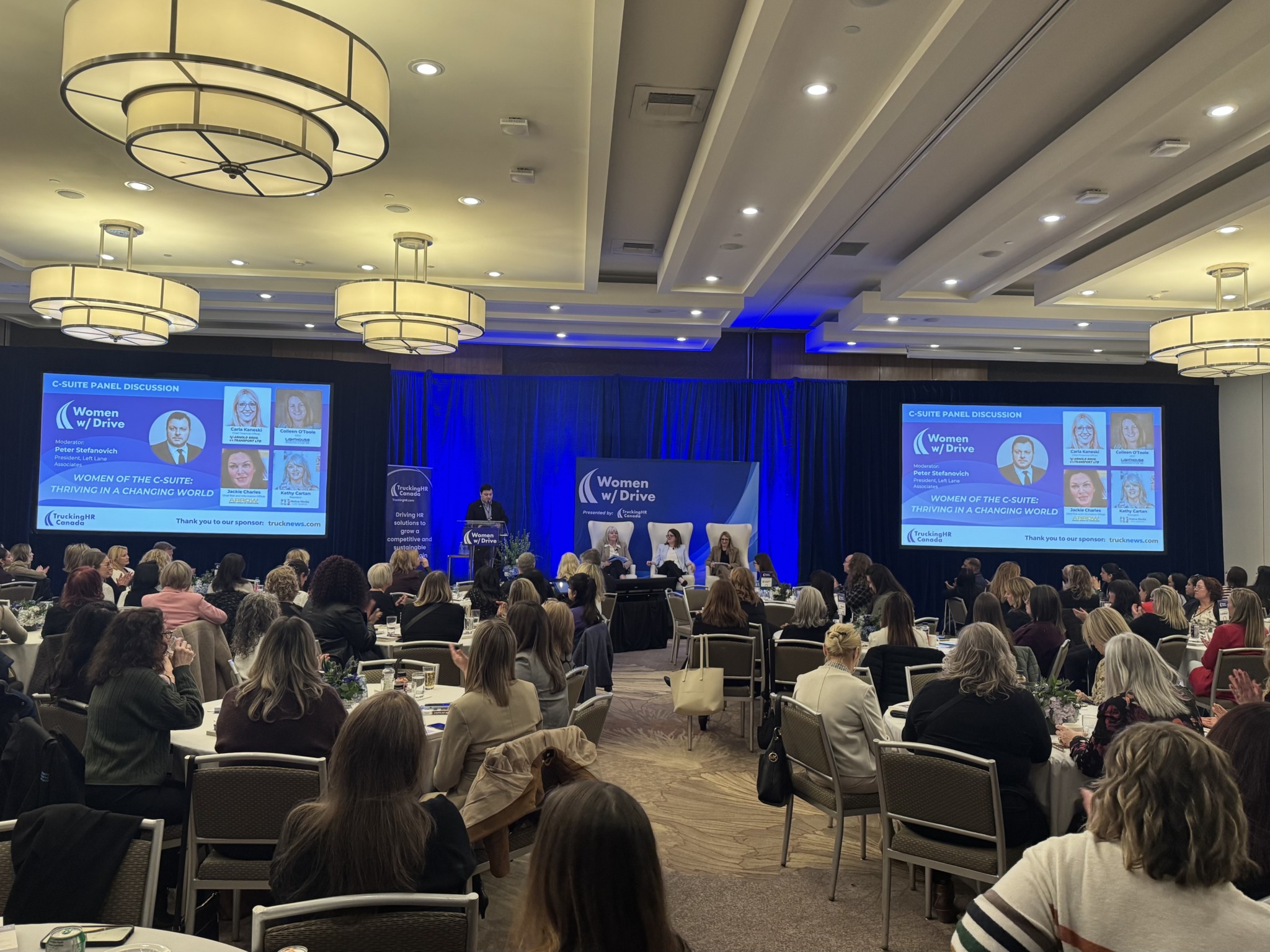
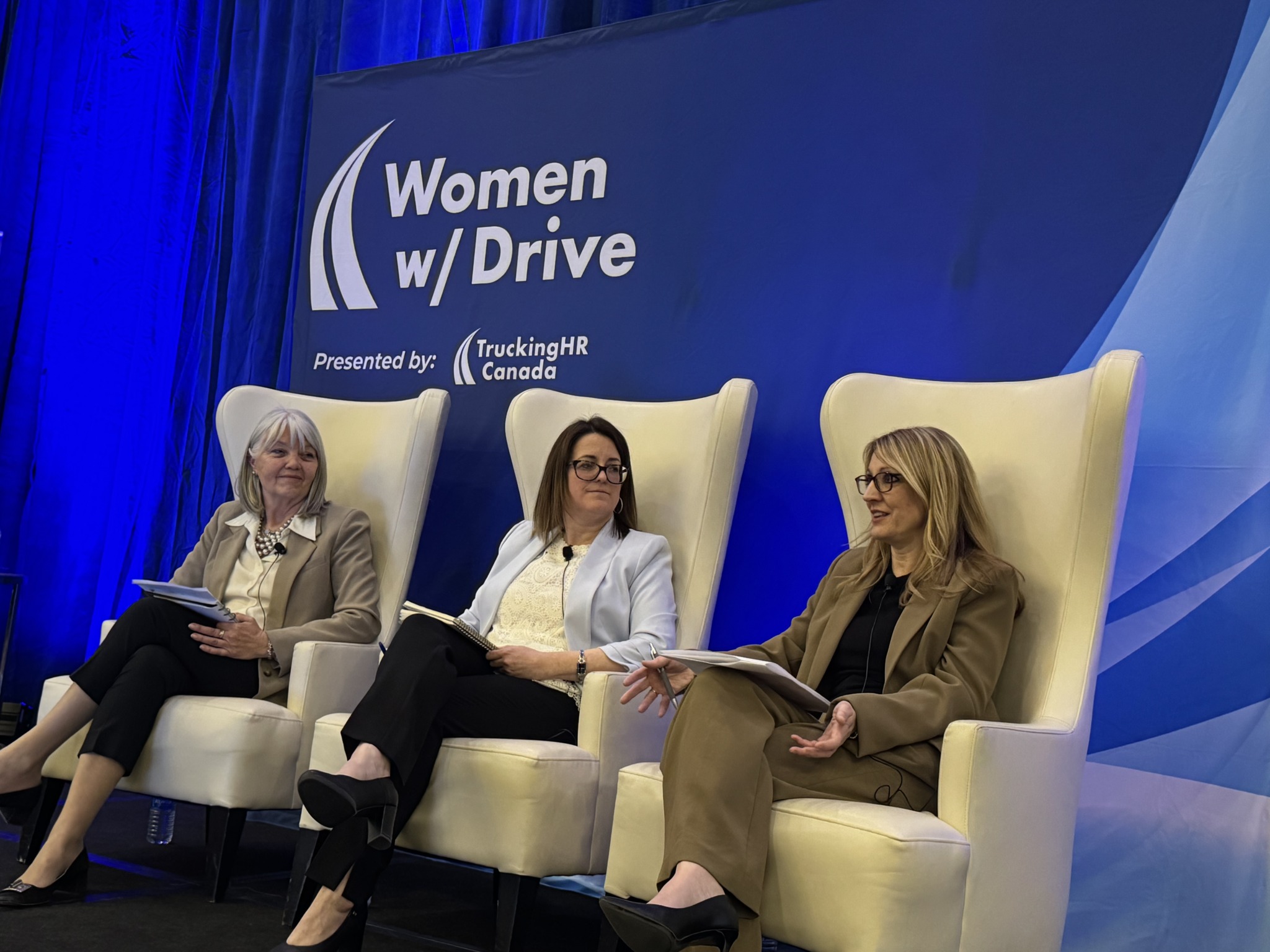
Today’s leaders say the way fleets respond to disruption is changing. Rather than reacting with top-down commands, successful leaders are now leaning on emotional intelligence, resilient decision-making, and data-driven insights to guide teams through volatile markets, panelists said during Trucking HR Canada’s Women with Drive leadership summit in Toronto on March 5.
They all agreed that a strong leadership presence becomes crucial for organizations when markets turn volatile and employees look to senior leaders for signals about the future.
Kathy Cartan, president of Motive Media, said that leaders should strive to remain accessible and empathetic when teams are dealing with uncertainty about workloads, customers, or job security.
Rather than retreating during slower business periods, leaders should also treat downturns as opportunities to reassess their operations and prepare for the next cycle of growth. That mindset has helped many trucking companies navigate past disruptions, from the 9/11 tragedy to the financial crisis of 2008 and the COVID-19 pandemic.
“I remind the team that every single time we came out of it stronger and better,” Cartan said. “It was hard, and we didn’t always see where you were going to end up. You just kept going. You were resilient. And you know, it’ll happen again. Now we’re relying on those same traits, and we’ll come out of it stronger, and we will come out of it better.”
That resilience is built through difficult decisions and the lessons learned when those decisions do not always work out as expected, said Colleen O’Toole, CEO of Lighthouse Transportation.
She shared an example from her early career involving a customer that represented roughly a third of the company’s business. Despite being a large account that always paid on time and was easy to work with in general, it was consistently unprofitable. It took O’Toole some time to finally make a tough decision to “break up” with the customer. The aftermath was tough for the next few years. But the long-term outcome proved it to be the right decision.
“What that did was allow us space to bring on new customers with better margins, and eventually the ship righted itself, and we moved on,” she said.
“I look at resilience as a bit like building muscle…the only way you’re going to be able to do it is if you do it,” O’Toole added. “It’s truly through failure that we learn how to be resilient. You learn how to go, ‘OK, that did not go well. Now, how do I do it better next time?”
Leadership styles, expectations evolve
Beyond navigating economic cycles, panelists also said leadership expectations in trucking have shifted significantly over the past two decades, moving away from the traditional command-and-control style toward a more collaborative and emotionally intelligent approach.
Carla Kaneski, chief financial officer at Arnold Bros Transport, said earlier in her career, leadership was often associated with authoritative figures who appeared to always have all the answers.
“I always thought that leaders were kind of these, I don’t know, larger-than-life, strong, loud, definitive decision makers. People that you didn’t question, they kind of almost weren’t approachable,” she recalled.
But as she progressed into leadership roles herself, that view has changed. “A good leader doesn’t know everything, and can say, ‘Hey, I don’t know this. I need to look into this… Leadership looks different today.”
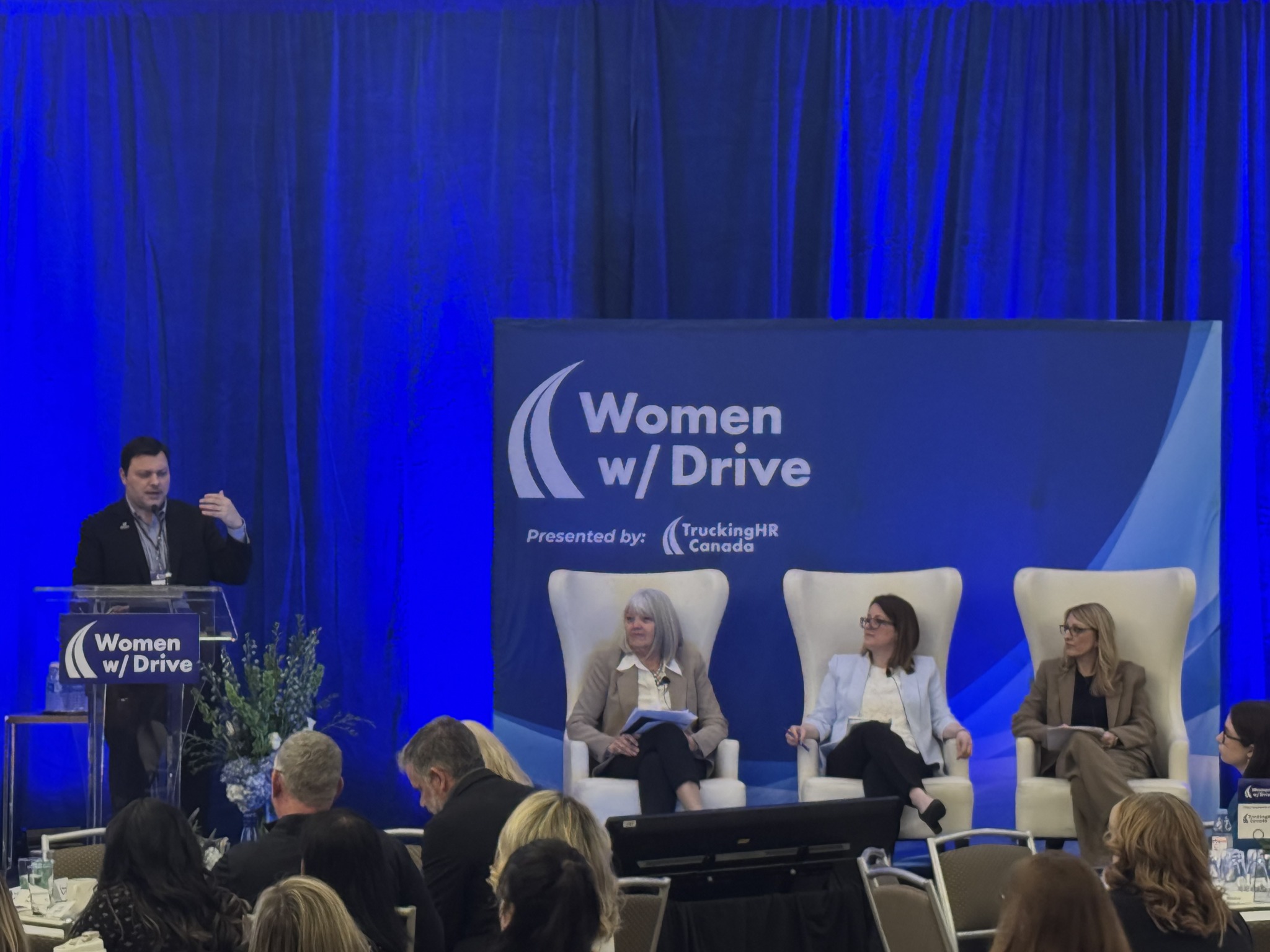
Kaneski added emotional intelligence — understanding both one’s own reactions and how others respond — has become one of the most important leadership skills for her. “Even before I started, that was commonplace for someone to come out of the ivory towers and yell at someone on the operations floor in front of everybody else, and thank goodness we’ve come so far that that doesn’t happen anymore,” she said.
Leadership journeys themselves can also be unexpected, she added, noting that many industry leaders did not initially set out to run companies. Kaneski herself is an example.
“I was just a girl that really liked math, and so, I didn’t aspire to be a leader or have all these people report to me. That was not really what I thought my life was going to be.”
She began her career in accounting and focused primarily on numbers before gradually moving into management roles. Encouragement from a mentor helped her recognize her leadership potential and step into a larger role, even when she did not feel fully prepared. “I had a CFO that really believed in me, and he was retiring, and he said, ‘You’re ready for this role.’ And I didn’t feel ready,” Kaneski said, highlighting the responsibility today’s leaders have in mentoring and sharing the next generation of trucking leaders.
For women in trucking, representation also plays an important role in shaping leadership ambitions. O’Toole, too, said she did not initially envision herself becoming a CEO while working in her family’s trucking business.
Building connections with other women leaders helped her redefine what leadership could look like. “When we went through the whole succession process, and we bought my dad out and I became CEO, I really had to look around to try and find a network of women that I could connect with,” she said.
O’Toole added that leadership is no longer defined strictly by title or position within an organization. She recalled moments during the COVID-19 pandemic when she found herself performing tasks far outside the traditional responsibilities of a CEO – like sanitizing bathrooms. “If you want to be a good leader, then you need to do more than what you’re required to do,” she said.
Motive’s Cartan said this mindset reflects a broader shift in how leadership is understood now across the board, adding that in an industry still influenced by older leadership norms, adaptability and people skills are becoming just as important as operational expertise.
“The uncertainty in the world is the only thing that is predictable,” Cartan said. “What always remains is the ability to work with people, and the ability to get along and to develop those relationships and work together.”
Technology reshapes decision-making
Panelists also said nowadays, in the modern trucking industry, leadership increasingly involves understanding and managing technology, data, and cyber risk.
Kaneski said fleets now have access to far more operational data than they did even a few years ago, allowing leaders to make better and more informed decisions.
“With AI and automation — we are seeing that in every facet of our business, from operations, HR [to] finance — the data that we have now available to us is better, faster. So, when you talk about decision making, we can make decisions faster with better data.”
She shares that Arnold Bros has invested heavily in artificial intelligence (AI) and automation, especially in fleet operations, where managers now rely on dashboards providing live information on driver performance and activity, and can make decisions on the fly. Meanwhile, predictive AI helps identify patterns associated with higher crash risk and allows for prompt driver-coaching.
But even with all its benefits, technology also introduces risks fleets weren’t exposed to before – especially in the cybersecurity space.
Though neither of the panelists had direct experience with cyberattacks, they definitely have seen an increased amount of phishing emails hitting their inboxes. O’Toole even says she often alerts other carriers if they are being impersonated by the scammers.
Kaneski added that companies – including Arnold Bros –are increasingly investing in employee training and testing to strengthen cyber awareness across their organizations.
“You’re only as safe as all the people that are working for you,” she said.

Have your say
This is a moderated forum. Comments will no longer be published unless they are accompanied by a first and last name and a verifiable email address. (Today's Trucking will not publish or share the email address.) Profane language and content deemed to be libelous, racist, or threatening in nature will not be published under any circumstances.