Fleet Advantage: Procurement paralysis, aging fleets reshape buying strategies

Fleet Advantage says heavy-duty fleets are facing growing uncertainty around equipment procurement while shifting maintenance strategies and aging assets reshape operational decision-making.
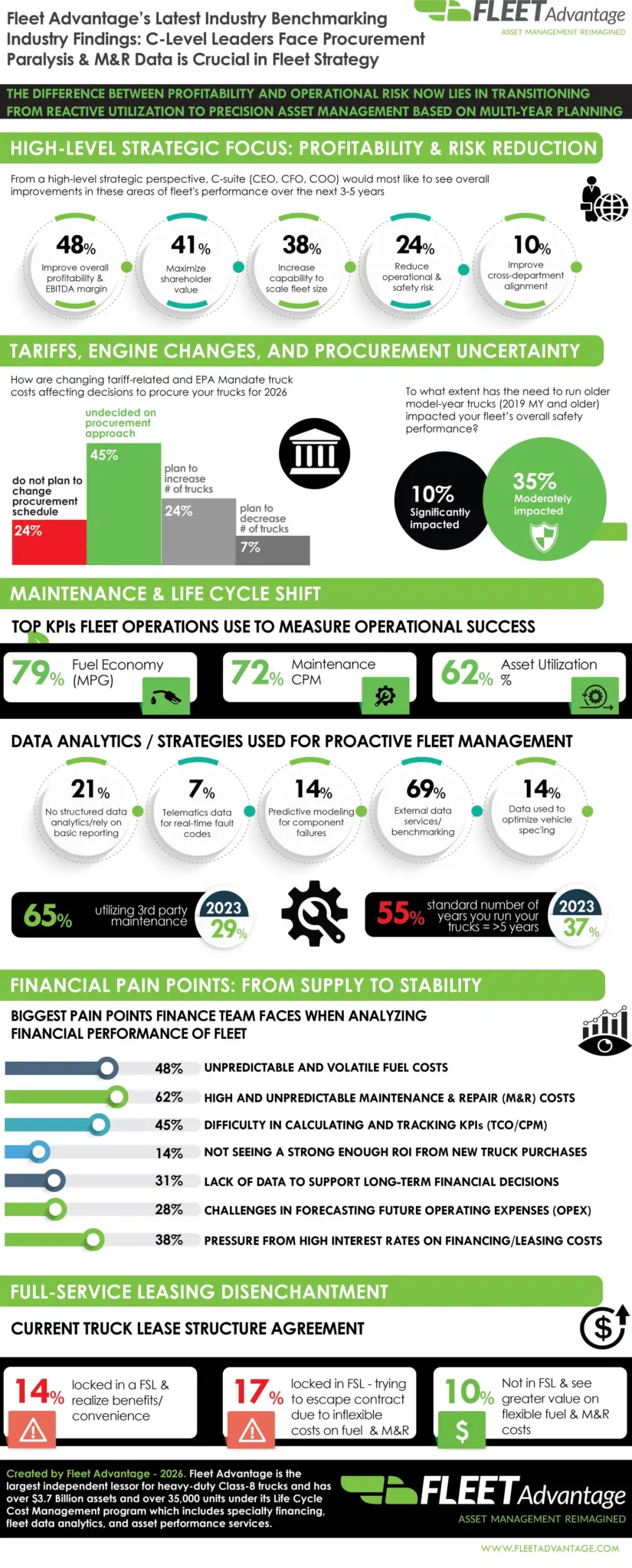
Findings from the company’s latest Transportation Industry Benchmark Survey, released at the Technology & Maintenance Council’s annual spring meeting, show 45% of fleet executives are now undecided on procurement strategies amid the combined pressures of new engine platforms, tariffs and rising costs.
That marks a significant shift from 2023, when more than half of respondents were simply monitoring regulatory developments.
At the same time, some fleets are moving in the opposite direction, with 24% planning to accelerate equipment purchases — up from just 7% two years ago — as they look to pre-buy ahead of anticipated cost increases.
“The heavy-duty transportation fleet industry has moved from a period of supply-chain recovery into a new era of deep financial and regulatory complexity,” said Matthew Wiedmeyer, senior director of asset performance and maintenance at Fleet Advantage. “With nearly half of the industry’s leadership currently paralyzed by uncertainty… the difference between profitability and operational risk now lies in the ability to transition from a reactive procurement strategy to precision asset management.”
Financial pressures are also intensifying. Nearly two-thirds (62%) of respondents cited unpredictable maintenance and repair costs as a top concern, while 45% said they struggle to accurately track total cost of ownership and cost per mile.
The survey also highlights a major shift in maintenance strategy. In 2023, about 70% of fleets handled maintenance in-house, but by 2025 that figure had dropped to 34.5%, with 65.5% now outsourcing to third-party providers.
That transition is being driven in part by dissatisfaction with full-service leasing. While adoption increased to 27% in 2025, 17% of respondents said they are actively trying to exit such agreements due to inflexible costs.
Fleet age is emerging as another growing concern. The share of fleets operating trucks older than five years has risen from 37% in 2023 to 55% in 2025, with 45% of respondents acknowledging that aging equipment is now impacting safety performance.
At the executive level, profitability remains the top priority, cited by 48% of respondents, followed by scaling organizational capabilities (38%) and reducing operational risk (24%).
The findings point to an industry increasingly reliant on data to navigate rising costs and complexity, with maintenance cost per mile now ranked among the most critical performance metrics.
Fleet Advantage said fleets that shift toward data-driven, multi-year asset planning will be better positioned to manage risk and protect margins in the years ahead.

Have your say
This is a moderated forum. Comments will no longer be published unless they are accompanied by a first and last name and a verifiable email address. (Today's Trucking will not publish or share the email address.) Profane language and content deemed to be libelous, racist, or threatening in nature will not be published under any circumstances.