We need to adjust our thinking about air brakes

Brake adjustment might not be the greatest crisis of our time, but with all the talk of Red Seal certification, mandatory entry-level training (MELT) upgrades and driver competency generally, now seems like good time to put this on the table.
We’ve had formalized air brake training in Canada for more than 20 years, but do we really need to know about anti-compounding valves and how compressor governors work? Should drivers know how variable geometry turbochargers work? Or how the shift algorithms are programmed into automated transmissions?
Drivers absolutely need to know how to determine if their brake system is working properly. Those checks and inspection procedures are part of the endorsement, but what about brake adjustment?
For some bizarre reason, drivers are held accountable for brake adjustment, yet they have no influence over how the systems are maintained. I mean, brake systems with automatic brake adjusters should never be “adjusted” except at installation and for diagnostic purposes, and even then, only by trained personnel.
Contradictions regarding drivers’ interaction with their brakes abound across Canada. Air brake manuals from various provinces offer conflicting guidance on brake adjustment; some even recommend practices that are expressly discouraged by brake manufacturers.
Provincial inconsistencies
Let’s begin with Ontario. That province basically prohibits drivers from touching their brakes except to conduct a mark-and-measure inspection. The air brake manual says drivers who obtain an air brake adjustment certificate may adjust brakes fitted with manual slack adjusters. It also notes only certified technicians are permitted to adjust automatic slack adjusters.
In addition to the mark-and-measure method, B.C.’s commercial driver manual also describes the pry method as an option for checking adjustment. Free stroke of between half and three-quarters of an inch (12-20 mm) is acceptable. Ontario specifically eschews this method as inaccurate.
If brakes are found to be out of adjustment, various provinces offer different solutions.
The Nova Scotia, B.C. and other air brake manuals actually offer instruction on how to adjust manual slack adjusters. In Ontario, you need a certificate to do this.
When it comes to automatic slack adjusters, air brake manuals from Saskatchewan, New Brunswick and others say, “two to four brake applications of 80–100 psi per day will keep the brakes properly adjusted.”
New Brunswick and Saskatchewan suggest, “If [brakes] are badly out of adjustment it may take up to 12 brake applications of 100 psi (690 kPa) to adjust them.”
But there’s a caveat: all the manuals that I researched noted automatic slack adjusters that are stroking beyond their adjustment limit are defective and must be repaired by a certified technician, or words to that effect.
If they are defective, why are drivers permitted to bring them back into adjustment with a procedure that goes against the manufacturers’ recommendations?
“If an automatic slack adjuster strokes beyond the maximum allowed, this usually indicates that there are other brake problems that need to be repaired by a qualified brake service mechanic,” notes the B.C. manual. “Manual adjustment [of an automatic adjuster] may temporarily shorten the stroke, but the automatic slack will soon re-set to its designed stroke.”
Most of the manuals also mention the possibility of damaging the internal mechanisms inside the adjuster through repeated manual adjustments.
B.C. also debunks a few brake-checking misconceptions, such as observing the air reservoir pressure drop when making a full-pressure application.
The thinking is, an abnormally large pressure drop indicates a possible out-of-adjustment condition. The pressure drop will vary from truck to truck depending on the size of the brake chambers and the number of axles. And when all is said and done, how do you tell which brake is out of adjustment?
Another is observing the angle between center of the slack adjuster arm and the push rod. Ideally, that angle should be 90 degrees or greater. But for various reasons, some slack adjuster arms and push rods may be longer or shorter than others. This will affect the push rod/slack adjuster angle, rendering this inspection method less than consistently reliable.
All the manuals describe the mark-and-measure procedure as well. But here’s the thing: while the regulations require drivers to inspect every brake on every vehicle they operate every day, that hardly ever happens. I have never met a single driver, ever, who does this.
We have a brake inspection procedure that nobody ever follows, and a couple of methods that might be a little easier on the driver but are not recommended. We are also offered procedures for resetting adjustment that aren’t endorsed by the brake makers, and others that may damage the equipment.
And at the end of the day, if an over-stroking brake is found during a roadside inspection, the driver gets the ticket. Why does the driver get the ticket when over-stroking brakes are actually a failing of the maintenance department?
Out-of-adjustment is a mechanical defect
First of all, the Commercial Vehicle Safety Alliance’s (CVSA’s) North American Standard Out-of-Service Criteria handbook defines a brake beyond its adjustment limits as a “defective brake.”
Further, with automatic brake adjusters, if the brake is over-stroking, the adjuster is telling you one of two things, either: a) the adjuster is defective; or b), there’s some other problem with the foundation brake — possibly worn worn S-cam bushings, rollers, etc. There are several possible suspects.
When you see an over-stroke condition with automatic adjusters, it’s almost always a symptom of something else wrong in the system. Even if the driver or someone else is able to wrench the adjuster back into compliance, it will likely be over-stroking again after just a few brake applications. That’s because the underlying problem hasn’t been addressed.
And here’s where it gets ridiculous. If an inspector finds 20% or more of the truck’s brakes out of adjustment, the trucks will be placed out of service and the driver will be ticketed for failing to note the defect on the daily inspection report.
But if the driver can somehow cause the brake to conform with the stroke requirements, upon reinspection, the inspector will allow the truck to continue its journey.
The truck is back on the road with exactly the same problem as before, the brakes will be out of adjustment again in a short time, and the driver is a few hundred dollars lighter. Who are we fooling here?
For all the fuss about brake adjustment, the system allows trucks to operate with defective brakes while holding drivers responsible for a problem that’s truly outside their sphere of influence.
Re-adjustment is not a solution
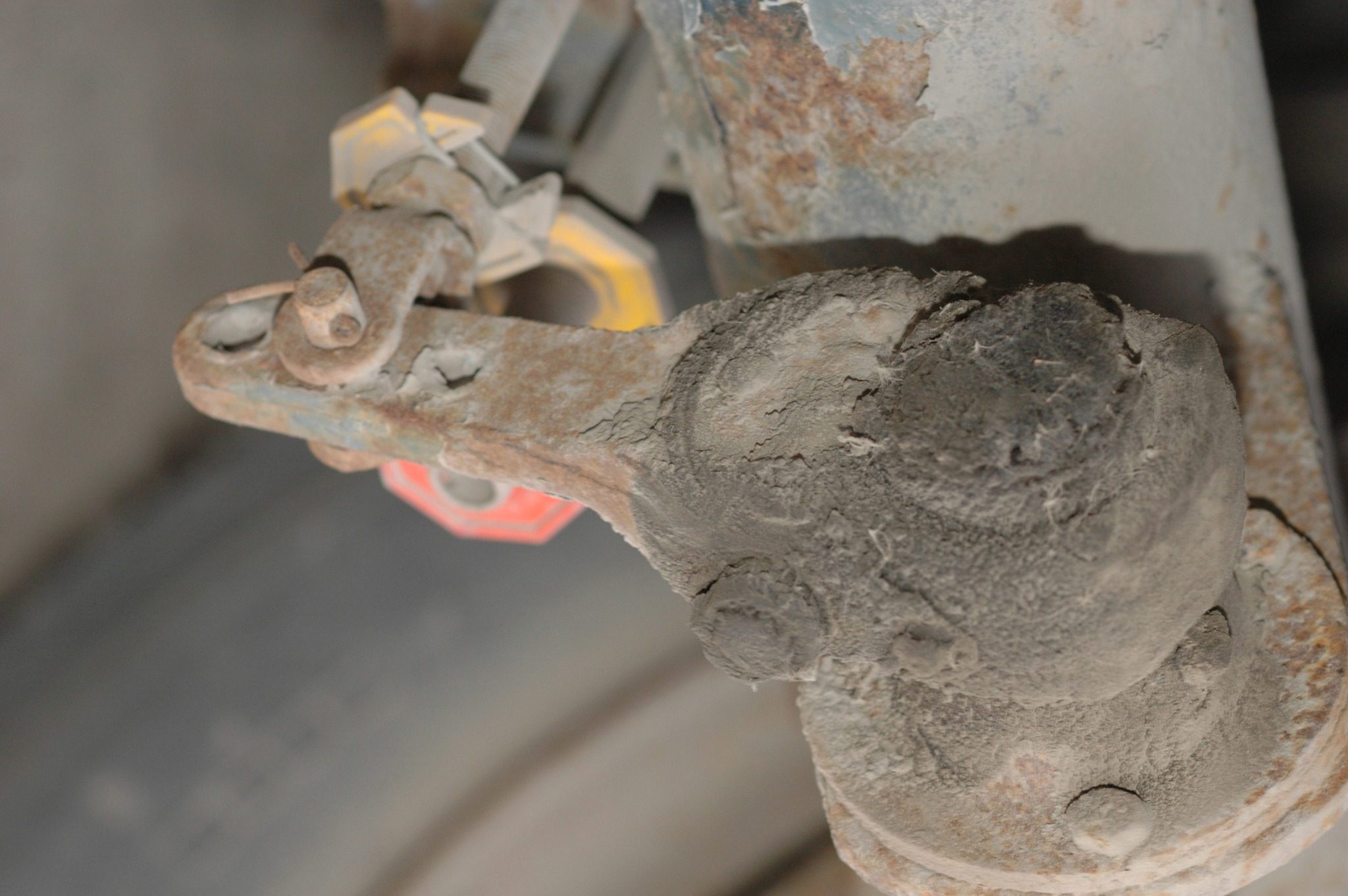
Frequent manual adjustment of auto-adjusting slacks can wear and damage the internal mechanism. This was proven by a U.S. National Transportation Safety Board investigation of a fatal crash involving an out-of-control dump truck in Glen Rock, Penn., in 2003.
That happened more than 20 years ago, and the industry is still manually adjusting automatic slack adjusters.
Manufacturer guidance is unambiguous on this. Meritor’s Maintenance Manual MM4 states that automatic slack adjusters must not be manually adjusted to correct excessive stroke, as this indicates a defect in the foundation brake. Haldex service literature similarly limits manual adjustment to set-up and diagnostics, instructing technicians to find and repair the root cause.
Says Bendix in its Knowledge Dock section on slack adjuster maintenance, “Do not manually adjust the adjuster. There are many factors that can cause an automatic slack adjuster to overstroke, but none of these will be remedied with a manual readjustment. Instead, investigate why the brake is over the stroke limit.”
As well, the the long-standing belief that a few hard brake applications will “ratchet” an automatic slack adjuster back into spec’ isn’t supported by any major brake manufacturer. Guidance from Bendix, Meritor and Haldex all make the same point: if a brake is out of adjustment, the cause is mechanical, and neither manual adjustment nor repeated brake applications will correct it.
Best intentions?
Let’s look at what probably happens when a driver reports an out-of-adjustment condition. Some fleets are likely to simply re-adjust the brake to bring it into compliance. But following OEM guidance, the problem should become a troubleshooting and brake repair event.
Considering the time and labor involved in a thorough brake troubleshooting and repair process, it’s a good thing drivers hardly ever do proper brake inspections.
We need to address this foolishness — the inconsistency and the misapplied responsibility. We need an alternative to the never done mark-and-measure brake inspection.
And we need some middle ground during brake inspections where “slightly” maladjusted brakes are given a warning that requires follow up within a reasonable time, while trucks with badly adjusted or flat-out defective brakes are sidelined until they are repaired, not just readjusted.
Overhaul the air brake endorsement
First, we need to get every driver on the same page by eliminating the discrepancies in various provincial air brake manuals.
Next, we need to dispel the myth that simply readjusting an over-stroking brake adjuster solves the problem. Lastly, we need to push the out-of-adjustment problem from the driver back to the shop — to the folks who are responsible for the mechanical condition of the vehicle.
Drivers need to be able to determine if their brake systems are functioning properly, and they need to know how to recognize when something isn’t working as it should — such as brakes that pull to the right or left, brakes that are slow to release, or why brakes “fail” when they are overheated.
And we need a reliable method for determining when brakes are out of adjustment with a simple visual inspection.
We are fooling ourselves if we think drivers mark-and-measure their brakes every morning. They don’t. So why, after all these years, are we still pretending they do?
Have your say
This is a moderated forum. Comments will no longer be published unless they are accompanied by a first and last name and a verifiable email address. (Today's Trucking will not publish or share the email address.) Profane language and content deemed to be libelous, racist, or threatening in nature will not be published under any circumstances.
Excellent article Jim, once again drivers accountable for everything and authorized and trained on nothing.
You are not getting any argument from me, Jim. Who wants to begin their day crawling around in the dirt and mud to measure a brake stroke? Perhaps what we need is for there to be a federally recognized system that manually records the brake pushrod stroke. There are several on the market, but they are not mandatory.
As for drivers not being allowed to adjust the slack adjuster, that’s ridiculous. It’s a simple thing to do, but it takes training and understanding. When I started driving almost every driver carried a 9/16th inch wrench with him. Then they came out with these Automatic Slack Adjusters. Do you know what the difference was? About $50!! They were not reliable.
I took my truck into a shop in Kitchener one day to get the oil changed. The shop I regularly went to in Waterloo was too busy. During the process there was this terrible noise. I asked the mechanic what was going on. He replied by telling me that he was just adjusting my brakes! The mechanic did not know how to properly adjust Automatic Slack Adjusters!! The result was me having to replace all my slack adjusters a few months later! My regular guy, when I told him what happened said, “Oh, you went to “Just Slacks” to get your oil changed? Never again!!
Good article Jim.
Lets just go back to the old days when we didnt have auto slacks and you just set them up every pretrip.
That way there are no excuses, no assuming, no hoping.
Great article, Jim !
Excellent article Jim! As a now retired driver (47 years) and former Air Brakes instructor/examiner in BC for Andy Roberts @ MTI in Castlegar, I agree the entire thinking and instruction on air brakes needs to be a: nationalised to safe standards. Not province to province although they have final say, b: current to today’s equipment standards offered by manufacturers and c: dragged kicking & screaming into the 21st century. Many things talked about in an Air Brakes certification course were very technical and “nice to know” instead of all “NEED to know” on current equipment. Was some information used to help fill the requirement of a 20 hr course? (BC). Plus on the practical test, proving how to correctly adjust a manual slack adjuster was a pass or fail criteria. Younger drivers I’ve come across had VERY divergent knowledge of what was lawfully required and expected of them. The one thing they mostly missed was: “prove” you have safe, properly functioning brakes, then drive as though you don’t have any for the rest of your shift.
Hi Jim:
I agree with most of your comments, but do not agree with your recommendation about not completing several brake applications at 80-100 psi to assist with automatic adjustment. In fact, I always promoted 100. Any adjuster that is performing correctly and near it’s readjustment limit should automatically adjust and reduce the pushrod travel. The brake system is designed to handle applications at this pressure, so mechanical damage should not occur. However, visual inspection is always required afterward. Keep in mind that several heavy brake applications may help to free up a seized clevis pin or s-cam roller and even identify a brake that is ready to cam-over (Yes, you can’t see everything with backing plates in place.).
Most professional drivers never apply anywhere near 80 psi pressure under normal brake applications, but during a roadside inspection, the driver is required to complete a full brake application at 90-100 psi. That usually results in the driver mashing their foot on the foot valve, causing deflection of many of the brake components and adding to pushrod travel.
I always thought that a separate valve should be available in the cab to apply the service brakes at 90-100 psi and that would allow a driver to exit the cab and visually inspect. Not some ridiculous piece of wood or other metal device that applied pressure to the foot-valve when wedged against the seat. If you want a driver to inspect safely, give them the necessary tools and that includes physical tools, training and knowledge.
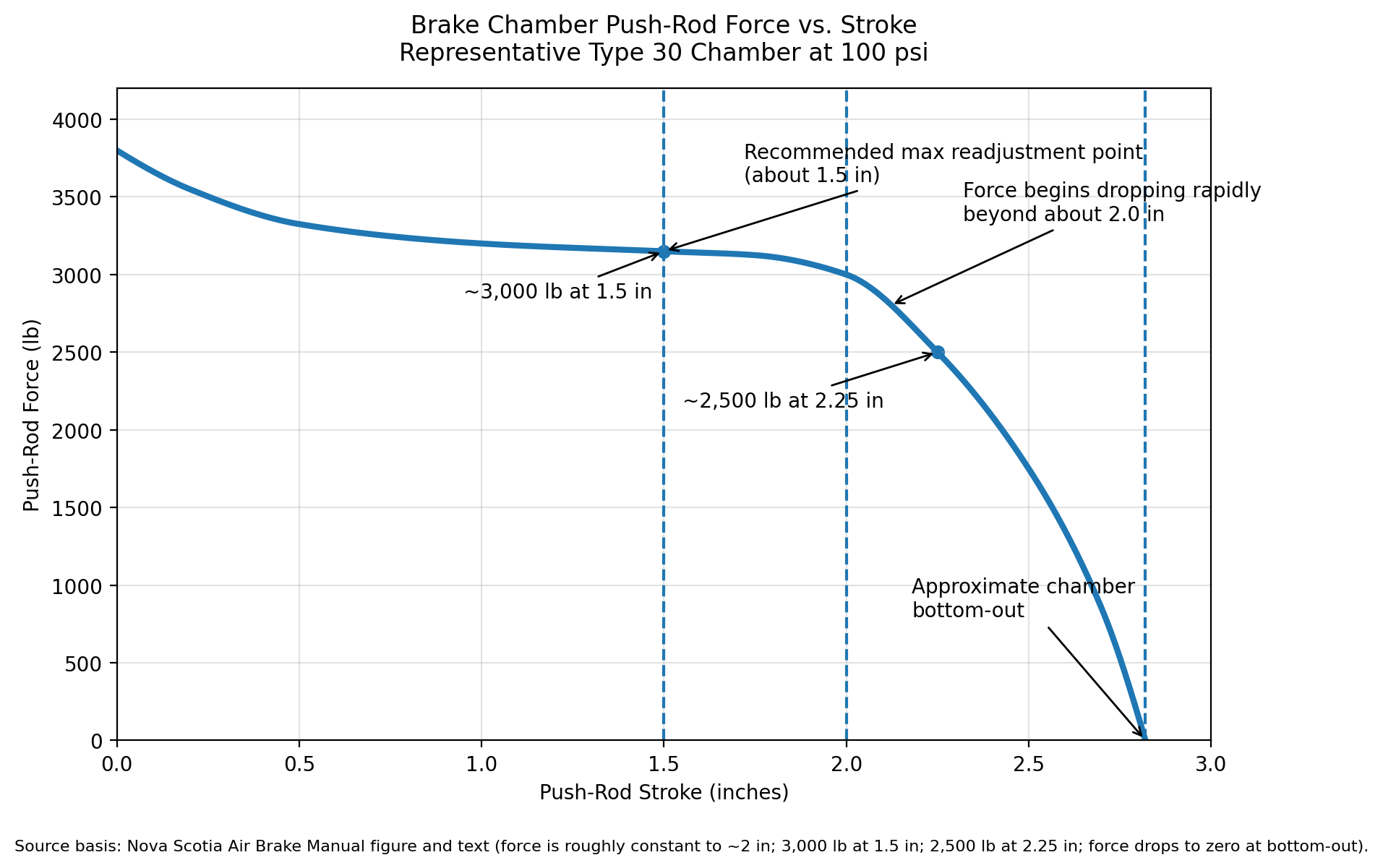
I worked hand in hand with our maintenance department and always provided input on vehicle purchases. At one point, we had trailers that always exceeded their maximum push rod travel of 2”. The problem was never “auto-slacks”, but foundation brake design. Long S-cams, excessive bushing clearances and design (even when new) … added up to another 1/8 inch travel. They never exceeded 2 1/8, but that was their readjustment sweet spot. In order to address the issue long term, all future vehicles were equipped with long stroke chambers and that problem went away. Greaseable clevis pins improved brake reliability and reduced unwanted brake drag and the application of a simple zip tie on the push rod at the brake chamber face (when the brakes were released), provided a simple visual system. Not perfect, not exact, but much better than nothing! Most drivers can generally tell the difference between 2 and 2 ½ inches and you tell them nothing over 2.
One area I fully agree with you is that auto slacks should NEVER be manually adjusted. Manually adjusting the auto-slack hides the problem from maintenance. Many drivers will not ensure that the maintenance department is made aware of the problem post adjustment and techs cannot address a problem if it isn’t present at the time of inspection/service. Drivers must leave them alone and techs must correct the problem!
So, I have to tell you that I was one of those drivers that did always inspect their brakes. Not well initially, because I lacked the knowledge of how they worked. Many tractors had no front brakes and everything had manual slacks when I entered the industry. You knew you had to adjust trailer brakes when you had to chase the trailer to couple or you could drive from Toronto to Montreal with the spike pulled (I’m exaggerating, a little!). Brake free-play was a tool I initially used. This wasn’t from training, this was self-preservation. Usually ½ inch of free play meant you usually had brakes and they wouldn’t drag. It also disclosed other things, like cracked or missing brake drums and/or shoes, bad valves, broken spring brakes and a host of other problems. As time went on, I gathered more knowledge and was certified to complete the adjustment of manual slacks and knew the importance of leaving auto-slacks alone (That was self taught. Try to find a detent ball and spring in a truck stop parking lot). And original auto-slacks were not without their faults. Getting to the point on Pie-IX in Montreal where you could no longer drag the trailer because the drums had expanded and the slacks kept adjusting apparently was not foreseen. So, for many years before I hung up the keys, I never left the yard without a thorough visual inspection.
I agree that a driver shouldn’t carry all of the responsibility on their shoulders, but in the real world, they have to do their part. Even if it is just to ensure their own safety. Inspect and report! Then it’s the company’s responsibility to take it seriously and have the persons and systems in place to properly correct and minimize the problem. The driver may not catch every defect, but if every driver does their part and they better understand their equipment, all highway users including themselves, will be safer.
Great article, Jim!! You are so right! We have a BIG problem with air brakes. I think the biggest flaw is that mechanics are told they can repeatedly, manually adjust an automatic slack adjuster! Another HUGE flaw in the system is the MTO changing the testing process for Air Brake endorsed drivers in Ontario. This new “air brake module” that we have to do online is a real joke. There’s no testing anymore to ensure that the driver understands how air brakes work and how to troubleshoot air brake problems. I could give my buddy 10 bucks, and he can do the module for me on a computer at home while he’s watching a movie on his laptop! What the heck was the Gov’t thinking?? NO TESTING REQUIRED now for AZ drivers on the AZ/DZ written test. Being tested via a written test forced the drivers to study for the written test portion for Air Brakes. Now you just have to watch a cartoon, and you’re good to go. Unreal. Thanks for bringing this crucial subject to light!!!!
The fleet I worked for had stroke indicators on about 50% of it’s trailers.
Now to be certain, there are a few problems. First off, most new/newer trucks do not have trailer brake spikes that cannot be applied and stay applied. Most are set up to spring back into the off position. On older (say classic) trucks, one could pull the spike down, it would stay down/applied, and go look at the travel, and as well LISTEN for leaks.
The other thing I have noticed, is that with even the units that had stroke indicators, there were numerous times they were damaged or covered in so much grime, it was impossible to see. Now to be certain, a gloved hand can scrape off the crud, but the presence of such build-up, shows me, that nobody is looking.
I always checked the stroke, even if only visually when there were no indicators, as well as checking for leaks.
And to those who say they can’t be bothered, or don’t want to crawl around under the trailer, I say, call me when your brakes fail, or something falls off the bogie of the trailer, and someone is killed. I’ll come visit you in jail during your 2 to 5 years, and tell you that 2 minutes of extra work, and the occasional wet knee, is really worth it.
I have installed many auto slacks on many makes and have installed many makes. Once installed and the correct angles are meet, most makers suggest a pressure of 89 to 90 psi be applied to make certain the adjustor is operating normally and brake adjustment is correct. Some makers have told me that normal braking pressures will do the job. However, if the truck is being driven correctly, normal braking pressure should be in the 15 to 20 psi range. Far too many truck drivers today do not speak English and they cannot read English. They also are not being the “Z” air brake correctly and most take it online using their homeland language. Since these guys do not read English they do not do the pre-trip inspection as the inspection is in English so the just forget it and on the road they go. My name is Tom MacKay and I worked with Mr. Green at the MTO in the middle 80’s to get the “Z” program going. I was the only instructor at that time who taught all the “Z” instructors in 1984 through 1987. The “z” today is a joke. Driver training in Canada from Ontario to B.C. is using far too many languages to train these people.

Mr. Parks you are so right most drivers don’t even carry tools so how can you adjust things out of your control.
We can be ticketed for adjusting brakes in some provinces but if you are not near a repair facility how do get them fixed.
and most new drivers wouldn’t have a clue how to even adjust them even if they are mechanical.
I started when we only had manual slack adjusters but now not a chance would i crawl under a truck or trailer and even attempt this procedure.
With disk brakes this is not even an issue as there are no adjustments why companies continue to use drum brakes is totally beyond my comprehension. mostly i believe its cause they believe its cost but if you are not put out of service its not even an issue cost wise.