Grocery delivery proves strong early case for electric Class 8 trucks: PIT study

Battery-electric Class 8 trucks demonstrated strong suitability for return-to-base grocery distribution during a year-long commercial deployment in the Montreal region, according to results from Transport Canada’s Zero-Emission Trucking Program.
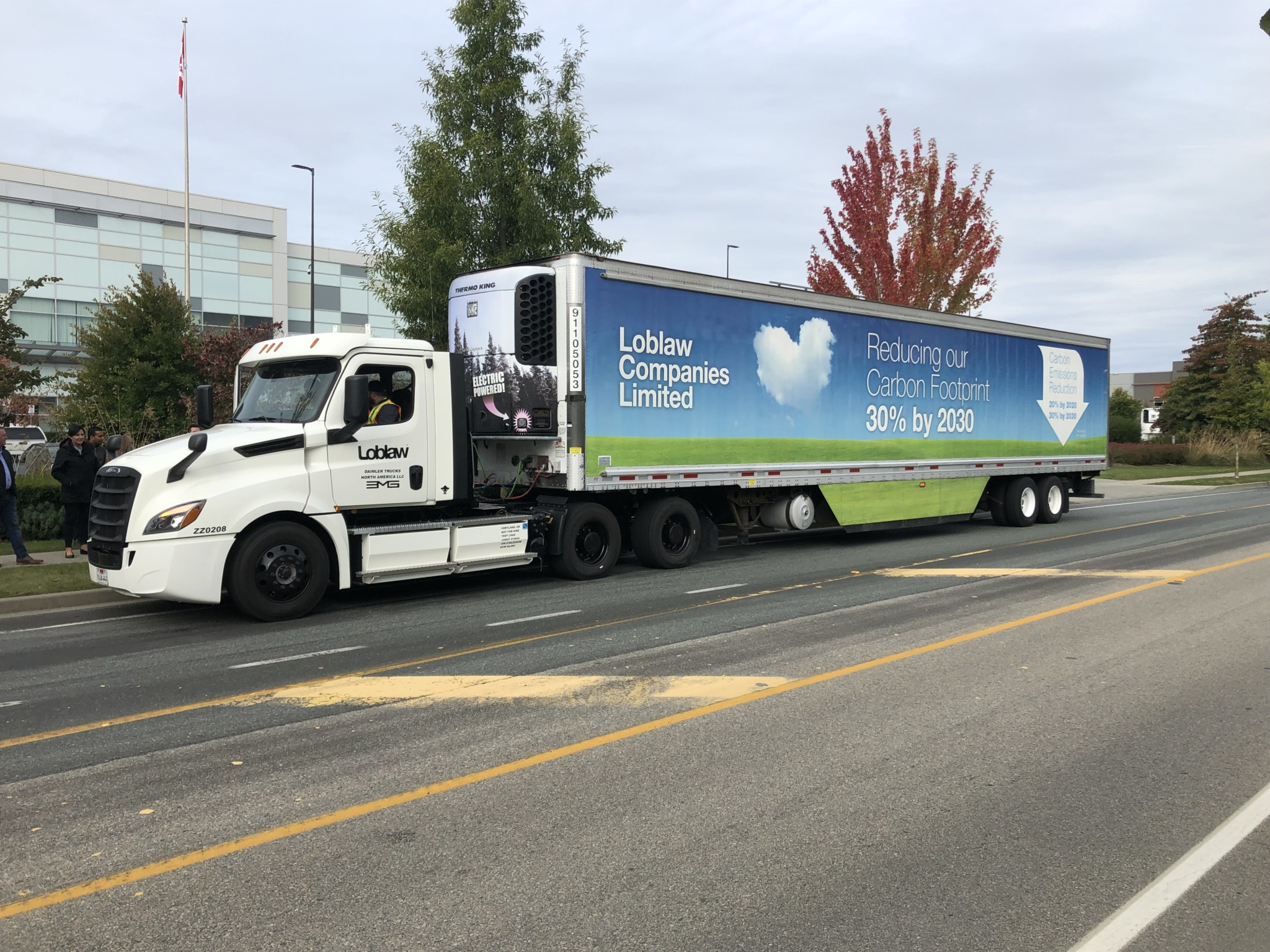
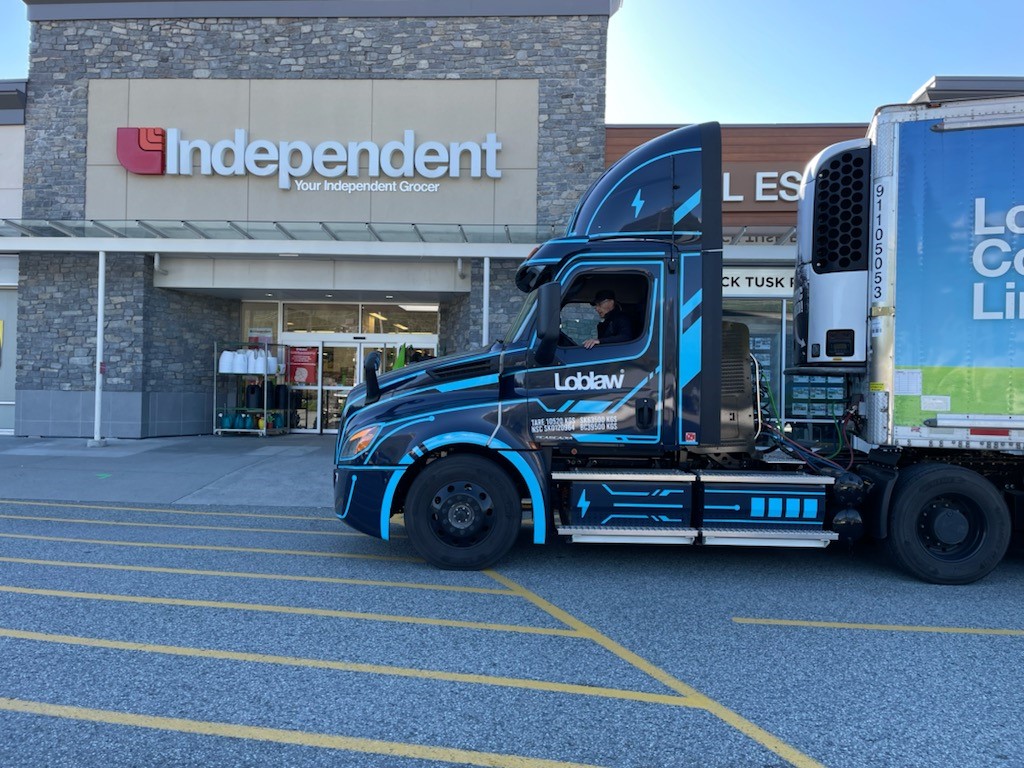
One of the participating fleets, Loblaw Companies Ltd., operated battery-electric tractors in real-world food retail distribution, providing one of Canada’s clearest looks yet at how electric heavy trucks perform in high-frequency urban delivery operations.
The testing program, led by FPInnovations’ PIT Group, monitored five battery-electric trucks operating more than 200,000 km (124,274 miles) in commercial service over a 12-month period, gathering detailed operational, energy and driver performance data under Canadian conditions.
Urban routes favor electrification
Loblaw’s operations proved particularly well aligned with electric truck capabilities. Daily routes typically ranged between 150 and 200 km (93-124 miles) — comfortably within operational limits despite driver caution around available range and charging access.
Researchers found battery-electric trucks consumed more than 60% less energy and produced at least 80% fewer greenhouse-gas emissions compared to diesel equivalents performing similar work. Those findings aligned with those discovered while also monitoring foodservice fleet Martin Brower.
The study concluded the vehicles “proved to be a viable option for return-to-base freight delivery under the test conditions,” highlighting grocery distribution as one of the most compatible early applications for heavy-duty electrification.
Because trucks returned to the same terminal each day, predictable overnight charging minimized operational disruption and simplified fleet planning — a key advantage over longhaul applications.
Researchers also observed that consistent routing allowed fleets to better anticipate energy consumption and charging needs compared to more variable freight operations.
Drivers quickly embrace electric trucks
Driver acceptance emerged as one of the strongest outcomes of the Loblaw deployment.
Operators reported smoother acceleration, quieter operation and reduced fatigue compared to diesel equipment — feedback the study noted repeatedly across participating fleets.
According to the report, electric trucks “performed well under load and were preferred by drivers in many ways,” particularly in stop-and-go urban delivery environments where regenerative braking reduced driver workload.
Researchers added that increased driver familiarity with battery range and energy-management strategies could further improve efficiency, suggesting early deployments may underrepresent long-term productivity potential.
However, in an interview with trucknews.com, Maxime Tanguay-Laflèche senior researcher, telematics and advanced data, said some drivers would prefer to continue operating a diesel simply because they could be deployed on longer, more rural routes, better suiting their personal preferences.
“I think it’s a common sentiment that a lot of drivers prefer a route that’s fairly simple, in the sense that you do on-highway, do a delivery or two, and then you come back at the end of your shift to the distribution center,” he explained. “Whereas for battery-electric trucks, for a bunch of reasons, dispatch might prefer to send them in the cities.”
All drivers, however, raved about the lack of noise and vibration. And drivers who enjoy socializing had plenty of opportunities to talk to curious members of the public about the electric trucks.
Operational lessons emerge
Despite strong performance, the study also highlighted practical growing pains typical of early technology adoption.
Electric trucks experienced more downtime than diesel units, primarily due to longer repair timelines and limited technician experience with high-voltage systems.
When vehicles required service, repairs “took longer to enact and complete compared to diesel vehicles,” reflecting the developing service ecosystem surrounding heavy-duty electric equipment.
Charging infrastructure planning and dispatcher training were also identified as critical success factors.
Range anxiety influenced utilization throughout the trial, with trucks frequently operating well below their theoretical capability. Researchers noted dispatchers often prioritized operational certainty while fleets gained experience with the technology.
The report emphasized that improved planning, driver education and operational familiarity could unlock higher daily mileage without hardware changes.
Economics still dependent on incentives
Cost parity remains the largest hurdle to broader adoption.
The study concluded battery-electric trucks can approach diesel total cost of ownership over a six-year lifecycle when supported by government purchase and infrastructure incentives.
Under incentive-supported conditions, electric trucks must typically accumulate about 74,000 km (45,981 miles) annually to achieve cost parity with diesel equipment. Without incentives, required utilization rises dramatically, underscoring the continued importance of policy support during early deployment phases.
Grocery fleets positioned as early adopters
Taken together, the Loblaw deployment suggests grocery distribution may represent one of the clearest near-term pathways for heavy-duty electrification in Canada, PIT Group found.
Stable routes, centralized terminals and predictable daily mileage allowed electric trucks to integrate into commercial operations with relatively limited disruption.
As charging infrastructure expands and fleet familiarity improves, researchers expect duty cycles similar to Loblaw’s to lead early adoption across urban and regional freight markets.
The study ultimately suggests electric Class 8 trucks are already capable of replacing diesel equipment in carefully matched applications — offering Canadian grocery fleets an early opportunity to reduce emissions without fundamentally altering delivery models.
Have your say
This is a moderated forum. Comments will no longer be published unless they are accompanied by a first and last name and a verifiable email address. (Today's Trucking will not publish or share the email address.) Profane language and content deemed to be libelous, racist, or threatening in nature will not be published under any circumstances.

With the electric truck be way less emissions do the go back and figure out where the electricity was produced to supply the trucks with charging is a coal fired power plant included in the emissions the truck saved
Nobody seems to talk about that