Is Quebec’s energy transition in trucking at a standstill or recharging?

The energy transition in the road transport sector was gaining momentum before U.S. President Donald Trump’s re-election and the adoption of his fossil fuel-focused policies.
Quebec, with its clean energy resources and its desire to build a battery industry and decarbonize transportation, has seen its efforts greatly slowed due to the difficulties faced by major players such as Lion Electric and the prolonged suspension of the Écocamionnage program.
Will the program’s return last December be enough to revive fleets’ intentions to make or resume an energy shift?
Several industry players welcome the return of Écocamionnage. Propulsion Québec CEO Alexis Laprés-Paradis believes that “the return of Écocamionnage is a new impetus for the decarbonization of transportation.”
“What the industry is really looking for is predictability. The program offers visibility over several years, which will help boost investment in the sector,” he said.
Polara, a Quebec-based company specializing in transportation electrification, shares this view. “This is an important signal to the market,” said Guillaume Brossard, vice president of sales.
Paccar’s Sainte-Thérèse plant
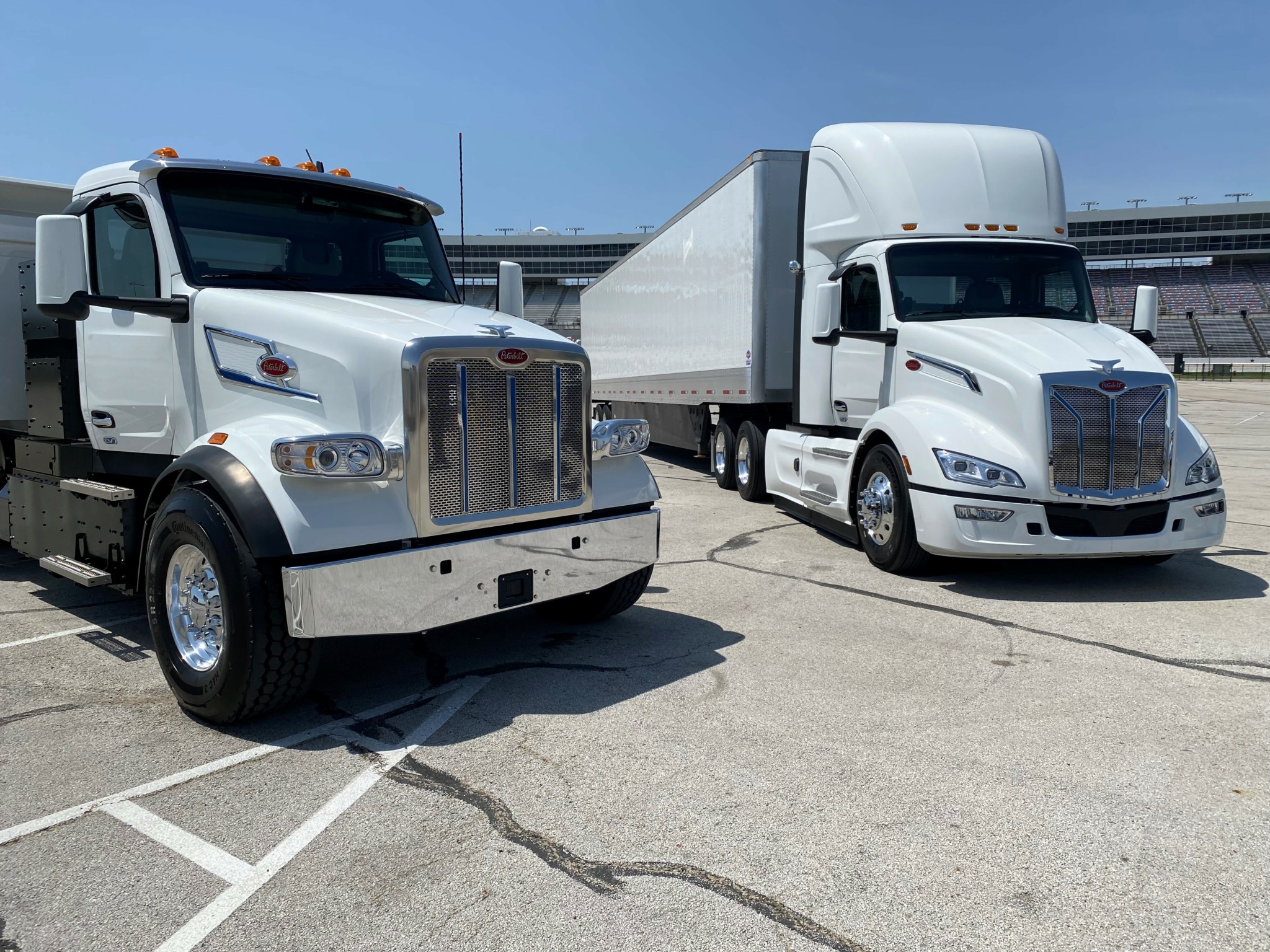
While Quebec lost one electric truck manufacturer with the collapse of Lion Electric, it gained another: Paccar, which launched production of electric trucks at its Sainte-Thérèse plant, where several medium-duty and Class 8 electric models will be assembled.
“Peterbilt is fully committed to the Quebec market, supported by a flexible manufacturing strategy that allows us to build trucks directly in the markets where they are sold,” said Kate Rahn, general manager of Peterbilt Canada.
For other stakeholders, however, enthusiasm must be tempered.
Limited window of opportunity
“Yes, the return of Écocamionnage will give new life, but it will be short-lived,” said Jean-François Brossard, director of energy technologies and innovations at Location Brossard. “With everything that’s going on in North America, and Donald Trump abandoning electric vehicles, it sends a clear message to nearby partners like Canada.”
According to him, the resumption of the program coincides with the upcoming end of the Zero-Emission Medium- and Heavy-Duty Vehicle Incentive Program. As a result, carriers have a very limited window of opportunity to finalize their purchases.
During the 15-month suspension of Écocamionnage, interest declined significantly. “There has been a loss of interest in alternative energy vehicles, particularly electric ones,” he observed.
Frustration and uncertainty
This sentiment was shared by Édouard Dalpé, key account manager at Globocam. “Among our customers, the words that came up most often were frustration and uncertainty. Several projects were halted overnight.”
The return of the program will certainly allow some projects to resume, but no one believes in massive electrification in the short term.
“Companies that have started to electrify may continue where they can. It’s very rare for a fleet to be able to electrify 100% of its operations,” said Yves Maurais, director of technical and operational issues at the Quebec Trucking Association (ACQ).
Financial obstacle
The main obstacle remains financial.
The purchase of an electric truck — and especially the installation of charging infrastructure — represents a considerable investment. Without subsidies, profitability is difficult to justify.
Simard Transport has already added four electric trucks to its fleet and plans to add two more. The company remains interested, but cautious.
“For now, the trucks are too expensive without subsidies. Prices will have to come down for them to become widely adopted,” said Brandon Abraham, vice president of corporate services.
Guillaume Brossard of Polara agreed. “It’s important to have financial support in order to properly back a fleet electrification project,” he said. “Financial incentives are essential to support implementation, including charging infrastructure.”
Call to extend federal purchase assistance program
In fact, several stakeholders are calling for an extension of the federal purchase assistance program. For them, Écocamionnage alone is not enough.
Beyond the price, the technology itself imposes constraints. Today, electric vehicles are best suited for urban and regional transportation. Long distances remain difficult.
“It’s viable, but only under ideal conditions,” Maurais said. “Range, load capacity, and access to charging stations greatly limit operations.”
Transition remains complex
In other words, electric vehicles are not yet a replacement for diesel.
“A diesel truck can do everything. An electric truck cannot yet replace a diesel truck in all applications,” Brossard said.
Some local fleets are adapting well. But for larger networks, the transition remains complex. The major challenge is recharging, and the lack of public infrastructure is probably the most critical obstacle.
“There is virtually no public network suitable for heavy trucks,” Maurais pointed out. “Transporters have to build their own facilities.”
The dominant model therefore remains terminal-to-terminal operation: the truck returns to base to recharge. This method works … but limits productivity.
Multi-energy approach sought
For Laprés-Paradis, the development of a public network will be decisive. “For medium and long distances, access to public charging is essential.”
Even private infrastructure remains costly and complex to implement. “Installing charging infrastructure remains a difficult and very expensive process,” added Brossard.
Some stakeholders also criticize the Écocamionnage program’s heavy focus on electric vehicles. Many would have preferred a multi-energy approach that included renewable natural gas.
“We have a functional solution, but we’re putting all our eggs in one basket,” Dalpé said.
However, the government favors zero-emission technologies. Natural gas, although less polluting than diesel, still produces emissions.
Richard Prévost, CNG specialist at EBI Énergie, believes that this approach lacks pragmatism. “We need to stop looking for a single solution. The transition will involve several complementary energies.”
Taking small steps
In his view, restricting the options too much risks slowing the transition rather than speeding it up.
Despite the obstacles, few believe there will be a complete reversal. “It will continue, but in small steps,” Dalpé said.
Many even believe that pressure will come mainly from customers. “It will be the environmental policies of the decision-makers that will guide the transition,” believes Brandon Abraham.
Quebec nevertheless retains certain advantages: clean energy, industrial expertise, and government support.
“The message sent by Écocamionnage is that the ecosystem is there to support the transition,” concludes Guillaume Brossard.
The energy transition of Quebec trucking is neither abandoned nor assured. It is progressing, but slowly, hampered by costs, infrastructure, and operational realities.
The return of Écocamionnage is reviving momentum — without, however, removing all uncertainty.
In short, the transition will likely survive. But it will not be rapid, uniform, or solely electric. It will be gradual, pragmatic … and dictated as much by the economy as by the environment.

Have your say
This is a moderated forum. Comments will no longer be published unless they are accompanied by a first and last name and a verifiable email address. (Today's Trucking will not publish or share the email address.) Profane language and content deemed to be libelous, racist, or threatening in nature will not be published under any circumstances.