NACFE report explores TCO of various powertrain options

The North American Council for Freight Efficiency (NACFE) says battery-electric trucks are on track to become the lowest-cost Class 8 powertrain option by 2035, but cautions there is no one-size-fits-all path through trucking’s “messy middle” transition period.
NACFE released its Forecasting the TCO of Powertrain Alternatives: The Messy Middle Cost Report on April 30, the third in a five-part Run on Less – Messy Middle series examining diesel, compressed natural gas/renewable natural gas (CNG/RNG), battery electric and hydrogen fuel-cell trucks. The report analyzes total cost of ownership (TCO) across multiple duty cycles through 2035.
“The core takeaway is that there is no universal TCO; it’s a custom calculation that changes with every zip code and duty cycle,” said Emilia Sibley, NACFE’s emerging technologies consultant and lead author of the report.
“While we’ve forecasted parity dates across the board, the real goal of this report is to help fleets outrun those projections. We’re giving fleet owners the framework to start capturing the financial upside of the messy middle today.”
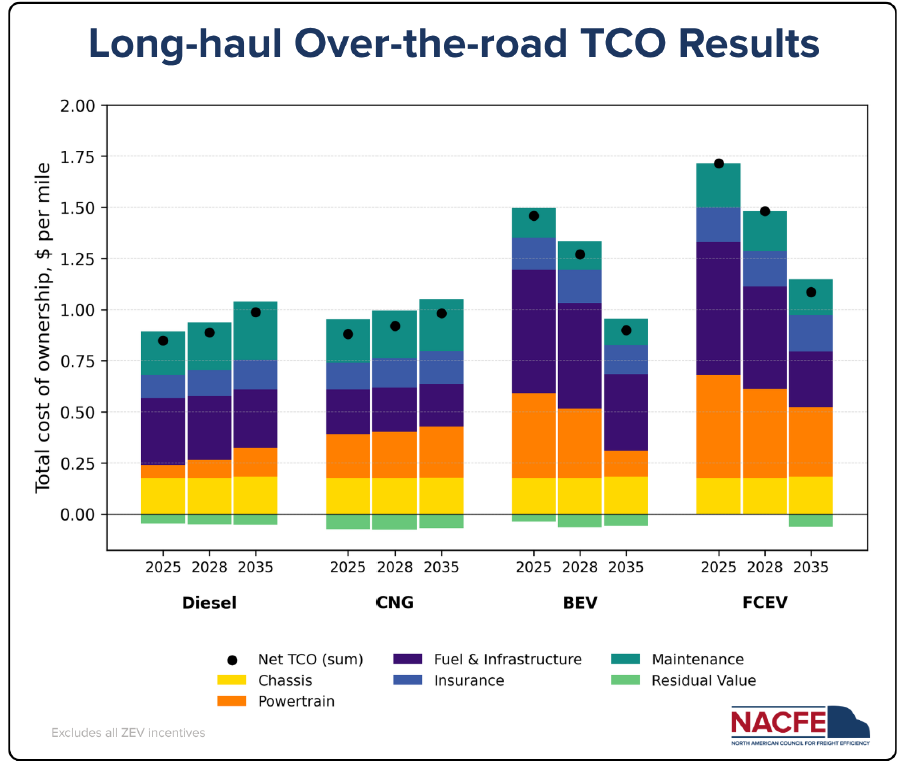
The analysis, which excludes government incentives, concludes battery-electric trucks will achieve the lowest net TCO across all modeled duty cycles by 2035, driven largely by falling battery and vehicle costs and lower energy expenses. NACFE said return-to-base regional haul and drayage applications are especially well-suited to electrification because they allow fleets to maximize depot charging and asset utilization.
Mike Roeth, NACFE’s executive director, said fleets should focus less on headline numbers and more on understanding the variables driving their own operations.
“There’s no average TCO,” Roeth said during a webinar discussing the findings. “This is more a guide for fleets and those that support them, and how to think about these numbers, not that any of these numbers we’re going to share are absolute.”
The report forecasts that diesel’s long-standing cost advantage will erode due to rising emissions-compliance costs, maintenance expenses, insurance premiums and fuel-price volatility.
“Diesel remains the incumbent benchmark across all duty cycles, but its long-term cost advantage is eroding,” Sibley said during the webinar.
CNG/RNG was identified as a practical near-term bridge technology, particularly for fleets seeking to reduce diesel exposure without waiting for electric charging or hydrogen infrastructure to mature.
“We do think that natural gas has a couple things right now that’s helping,” Roeth said, pointing to increasing renewable natural gas production, improving fueling infrastructure and the latest 15-liter natural gas engines.
“The natural gas numbers in really some heavy-haul trucks during the run were impressive,” he added.
However, Roeth acknowledged switching to natural gas still requires meaningful operational changes.
“It’s not inconsequential to move to natural gas,” he said. “You’ve got to put fueling on site if you’re returning to depot, or you’ve got to find these public stations and train on the new trucks.”
Hydrogen fuel-cell-electric trucks, meanwhile, were projected to remain the most expensive option through 2035 because of high hydrogen costs and limited fueling infrastructure. NACFE nevertheless sees potential in heavy-haul and high-mileage applications where rapid refueling and payload capacity are critical.
The report is based partly on operational data gathered during NACFE’s 2025 Run on Less – Messy Middle demonstration, which involved 13 fleets operating 14 trucks across four powertrain technologies. Over 18 days, participating fleets generated more than 2 million lines of operational data covering roughly 73,000 miles.
Roeth said fleets participating in the program were willing to openly share operational successes and challenges to help accelerate industry learning.
“They feel a stewardship to share what they’re learning with the rest of the industry,” he said during the webinar. “They know that if they share information through NACFE, people are going to take action.”
The report can be downloaded here.
Have your say
This is a moderated forum. Comments will no longer be published unless they are accompanied by a first and last name and a verifiable email address. (Today's Trucking will not publish or share the email address.) Profane language and content deemed to be libelous, racist, or threatening in nature will not be published under any circumstances.

The Tesla Semi just entered mass production. That will be the one to watch.