NACFE report highlights real-world performance across competing truck powertrains

The North American Council for Freight Efficiency (NACFE) has released the second report from its Run on Less – Messy Middle demonstration project, offering new insights into how different truck powertrains perform in real-world freight operations.
The report, Terrain, Technology, and Telematics: The Messy Middle Operations Report, analyzes operational data from 14 Class 8 tractors operated by 13 fleets using four energy pathways: diesel and renewable diesel, compressed natural gas/renewable natural gas (CNG/RNG), battery-electric, and hydrogen fuel cell.
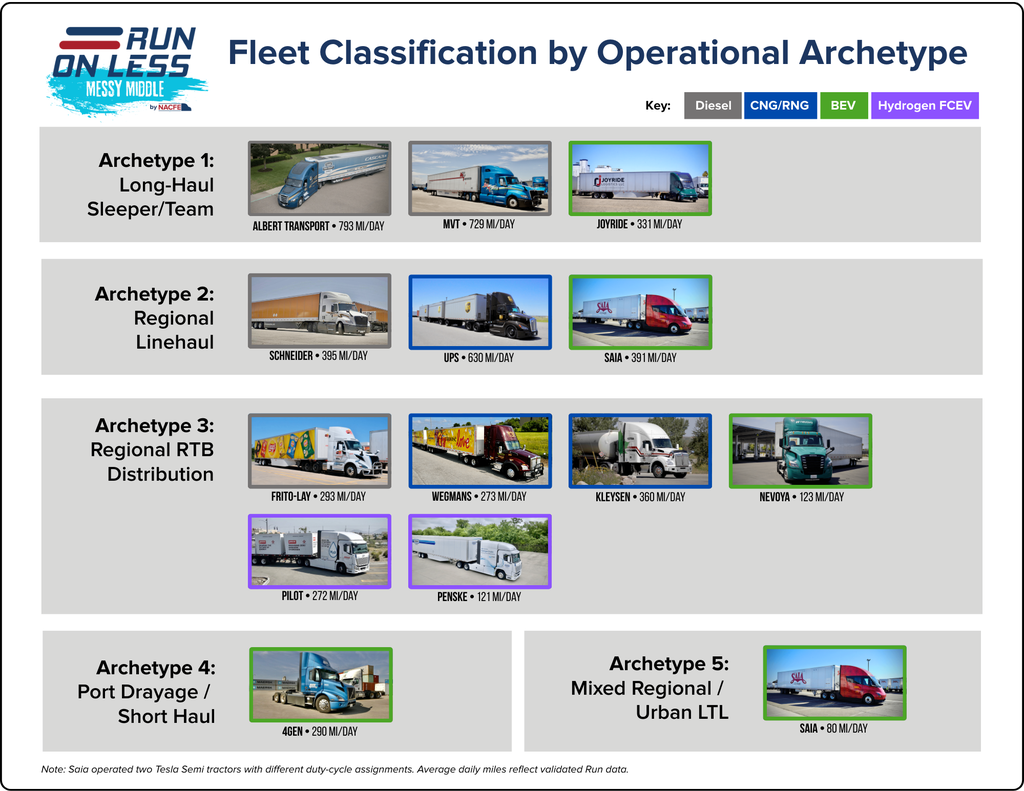
Collectively, the trucks logged more than 73,000 validated miles (117,482 km) hauling revenue freight, with telematics devices collecting performance data throughout the Run.
The findings reinforce what NACFE describes as the “messy middle” of trucking’s energy transition — a period where multiple technologies will coexist rather than a single dominant solution emerging quickly.
“Transparency is the antidote to uncertainty,” said Dean Bushey, NACFE’s director of programs and the report’s lead author. “By putting real-world data behind these emerging fuel types, we’re giving the industry the roadmap it needs to navigate the most complex transition in trucking history.”
Diesel still sets the benchmark
The report found diesel remains the operational benchmark for longhaul trucking, with participating fleets achieving fuel efficiency of up to 11.8 mpg while covering 500–800 miles (804-1,287 km) per day across varied terrain.
Renewable diesel offers an immediate emissions-reduction pathway using existing vehicles and fueling infrastructure.
Natural gas powertrains also demonstrated strong performance in certain applications. Trucks powered by the Cummins X15N natural gas engine handled demanding freight operations, including tanker and heavy-haul configurations, particularly where fueling infrastructure was readily available.
Electric trucks expanding capabilities
Battery-electric trucks demonstrated growing capability beyond short-haul applications.
Tractors equipped with 565- to 705-kWh battery packs achieved daily operations of 350-500 miles (563-804 km) and recorded a validated single-day maximum of 875 miles (1,408 km) under favorable conditions.
However, NACFE found electric trucks remain sensitive to terrain and dependent on charging infrastructure, meaning corridor-specific planning is critical.
Hydrogen fuel-cell-electric trucks also showed promising operational characteristics, including quick refueling and weight advantages compared with battery-electric trucks. But limited fueling infrastructure and high fuel costs remain significant barriers to widespread adoption.
Terrain and operations
One key finding was the outsized impact of terrain on truck efficiency. Diesel trucks experienced about a 30% efficiency swing between flat routes and mountainous terrain, while battery-electric trucks saw efficiency variations of 50% to 70% in comparable conditions.
The report also emphasized that real-world performance depends heavily on operational factors such as payload, driver behavior, maintenance practices and dispatch strategy.
“By looking at how these pioneering fleets are working, we can then project what the future might be for the entire industry,” said NACFE CEO Mike Roeth.
A portfolio approach to decarbonization
NACFE concludes that most fleets will likely operate multiple powertrain technologies in the coming years, matching each technology to applications where it performs best.
Infrastructure availability, daily mileage requirements and organizational readiness will all influence which technologies fleets deploy.

Have your say
This is a moderated forum. Comments will no longer be published unless they are accompanied by a first and last name and a verifiable email address. (Today's Trucking will not publish or share the email address.) Profane language and content deemed to be libelous, racist, or threatening in nature will not be published under any circumstances.