Drivers might start jumping ship as trust in carriers erodes and disconnect continues, CarriersEdge warns

Drivers may not be leaving in large numbers today, but declining trust, dissatisfaction with pay structures, and rising stress levels suggest many might be preparing to move when the market improves.
That was the warning from Jane Jazrawy, CEO of CarriersEdge, who pointed to shifting sentiment in Best Fleets to Drive For survey data during an education session in Charlotte, N.C.
“It’s not great,” Jazrawy said. “Drivers are feeling the stress that you’re feeling … that anxiety is definitely there.”

While many fleets have avoided large-scale turnover in the current downturn, Jazrawy cautioned that the stability may be temporary. “As soon as the economy starts showing signs of any sort of life at all, drivers are going to be going,” she warned. “It’s going to be a little crazy.”
The latest Best Fleets to Drive For evaluation results build on last year’s theme of growing disconnect between drivers and carriers, particularly around compensation, communication and workplace culture. At the time, Jazrawy said many drivers were feeling unheard or disconnected from company decisions. This year’s data suggests this might have evolved into declining trust and increased readiness to leave.
Trust between drivers and management slipping
After receiving 108 nominations, the Best Fleets data is based on 56 corporate interviews and 4,493 driver surveys — a dataset Jazrawy says is broad enough to reveal meaningful changes in driver sentiment, adding that several key indicators declined between 2024 and 2026, pointing to a gradual but significant shift.
She added the figures presented reflect only the most negative responses, as she focuses less on the positives and more on where sentiment begins to weaken. “So, when I start seeing the ‘neutral’ to ‘strongly disagree’ start to come up — like there’s a couple of places where it’s 50% of the score or of the response — I start to think something’s going on here.”

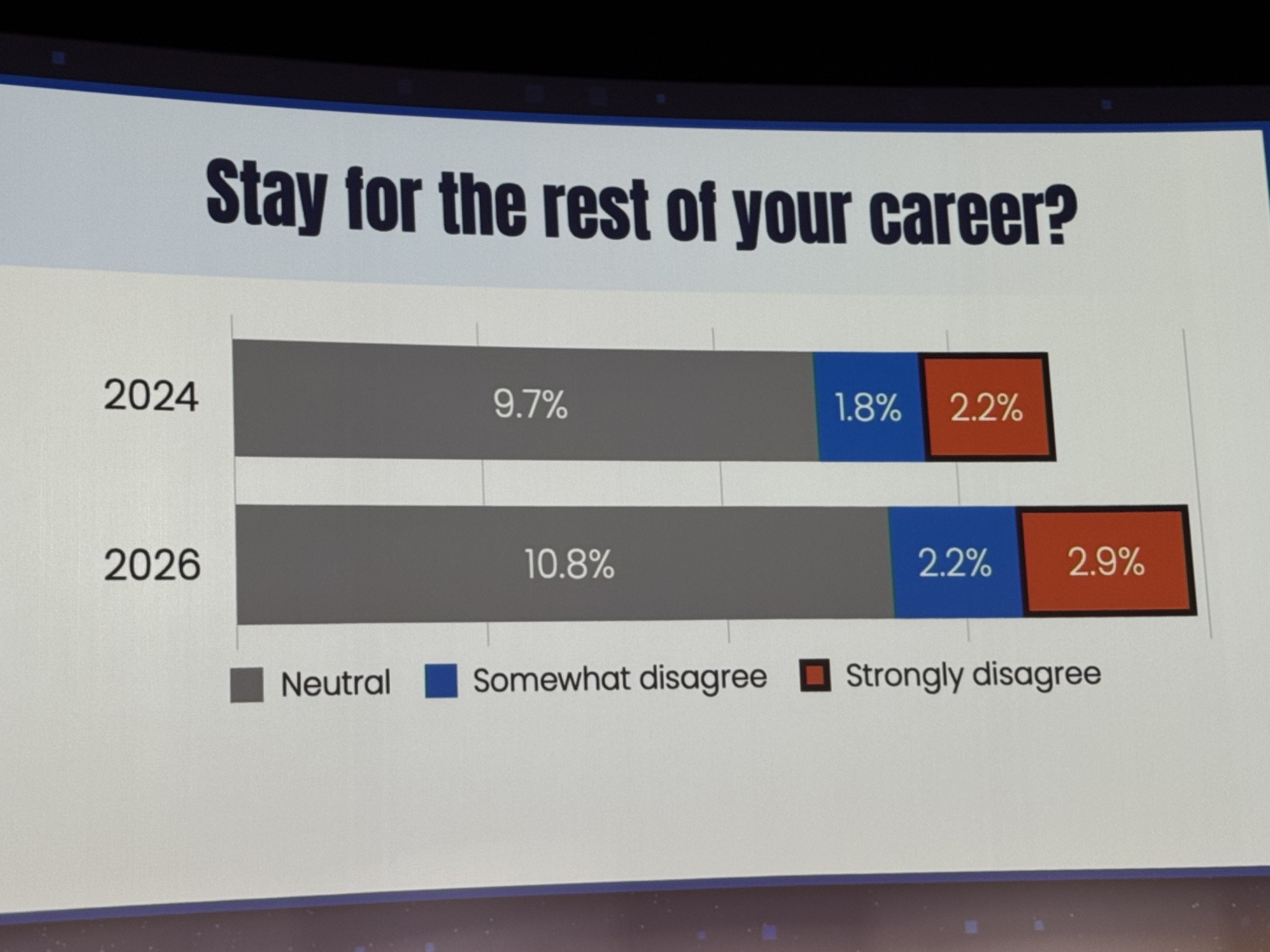
Trust in the company dropped by roughly 4%. “That is huge in Best Fleets, I don’t see this from year to year,” Jazrawy said. Meanwhile, perceptions that carriers communicate honestly declined by about 2.5%, with 2.8% of drivers strongly disagreeing with the statement. At the same time, the likelihood that drivers would recommend their employer fell by more than 3%, an indictor it might be harder for carriers to recruit in the future. More drivers indicated they do not plan to stay with their employer for the rest of their careers, compared to two years ago.
“Trust is the thing that is really the tie that binds,” Jazrawy said. “The pay goes away, trust starts kind of going away too.”
Pay-adjacent issues
While declining pay and miles are a clear driver of dissatisfaction, Jazrawy emphasized that frustration is increasingly tied to how work is structured — what she described as “pay-adjacent” issues.
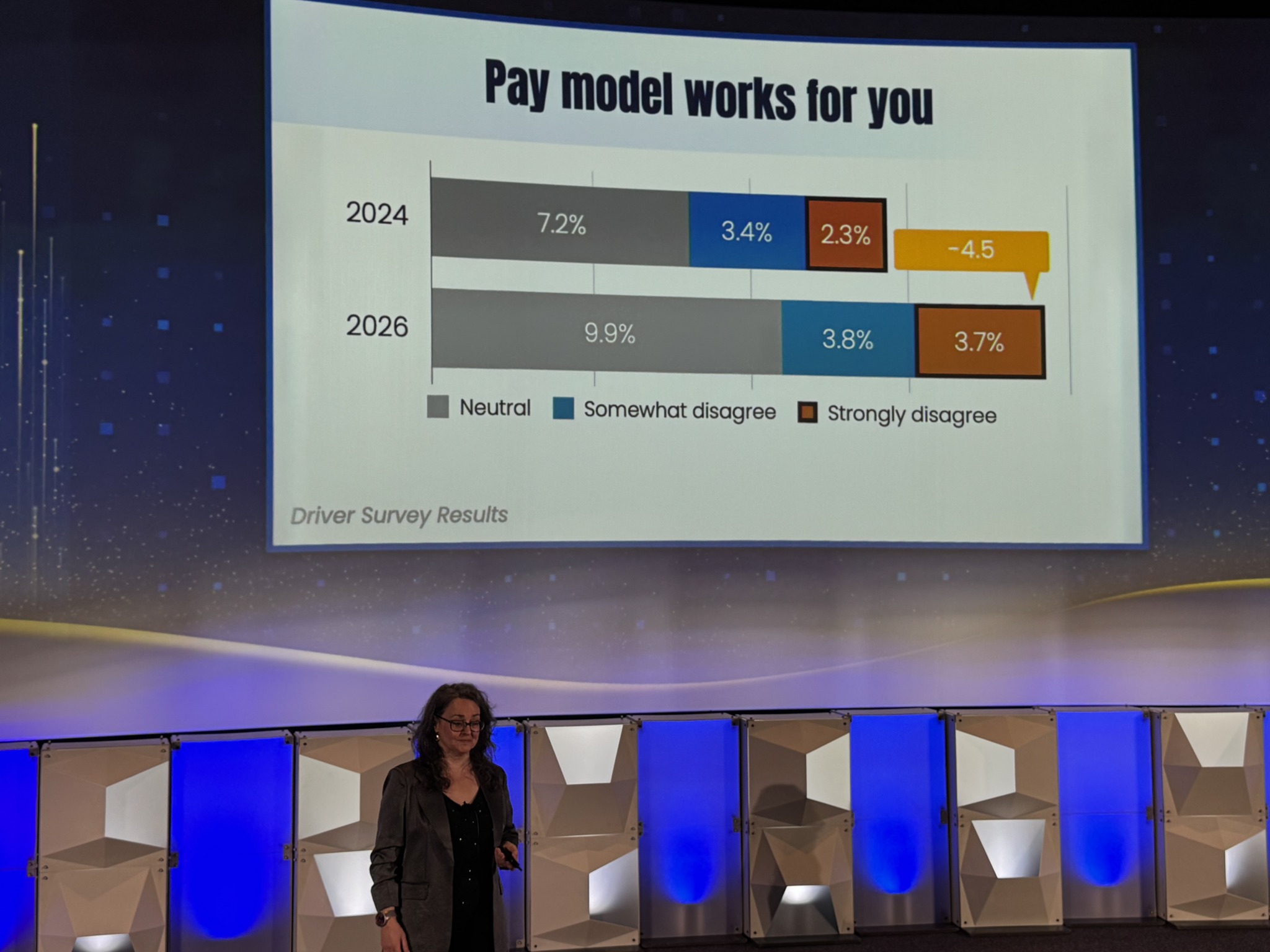
Drivers are not only reacting to lower earnings, but to how fairly those earnings are distributed and explained. Satisfaction with pay has dropped sharply — with 4.5% more drivers saying they are not happy with how the current pay model works for them — while perceptions of fairness continue to erode. When asked if compensated fairly, 3.3% said they strongly disagree in 2026. In 2024 this figure was at 2.2%.
Routing seems to be another pain point for drivers, with about 4% of drivers in 2026 saying routing is not fair, compared to roughly 2.8% in 2024 — a noticeable shift in Best Fleets data, Jazrawy said.
But the real issue is not dissatisfaction alone, but also lack of transparency. Jazrawy broke it down, saying that only about 31% of drivers are satisfied with how routing works, while another 17% say they simply go where they are told and do not question the system. At the same time, roughly 27% of drivers say they have no understanding of how routing decisions are made at all.
“Seventy per cent of drivers either have a really negative view … or they just have no idea,” she said.
A smaller but significant share (11%) explicitly cited favoritism, Jazrawy noted, adding that drivers had to use that specific term for it to be included in her analysis.
That lack of clarity is feeding mistrust, particularly because routing directly affects miles and pay. When drivers do not understand how decisions are made, they are more likely to assume bias or inconsistency.
One driver wrote in a survey, “They intentionally give you the opposite of what you ask for and lie to you about why.”
Unpaid work
Additional responsibilities are also becoming a source of friction when compensation does not match expectations. Survey results show that satisfaction with whether additional work is fairly compensated declined by about 4.1%, reflecting growing concern over unpaid or underpaid tasks such as training, waiting time, and administrative responsibilities.
Mentorship, for example, is a role that has become more formalized over the past five to six years, and fleets have different visions of what it involves. Some have structured programs, while others define it as something as informal as picking up a phone call from another driver.
About 10% of surveyed fleets do not pay mentors at all, while another 13% offer only minimal compensation or non-monetary rewards. Roughly 27% pay less than $100 per day, while 31% pay $100 or more.
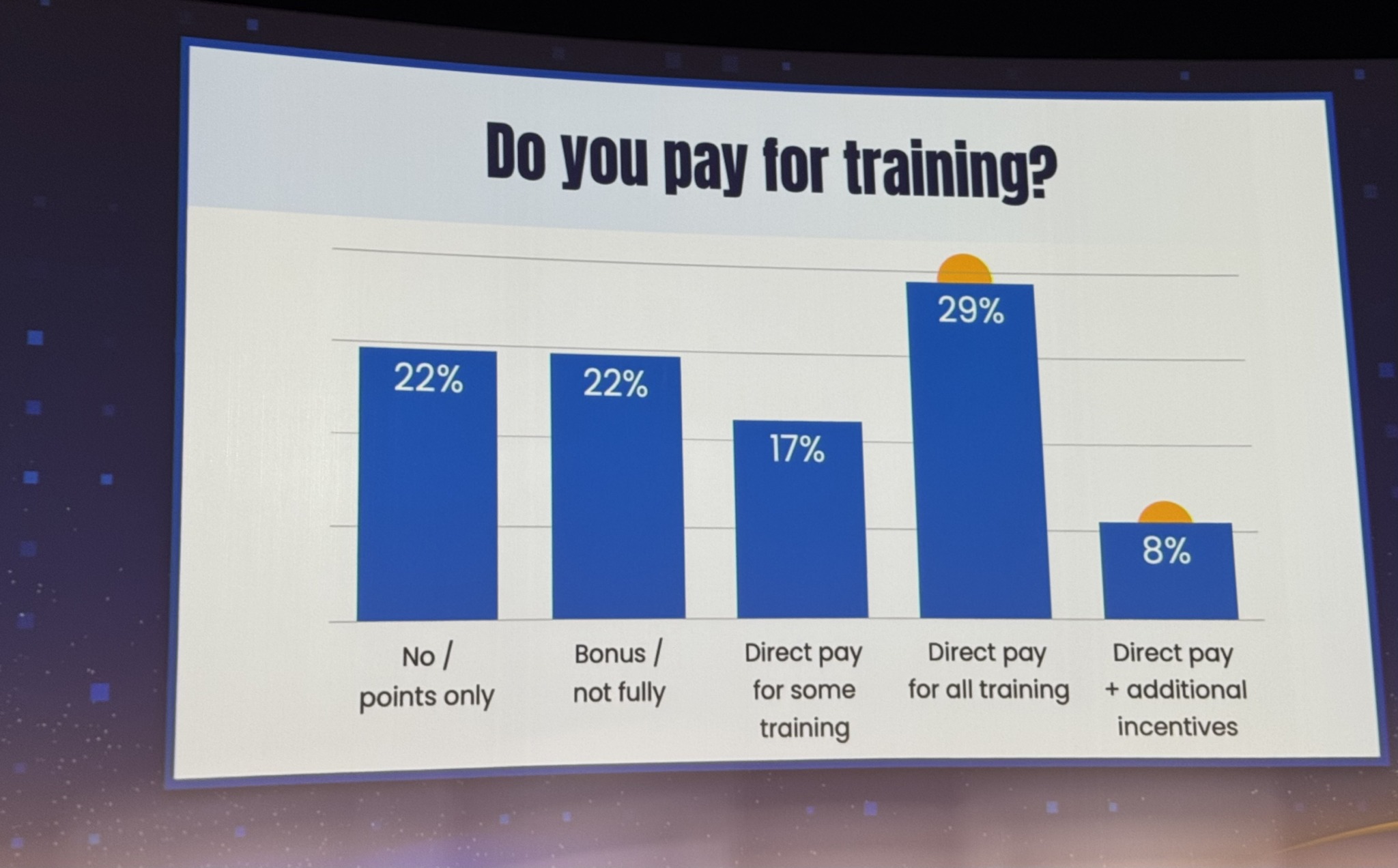
Some fleets are beginning to recognize the added burden more directly, as 19% of fleets pay around $150 per day — or cover costs associated with the role. In one case, she noted a fleet provided a cell phone allowance so drivers are not using their personal devices and data to support other drivers.
“If you think driver mentors are providing a valuable service and you’re not paying them for it, your drivers will eventually start to resent it because they don’t want to work for free,” Jazrawy said. “This industry has a habit of getting drivers to do work for free and this is one of the places where I think people are starting to take advantage.”
Jazrawy also cited driver feedback indicating that some training is now being completed informally and without compensation. One driver wrote, “I do training while watching television,” citing issues with unpaid work time.
Are you listening to your drivers?
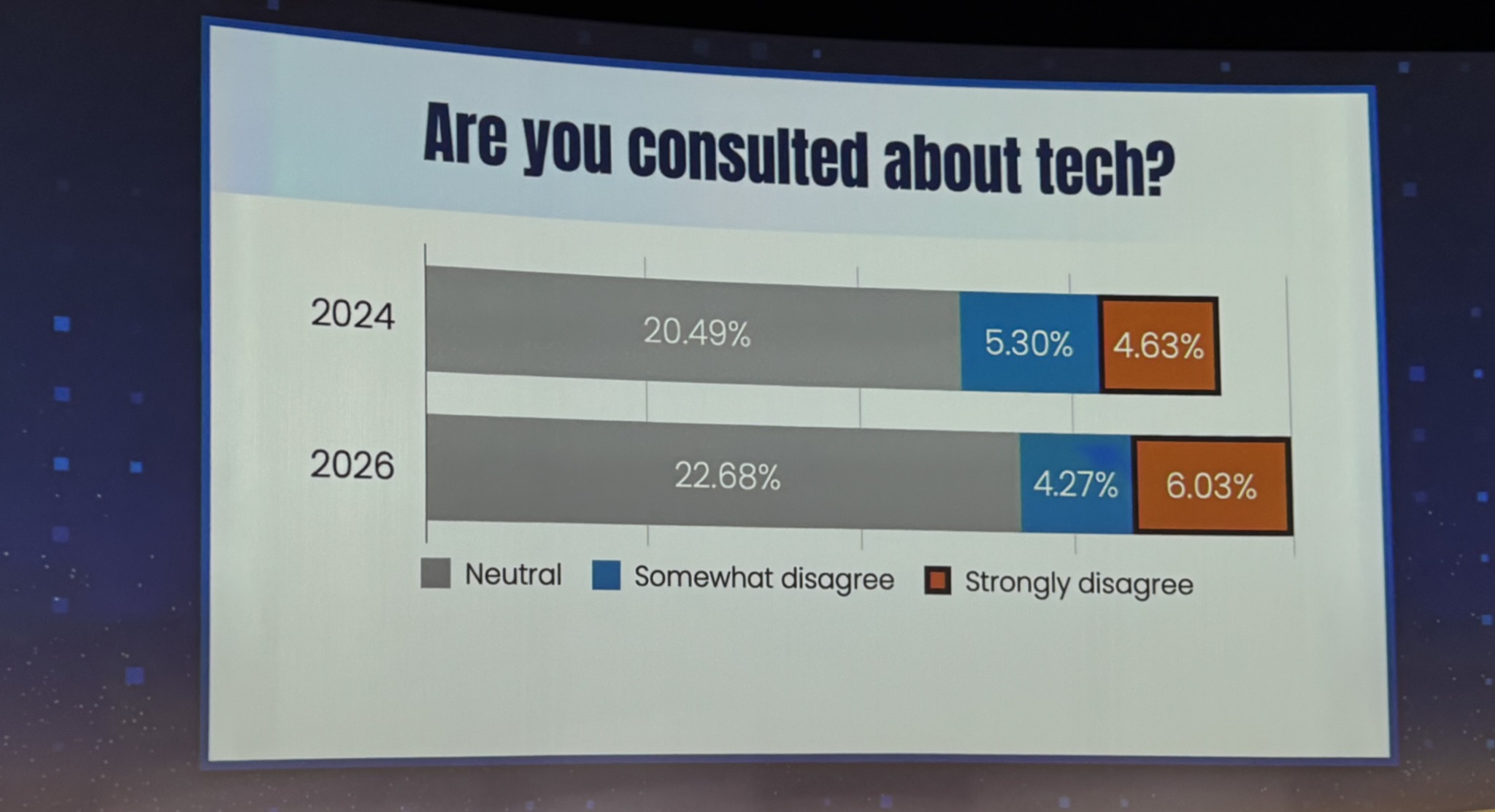
Drivers keep flagging that they are not being consulted about decisions that directly affect their work, particularly when it comes to technology. In 2024, about 4.63% of drivers strongly disagreed that they were consulted about technology decisions, alongside 5.3% who somewhat disagreed. By 2026, the share of drivers who strongly disagreed rose to 6.03%, while those somewhat disagreeing stood at 4.27%.
Another concern that emerged in questionnaires was performance management, reinforced by how fleets structure feedback and performance conversations. About 25% of fleets only speak with drivers on an intervention basis — typically when something goes wrong. Another 38% rely primarily on annual reviews or scorecards, while a similar share conducts more frequent reviews combined with broader feedback.
Communication falling out of sync
Communication channels are also not always aligned with driver preferences, Jazrawy said. Fleets continue to rely heavily on social media — with 29% using five or more platforms — to communicate with drivers, with 94% using Facebook, 77% Instagram and 58% LinkedIn. Some use X, YouTube and TikTok.
However, nearly half of the surveyed drivers say they do not follow company communications. The share of those who say they actively follow company communications declined from 63% in 2024 to 54% in 2026, while those who do not follow rose from 37% two years ago to 46% in 2026.

Jazrawy noted that drivers are increasingly disengaging from traditional, broadcast-style communication, which is often seen as repetitive or focused on office priorities rather than driver concerns.
But alternative formats of communication are gaining traction. Recorded safety meetings, driver-focused podcasts and on-demand content are generally better received, as they allow drivers to engage on their own schedule and focus on topics that are directly relevant to their work.
Survey fatigue continues
Surveys — once a key tool for collecting and understanding driver sentiment — are losing effectiveness. Drivers are facing a ‘survey burnout’, with requests coming from employers, vendors, industry groups, and even the media. Participation is becoming less consistent, and skepticism about anonymity remains a barrier to candid responses.
At the same time, Jazrawy pointed to emerging data quality issues, with some written responses appearing to be generated using artificial intelligence.
“I know for a fact that in some cases, the driver surveys from some of the Best Fleets companies were generated by AI because you can tell,” she said, noting that those responses tend to sound more corporate and less personal than typical driver feedback.
The result, she warned, is that surveys alone are no longer enough, and fleets may need to rely more on direct conversations and ongoing engagement to understand driver sentiment.
Emotional well-being
Beyond operational and communication challenges, Jazrawy pointed to growing emotional strain among drivers tied to economic pressure and day-to-day working conditions.
Survey data shows that 50.7% of drivers strongly agree their company provides programs aimed at minimizing stress and anxiety, a “very low” score for a first-year question, she said. Just under 20% selected a neutral response, while about 7.5% expressed some level of disagreement, with 3.8% strongly disagreeing.
Fleets not addressing mental health tracks in corporate questionnaire responses, too, with 68% of fleets not mentioning mental health at all in their wellness or work-life balance programs, while 23% referenced only an employee assistance program (EAP).
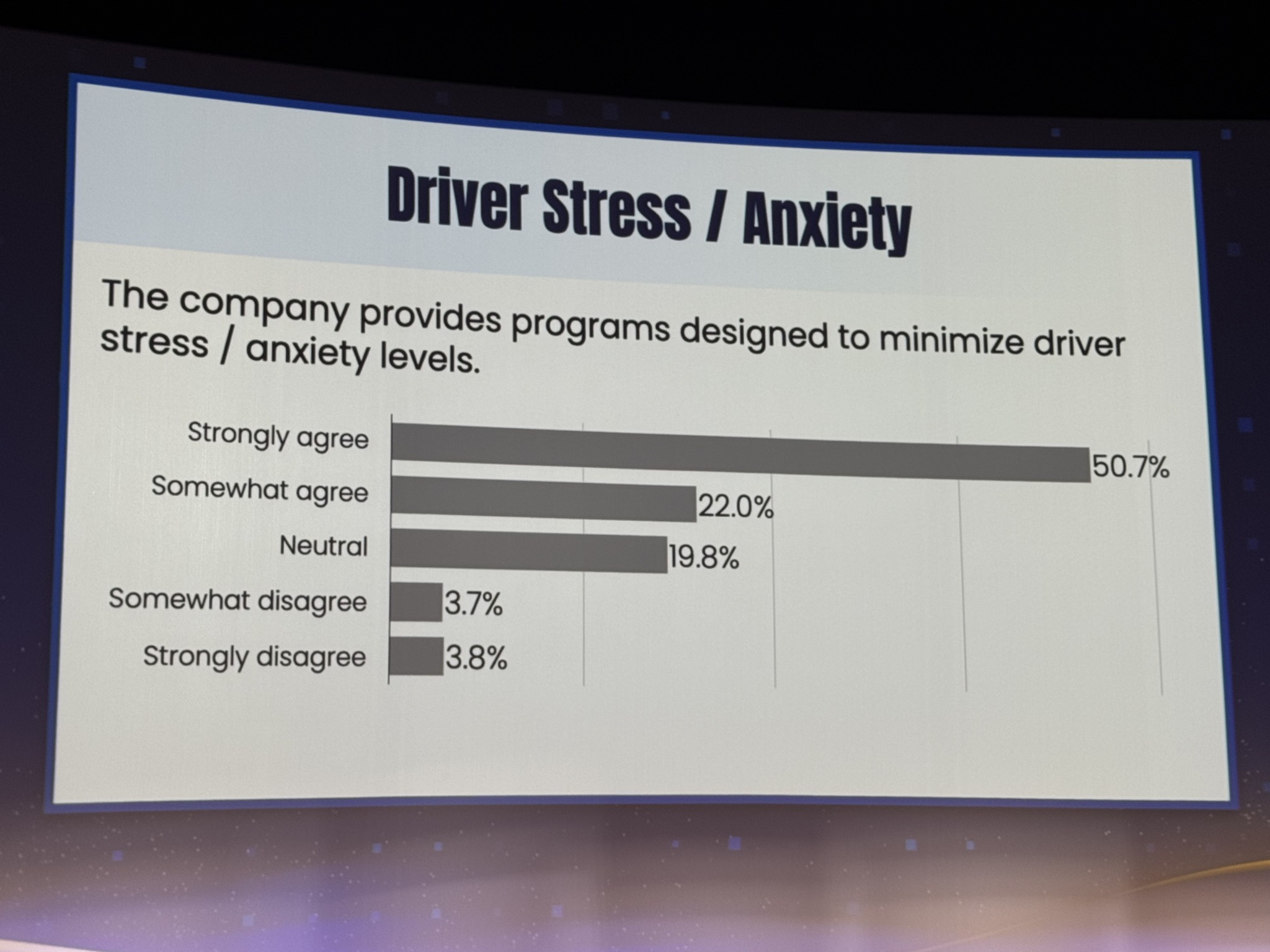
Jazrawy said that simply offering an EAP may not be enough if drivers are not aware of it or do not find it useful. She said the issue is complicated due to the nature of the job, where drivers often work in isolation and rely on dispatchers as their primary point of contact, making it important for the company staff to recognize and respond to signs of distress.
She highlighted initiatives such as Mental Health First Aid training — used by some Canadian carriers, including Bison Transport — to help staff identify early signs of distress and intervene before situations get worse. Others have introduced roles such as corporate chaplains, providing drivers with a neutral, accessible person to speak with.
Canadian fleets have started the conversations on mental health earlier, Jazrawy said, resulting in supports already in place, while many American fleets still have significant ground to cover.
That gap between rising stress levels and available support is also reflected in what drivers say they value most in their day-to-day work.
Across the Best Fleets data, both company and independent drivers consistently rank practical, everyday health supports highest — particularly those that make it easier to maintain routines on the road.
Access to healthy snacks at terminals emerged as the top-rated wellness perk, followed by weight-management programs and access to fitness equipment at terminals or in cabs.

That emphasis on practicality extends beyond health programs.
Among company drivers, Driver Appreciation Week continues to rank as the most valued perk, despite mixed feedback about how it is delivered. Other highly rated benefits include company clothing, rewards programs, and shoe or tool allowances — all items that reduce out-of-pocket costs.
For contractors, the focus shifts more toward financial supports, with fuel, maintenance, and other operational discounts ranking highest.
Support tied directly to working conditions also stands out. Parking at terminals emerged as one of the most valued supports, while company drivers showed strong appreciation for access to counselling services for personal or job-related issues.

Have your say
This is a moderated forum. Comments will no longer be published unless they are accompanied by a first and last name and a verifiable email address. (Today's Trucking will not publish or share the email address.) Profane language and content deemed to be libelous, racist, or threatening in nature will not be published under any circumstances.