Ontario audit uncovers egregious truck driver training shortcomings

Truck driver trainees in Ontario were instructed to sign off on training hours they never completed, while some schools issued mandatory entry-level training (MELT) certificates after delivering barely half of the required instruction, a new auditor general report has found.
The audit, released May 12, found that two registered private career colleges provided only 57% and 78% of the mandatory 103.5 training hours required for a Class A license. The report also found that 25% of Ontario’s truck driver training schools had never been inspected by the province.
The year-long audit conducted between January and December 2025 discovered other issues, too. Those, among others, include inconsistent road-testing standards across Ontario, unregistered training providers operating through registered colleges, poor information sharing between ministries and a lack of restrictions preventing drivers with past infractions from obtaining commercial truck licenses.
All this, as commercial trucks accounted for 12% of fatal crashes in the province between 2019 and 2023, while representing only 3% of the vehicles on the Ontario roads.
“The auditor general’s report confirms what the PMTC and many other stakeholders have been raising alarm bells on since shortly after MELT was introduced. While the report, unfortunately, is not surprising to us, we hope it raises significant alarm bells with the general public and within those in government circles that need to act on this,” Mike Millian, president of Private Motor Truck Council of Canada, told trucknews.com. “Abuse and fraud has been allowed to run rampant in the training industry for years now with little to no oversight. While we acknowledge recent improvements by the government, including the addition of a Commercial Training and Oversight branch, much more needs to be done. It is time the province put real money and resources towards fixing this problem. It is affecting the reputation of our industry while hurting real people. We have consulted for years, now let’s see the action.”
Falsified training records
As part of the audit, students were enrolled at five private career colleges (PCCs) and one driver certification program (DCP) organization between June and December 2025 to assess the quality and delivery of training. DCP allows organizations approved by the Ministry of Transportation (MTO) to train and test drivers.
Investigators found some students were instructed to sign off on hours they did not complete, while one school exceeded the province’s maximum student-to-instructor ratio during in-yard training.
For example, Ontario’s MELT standard requires students to complete a minimum of 103.5 hours of training before taking a road test, including 36.5 hours of in-class training, 17 hours of in-yard instruction, and 50 hours of behind-the-wheel training.
The auditors found four colleges could not produce documentation proving students had completed mandatory MELT components, while three failed to teach all required elements of the curriculum, such as reversing maneuvers and mandatory in-class training. One college certified two students who had completed only about 60% of the required training hours, and one student admitted to Ministry of Colleges, Universities, Research Excellence and Security (MCURES) investigators that they had never actually attended classes at the PCC they were certified by.
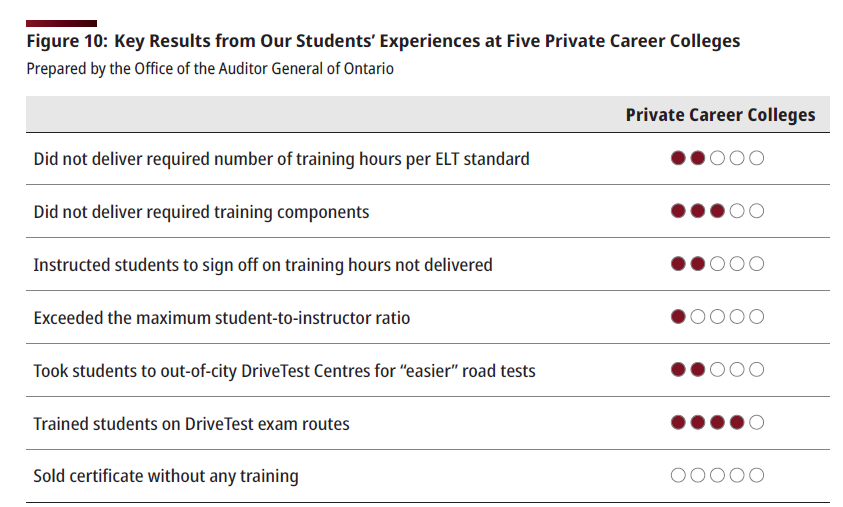
Another student reported receiving just 12 hours of classroom instruction instead of the required 36.5 hours and roughly 20 hours of behind-the-wheel training instead of the mandatory 50 hours.
The student said they were taught only one type of reverse parking because it was “the only type used at the Peterborough DriveTest Centre,” according to the report. At the end of the course, the student said staff instructed them to sign off on training hours they had not completed. “I was told I needed to sign it anyways for their records or in case of an audit,” the student said in a statement included in the report.
Other trainees, too, complained instructors focused mainly on helping them pass the road test rather than teaching broader safety skills. The audit found several colleges that trained students specifically on DriveTest exam routes or took them to testing centers considered “easier” because they used lower-speed highways or tested only one type of maneuver. Two students said they were not taught critical driving skills, including left turns at major intersections, reverse parking, and emergency stopping.
One school exceeded the province’s maximum 4:1 student-to-instructor ratio during yard training, operating at a 6:1 ratio.
MCURES never inspected 25% of providers
As the PCCs audited by MCURES for the audit demonstrated that they can stay compliant on paper while taking shortcuts by undermining safety and training standards, the auditor’s office also found that, as of March 2025, 25% of all Ontario PCCs offering MELT (54 of the 216) were never inspected by MCURES.
And of the 81 schools that had reached the province’s five-year reinspection threshold, 54% had still not been reinspected.
The auditor’s office recommended that MCURES and MTO implement a formal risk-based inspection system for truck driver training providers, including clearer rules on inspection frequency, provider prioritization, and the use of training outcome data, such as collision and road test pass rates, to identify high-risk schools.
It also called for more proactive oversight through routine unannounced inspections, improved monitoring of instructor qualifications, and tougher enforcement against unregistered or non-compliant schools. Both ministries agreed with the recommendations and had begun expanding oversight and coordinating compliance efforts by late 2025, according to the report.
Stronger and more information-sharing between ministries is encouraged, too, as inconsistent communication between MTO and MCURES was found to be one of the issues. The report says that MCURES informed the MTO of non-compliance issues found during investigations only on an “ad hoc basis,” all while MTO does not have direct access to the student training records maintained by the private career colleges that MCURES oversees.
Unqualified instructors
It was also found that neither of the ministries’ IT systems tracked information on instructors at private career colleges. As it turned out in a review of inspection reports from 12 private career colleges between 2019 and 2024, auditors found two colleges each employed an unqualified instructor.
A separate review of 10 investigation files found four private career colleges were actively employing a total of seven unqualified instructors at the time of investigation.
The report also noted that, unlike instructors at DCP organizations, instructors at private career colleges are not centrally approved or tracked by MTO. Instead, colleges themselves are responsible for ensuring instructors meet qualification requirements, creating what the auditor described as gaps in oversight and monitoring.
Unregistered and suspended training providers still operate
Another issue discovered by the investigators was that some unregistered PCCs were operating illegally or obtaining ELT certificates for their students through arrangements with registered schools that entered records into MTO’s system.
Between April 2020 and October 2025, MCURES investigated 13 allegations involving unregistered colleges delivering commercial driver training. In one case, a never-registered school was teaching Class A driving using an unapproved curriculum, resulting in fraud charges and a $5,000 fine for the owner.
Another school continued operating after reporting it had closed and was later fined $6,500. Auditors also found four unregistered colleges obtained MELT certificates through registered schools, including one case where students trained at an unregistered Quebec college were listed as having completed training through registered colleges in Mississauga and Scarborough in Ontario.
More than 3,200 road test appointments were booked by 17 schools that had never registered with MCURES between January 2024 and June 2025, while 3,166 exams were booked by 11 schools with invalid registrations that were expired, revoked, closed, or suspended.
The report also found some suspended DCP organizations continued training and certifying students during suspension periods due to gaps in MTO’s IT systems. The auditor general recommended stronger enforcement, improved data-sharing with DriveTest operator Serco, and IT changes to automatically block suspended organizations from certifying students.
Inconsistent road tests
The audit also found significant issues with how commercial truck road tests are administered across Ontario, with some DriveTest Centres using lower-speed highways and testing only one type of reversing maneuver instead of both required by provincial standards.
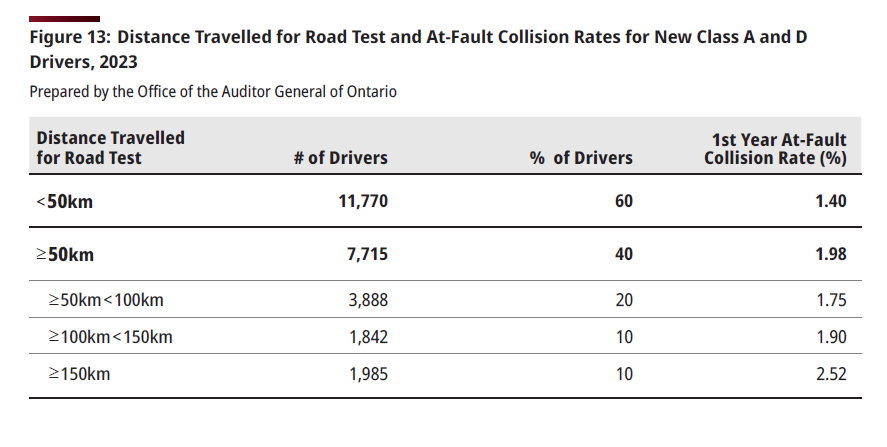
The report linked such less demanding test routes to higher collision risks. Drivers tested on replacement routes had a first-year at-fault collision rate of 1.9%, compared to 1.5% for those tested on standard routes.

Auditors also found many students were traveling long distances to testing centers perceived as “easier” to pass. In 2023, 40% of newly licensed Class A and D drivers traveled at least 50 km for their road test, while drivers traveling more than 150 km had a 2.52% at-fault collision rate compared to 1.4% for those testing within 50 km of home.
“Although the school was in Brampton, all six students, including myself, were booked for road tests at the Peterborough DriveTest Centre. Students were told it was easier to pass at that location, as they only do one type of reverse testing,” one of the students said. “All six students were told to arrive at Peterborough the night before and stay at a hotel so they can practice the test route prior. I declined but was asked to arrive early on the day of the test to practice the test route.”
That center saw the highest number of out-of-town drivers, followed by Brampton, Lindsay, Belleville, and Orillia.
Lax eligibility criteria
The audit also found Ontario does not restrict individuals with demerit points, prior suspensions or criminal convictions from obtaining commercial truck licences, unlike Quebec and British Columbia.
The report found that Ontario would have denied licences to at least 986 drivers if Quebec-style restrictions were in place. Of those, 202 drivers went on to cause at least 252 collisions between 2015 and 2025, including one fatal crash, the report says.
For more information, read the full free, 68-page report with additional findings and recommendations.
Have your say
This is a moderated forum. Comments will no longer be published unless they are accompanied by a first and last name and a verifiable email address. (Today's Trucking will not publish or share the email address.) Profane language and content deemed to be libelous, racist, or threatening in nature will not be published under any circumstances.
Excellent article Krystyna.
The first question I have is why do we need 216 schools?
Pick the top 20, shut the rest down.
The MTO has a lot to account for too for not having a better system in place.
My second question, are all the drivers from these negligent schools having their licenses suspended immediately?
A doctor, laywer or trades person that had obtained a license under suspicion would be suspended immediately pending an investigation.
This shows how little our provincial and federal governments care about trucking and the safety of the good people we share the roads with.
The professional truckers need to have a very loud voice during the next provincial and federal elections.
As mentioned in the article, for those of us that want to follow the rules, none of what is contained in the article is of any surprise.
How these schools decimate the students is criminal. Un qualified instructors, no curriculum or lesson plans, taking advantage of the students lack of knowledge of the rules and short cutting their training.
And they know when they send them to Drive Test they are going to fail and its another truck rental for them!
Three, four, five, six, seven, eight, nine, ten, eleven, twelve attempts and on and on and all at 400 to 600 a shot!
Then those same students, now desperate for their future, look to the good schools to help them and we cannot.
They have nothing to build on. No skill, no knowledge and now that all of their money has been taken from them, no hope.
The only thing we can do is enroll them in a brand new course and we try and help one student every month free of charge. Sometimes two. We feel terrible for them.
New to Canada, looking for a better life. Have heard great things about the Canadian people only to run into these supposed schools who not only steal their money, they steal their hopes, their dreams and their opportunity at the Canadian Dream.
And now years after 16 died and many more permanently injured in the Humboldt bus tragedy, nothing has changed which leaves all of the good schools wondering “what more is it going to take?”
How many more Ontarians must be injured or killed before our government will take real, swift and decisive action? The MTO has all the resources they need.
I just don’t understand. What is the hold up. 10 years after the Class A Training Standard was introduced and still lacking the oversight that is so badly required!
I just dont get it.
Excellent article and congratulations to the Auditor General’s office for such a thorough investigation.
How many students are being recalled to complete their training?
How many students are having their licenses suspended and being re-scheduled for another road test?
Do all Drive Test Centers now test equally?
Is there a ban in place for individuals testing too far from the schools location?
In other words great research what is being done to solve the problem?
I agree with Dallas Duncan, how can other jurisdictions trust any new driver that suddenly shows up in BC? Were they tested properly? Did they receive the mandated training? Getting an AZ license in Ontario is a joke at this point, not that the rest of the Country is that much better in most cases.
Great Report, finally the issue is been identified by Government, but now will they take action and shut down and reduce the number of Driver Training Schools to a manageable number of locations?
Now maybe they will be shamed into taking on Driver Inc.!!!!!!!
Name the schools.
This another in a series of articles exposing the training industry, yet leaving them covered up.
We know there are bad actors, there have always been bad actors. You do nobody any good by not telling the world who they are. Woodward and Bernstein told us as soon as they knew who did what, they did not simply say, some government officials broke the law.
Hi-same people same challenges,Ontario is at fault contracting drivers licenses to companies that were not policed by the province.
This been on for years the government look the other way name the schools shut them down
Just another reason for the government not to impose rules,,, but NEVER follow up on anything they do,,, another government disaster. But the most important issue would be,, we’ll, not going to get into that,, wink, wink

Sure wish we would get names of schools so we can ask where they trained when they come out west for jobs.