Samsara’s AI strategy focuses on proactive driver coaching to prevent collisions

Artificial intelligence continues to be at the center Samsara’s approach to fleet safety. However, it is not just because AI it can just detect more risky driving events, but because it can also help fleets act on those events before they become crashes.
This is according to Arpan Podduturi, the company’s vice president of product safety, who spoke with trucknews.com at the Beyond conference in Las Vegas in late June. The company’s recently announced safety portfolio — including AI-generated Driver Briefings, AI Ride-Alongs and Coaching Priority — is designed around that thinking.
Today, he said, fleets face the same challenges: safety managers are stretched thin, driver turnover is high, and a relatively small group of drivers can account for a big share of collisions.
“When we look at the data… the top 10% of risky drivers contribute to a third of crashes, the top 25% contribute almost two thirds of crashes,” he said, explaining why the company has invested heavily in AI-powered coaching and automation.
Moving away from Big Brother narrative
Those efforts are built on what Podduturi described as one of Samsara’s competitive advantages — a connected operations platform that now processes about 20 trillion data points accumulated over the past decade. This allows the company identify driving patterns, evaluate coaching outcomes and continuously refine its safety models.
For Podduturi, however, improving AI is only part of the equation. Equally important is changing drivers’ perception of the technology.
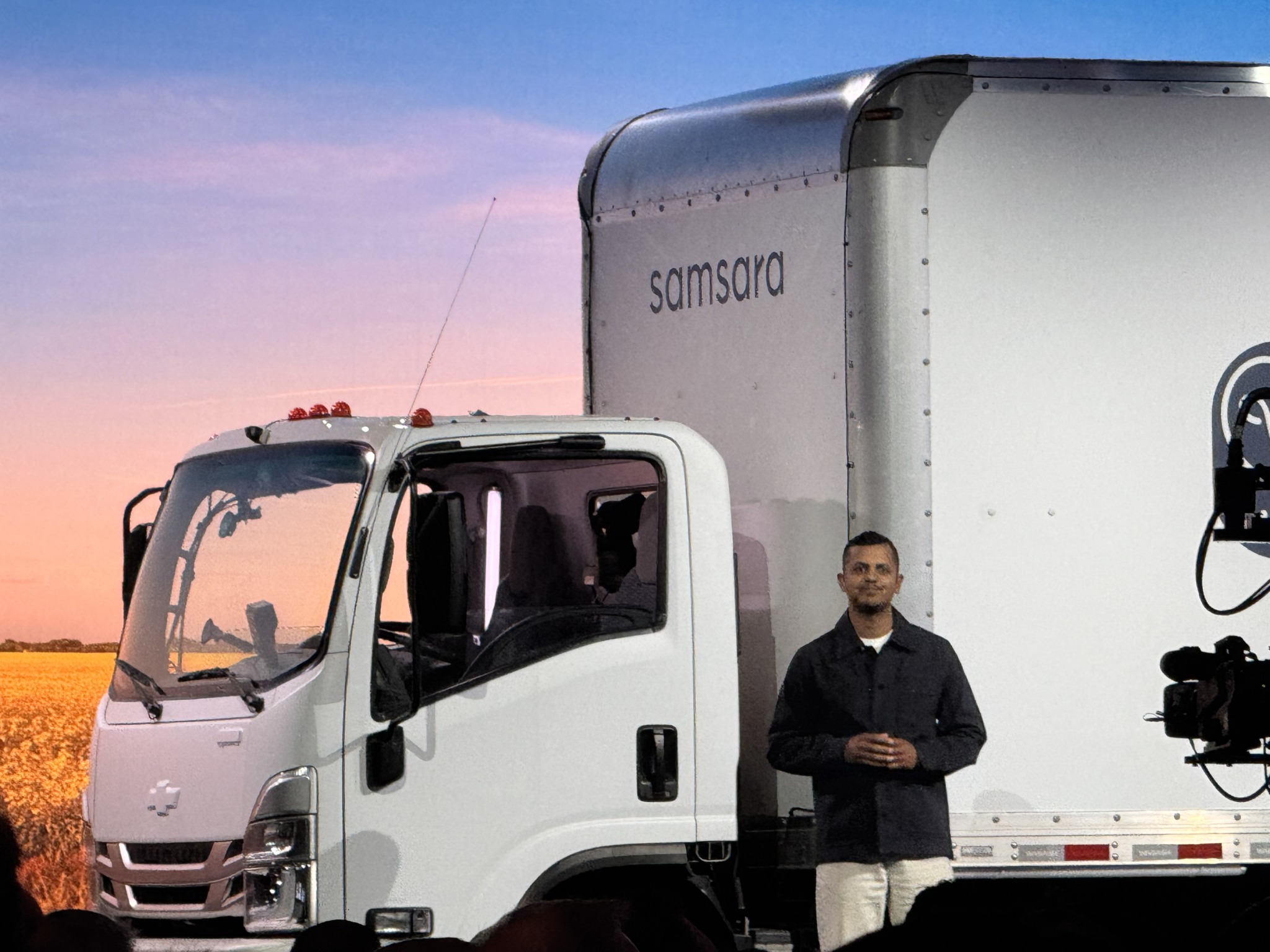
“A driver historically has viewed Samsara as sort of a thing that gets them in trouble. It catches the things that they do wrong, and then it tells them you need to go get coaching,” Podduturi said. “What we are trying to do is empower drivers with a basically super intelligent agent that is with them every step of the way… Everything they need to know about their drive is boiled into a two-minute update.”
This is why the company introduced AI Driver Briefings. Rather than focusing solely on what happened after a risky event, the in-cab, context-aware AI assistant is designed to prepare drivers before they begin a trip and guide them along the way.
Before a shift begins, the AI can summarize weather, traffic, route information and high-risk locations. And while the driver is on the road, it can continue delivering voice alerts, reducing the need for drivers to look at navigation or other mobile applications.
“It’s really about keeping eyes on the road and keeping our drivers safe and just eliminating those distractions.”
Turning data into coaching insights
Delivering those alerts requires different types of AI working together.
Immediate safety functions, such as collision warnings and distracted-driving detection, run directly on the vehicle using edge computing.
“Almost all of our detections run on the edge. We have custom models that we train, and they run in real time, and so from a latency perspective, it’s milliseconds, it’s extremely fast — and has to be because that’s the dynamic of the road.”
Cloud-based AI, however, serves a different purpose. It analyzes driving behavior over time, combining individual incidents into broader patterns that help safety managers understand coaching effectiveness, needs and emerging risks.
“We also send up events to our back end, and we run inference against those events, and that’s where we do evaluations, validation, offline labeling and things like that,” Podduturi said.
“From there, we have the opportunity to stitch events together and really find patterns in the driving behavior, and we weren’t able to do that as of a couple of years ago. This is new technology…we can find contributing risk events, pull those together and paint a picture for a coach that is full of the environmental context that they wouldn’t have had otherwise.”
The company’s growing dataset has also revealed regional differences in driver behavior and helps them shape future products. In Canada, because of the vast open spaces, speeding is one of the biggest behaviors Samsara sees across its users, while in Mexico, for example, fleets are more focused on cellphone use, cargo security and GPS jamming.
Coaching priority feature
That ability to recognize context and patterns also enables Samsara to help fleets decide where to focus their coaching efforts that can sometimes be limited.
Instead of flagging a single harsh braking event or rolling stop, the AI tool looks at how multiple factors interact — such as driving behavior, weather, road environment and time on the road — to build a more complete picture of risk and prioritize coaching accordingly.
During a product demo session for the media, Samsara said internal analysis showed Coaching Priority identified drivers who later became involved in an incident as high priority at least five days before the event about 80% of the time. The company also points out that while the ‘safety score’ is something fleets configure and even gamify for drivers, the ‘coaching priority score’ is completely separate and looks at all risk factors, including those drivers can’t control, to help managers decide where to focus coaching.
But the feature won’t replace the safety manager’s judgement, Podduturi said.
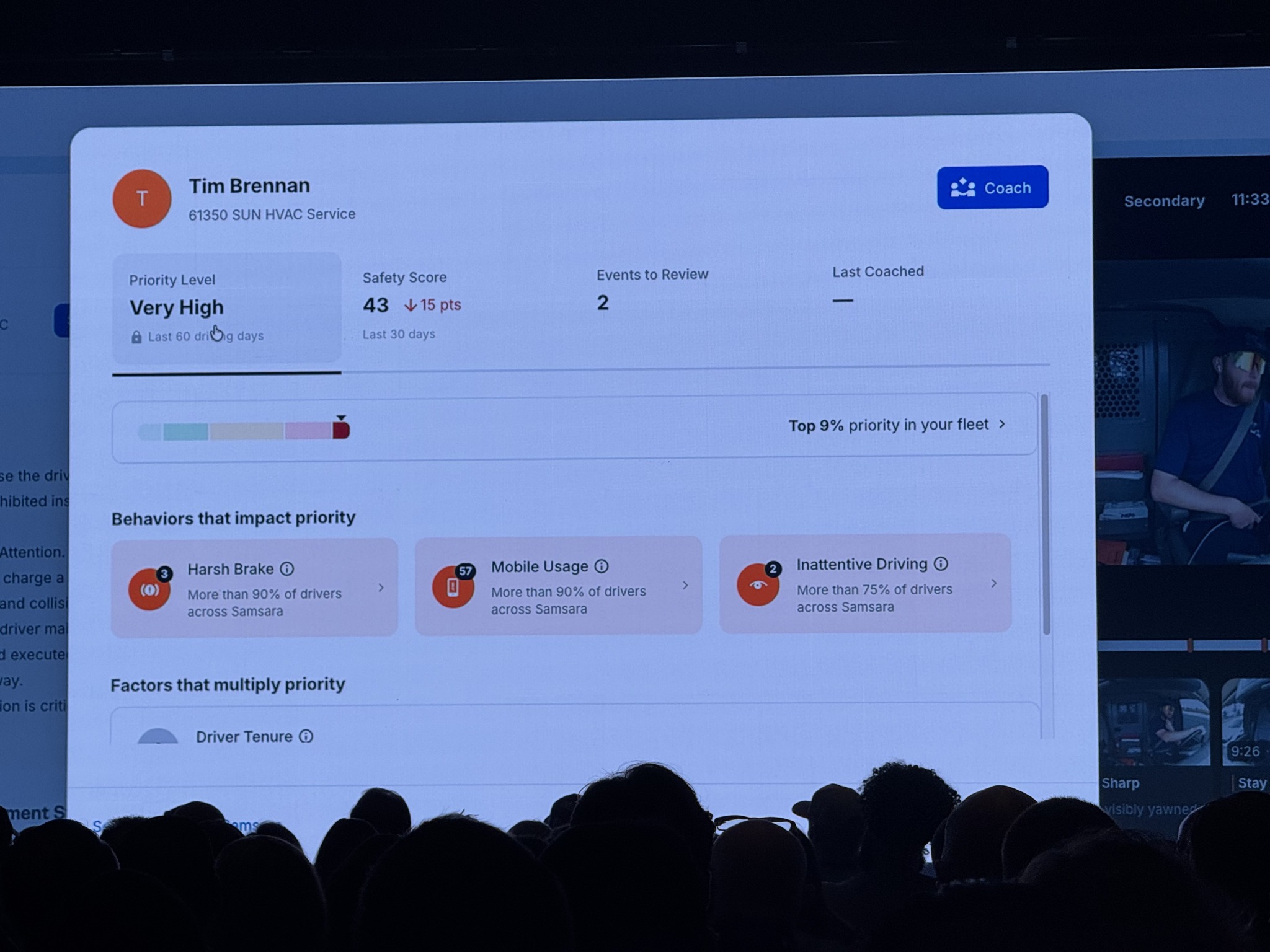
Rather than recommending a specific action, Coaching Priority surfaces the drivers who may need attention and gives fleets the flexibility to decide how they want to respond. Depending on their policies, organizations can assign automated coaching, self-guided training, group coaching sessions or one-on-one conversations with a safety manager.
“It’s totally up to the customer,” Podduturi said. “We don’t actually make a concrete recommendation there, but we give them the tools to say, ‘I want to intervene and I want to coach these drivers.'”
For large fleets, he added, that visibility becomes increasingly valuable. Instead of trying to review thousands of drivers individually, managers can quickly find out the few that need immediate attention.
“Who are the 50 that I need to really pay attention to, and how do they overlap in terms of tenure? How are their scores trending over time?,” are the questions managers can now get answers to, Podduturi said. “Sometimes we see really good drivers who kind of go through a little lull in their score, and the coach needs to just lean in and talk to that person, ‘what’s going on in their life? Can I help you? And are there things that we can address?’ So it’s it’s just like putting data around intuition.”

Have your say
This is a moderated forum. Comments will no longer be published unless they are accompanied by a first and last name and a verifiable email address. (Today's Trucking will not publish or share the email address.) Profane language and content deemed to be libelous, racist, or threatening in nature will not be published under any circumstances.