Samsara looks to enhance driver experience with AI assistants, ride-alongs, coaching tools

When a driver starts a shift, he or she needs weather updates, traffic conditions and job-site information to complete the job successfully. Along the way, dispatch might need to communicate a route change, while the safety department looks at the reports back in the office to figure out who needs to be coached before the next preventable crash.
Traditionally, each task requires a different person, system or conversation. But Samsara believes artificial intelligence (AI) can help bring those touchpoints together.
At its fifth annual user conference, Beyond, in Las Vegas, the company unveiled a series of tools designed to brief drivers before a shift, analyze their behavior behind the wheel, prioritize coaching and communicate directly through in-cab cameras.
The announcements, among others, included AI Ride-Alongs, Coaching Priority, AI-generated driver briefings, Bird’s Eye View, a new 360-Degree Camera and two-way audio communication through the company’s camera platform.
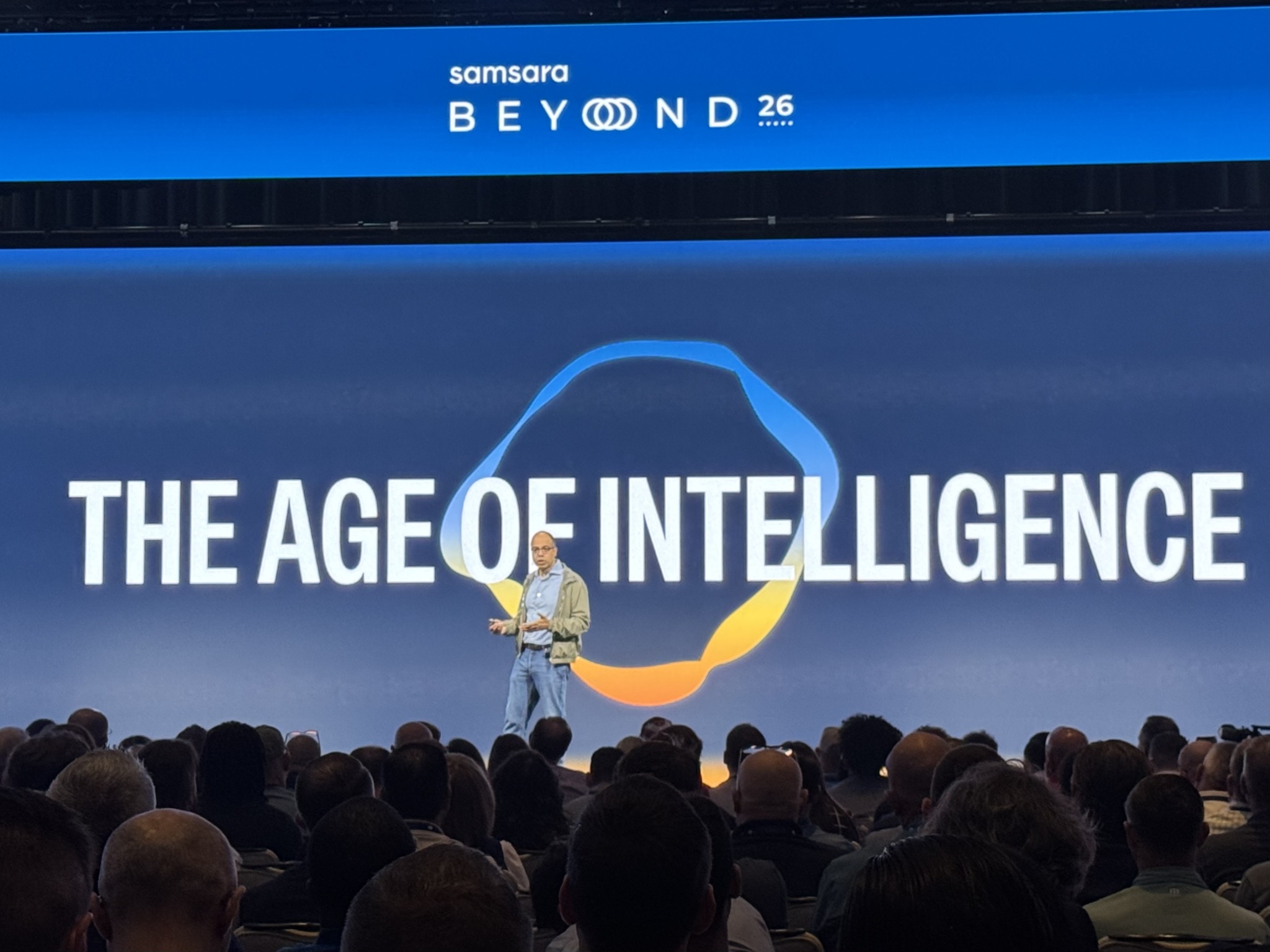
Together, the products reflect a broader shift in the company’s AI strategy: while Samsara helps fleets collect and interpret operational data, it is now turning AI tools to “automate the grind” and help fleets act on the information they have.
“We’re entering something we call the Age of Intelligence,” co-founder and CEO Sanjit Biswas told more than 4,000 attendees during the keynote on June 24. “In the last year, since we met, AI has gotten even more capable, even more powerful. AI can now formulate plans, figure out tools, and really help you run your operation and take action on your behalf, and that’s exciting to that state. And the most practical part of that is that AI can now start automating away some of the task work that has to happen every single day as part of your operation, and this is a huge unlock.”
Biswas reflected on conversations with its customers, saying that as fleets continue to deal with driver turnover, insurance costs, nuclear verdicts and increasingly complex regulatory requirements, he sees the industry with more information than ever but limited time to interpret and act on it.
So the new product lineup — from AI driver assistants and maintenance agents to a paper-thin tracking label for freight — is designed to help fleets turn information into action, Samsara executives argued. As chief product officer Johan Land summarized, “Only when we see everything can we actually act on it,” he said during the keynote.
AI takes on pre-trip briefing
One of the demonstrations was the redesigned driver experience built around AI-generated briefings, where a driver entering the cab was greeted by an AI voice delivered through Samsara’s existing camera system.
“Incoming message to your camera, please turn off the radio. I’m an AI agent on a recorded line. Are you ready for your startup day briefing?” the agent asked the driver. It proceeded to review the driver’s safety score, and summarized the route ahead, while pointing out a recent following distance event.
“Your safety score is fully steady at 96, and your safe speed streak is up to 236 miles. Great job. Today’s drive is a 90-minute round trip,” AI said. “Conditions are clear, and traffic is moving well this week. I noticed you had one following distance event, so today let’s aim for four seconds of space, especially when traffic is merging. Do you have any more questions?”
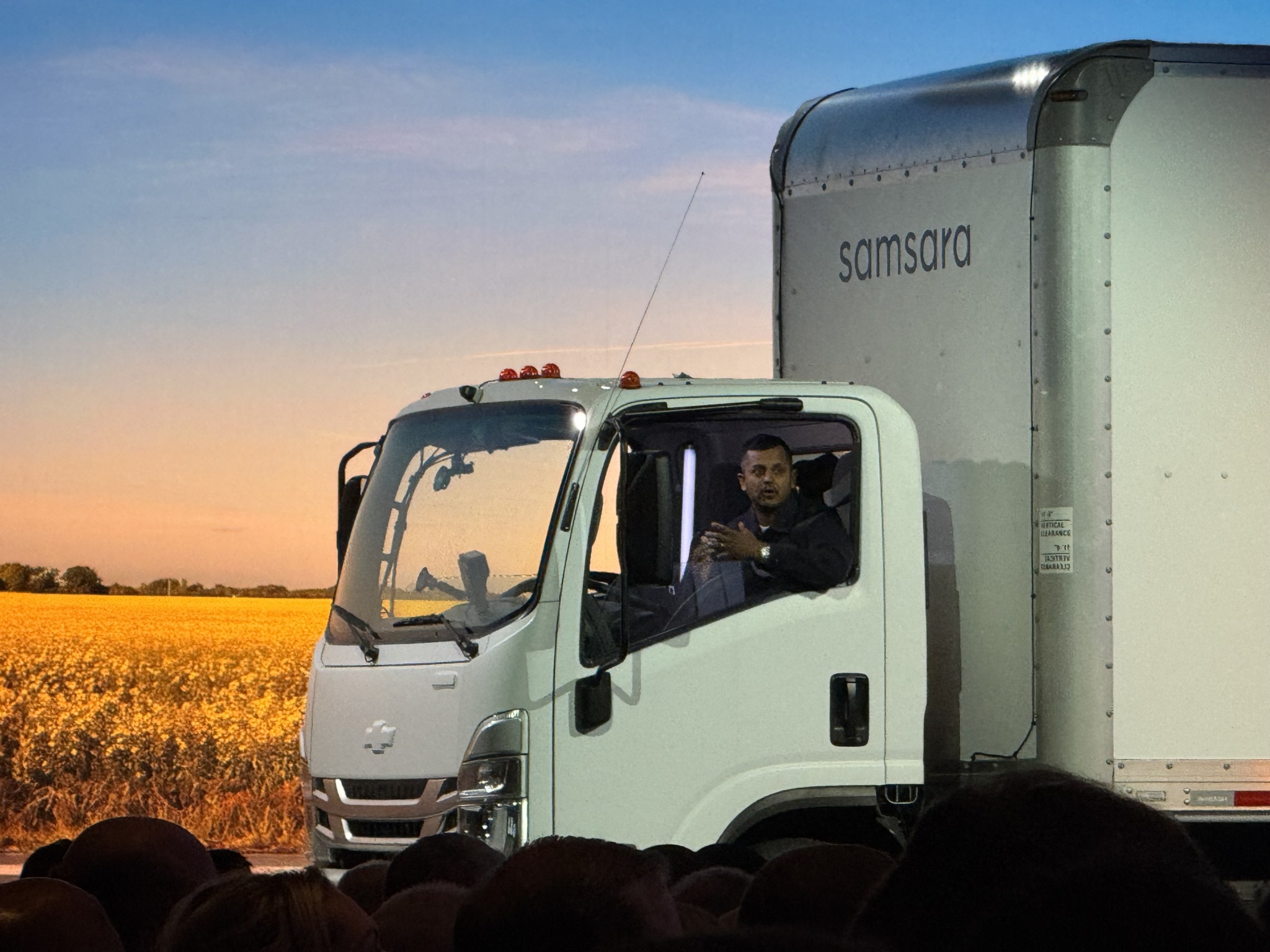
The driver asked whether there were any high-risk areas along the route. The AI responded with information about an upcoming construction zone on Interstate 15, warning of reduced speed limits and the potential for sudden stops.
This resembled a conversation with a dispatcher, driving coach and safety manager rolled into one, but was generated automatically using data already available through the Samsara platform of connected vehicles.
During a press conference following the keynote, Biswas said fleets will be able to customize the briefings by determining what information is shared with drivers, how detailed the updates should be and when they are delivered. Some may choose short daily safety updates while others may include operational information, route guidance or driver recognition.
The feature is currently available in beta.
During the keynote, vice president of product safety Arpan Podduturi described a modern cab environment filled with screens, alerts, messages and mobile devices competing for a driver’s attention. The goal, he said, is to deliver relevant information at the right moment without introducing additional distractions.
“They have screens, they have more screens, they get beeps and alerts, they have post‑its stuck to their dash… So we challenged ourselves, can we help you reach drivers without phones, without mobile plans, and without another screen,” Podduturi said, revealing that AI briefings are only one part of Samsara’s broader vision for the cab.
“Today, I’m excited to share you can now reach drivers in the moment using Samsara’s cameras that are already in the cab.”
Using a feature called Two-Way Audio, dispatchers can contact drivers directly through Samsara’s camera system rather than relying on mobile phones. During a demonstration, a dispatcher informed a driver about a route change and pushed updated navigation instructions directly to the vehicle. All the driver had to do was accept the new route on his end by tapping the screen.
But communication is only one part of the equation. Samsara also introduced visibility tools that help drivers be more aware on the road.
Bird’s Eye View, built on the AI multi-cam launched last year, combines feeds from four cameras mounted around a vehicle into a single top-down image, giving drivers a complete view of their surroundings from one screen. AI continuously monitors the scene, identifying pedestrians and other hazards and alerting drivers when someone enters a potential danger zone.
Land said the technology is designed for environments where visibility is limited and interactions with pedestrians are common, including urban delivery routes, school buses and other commercial operations.
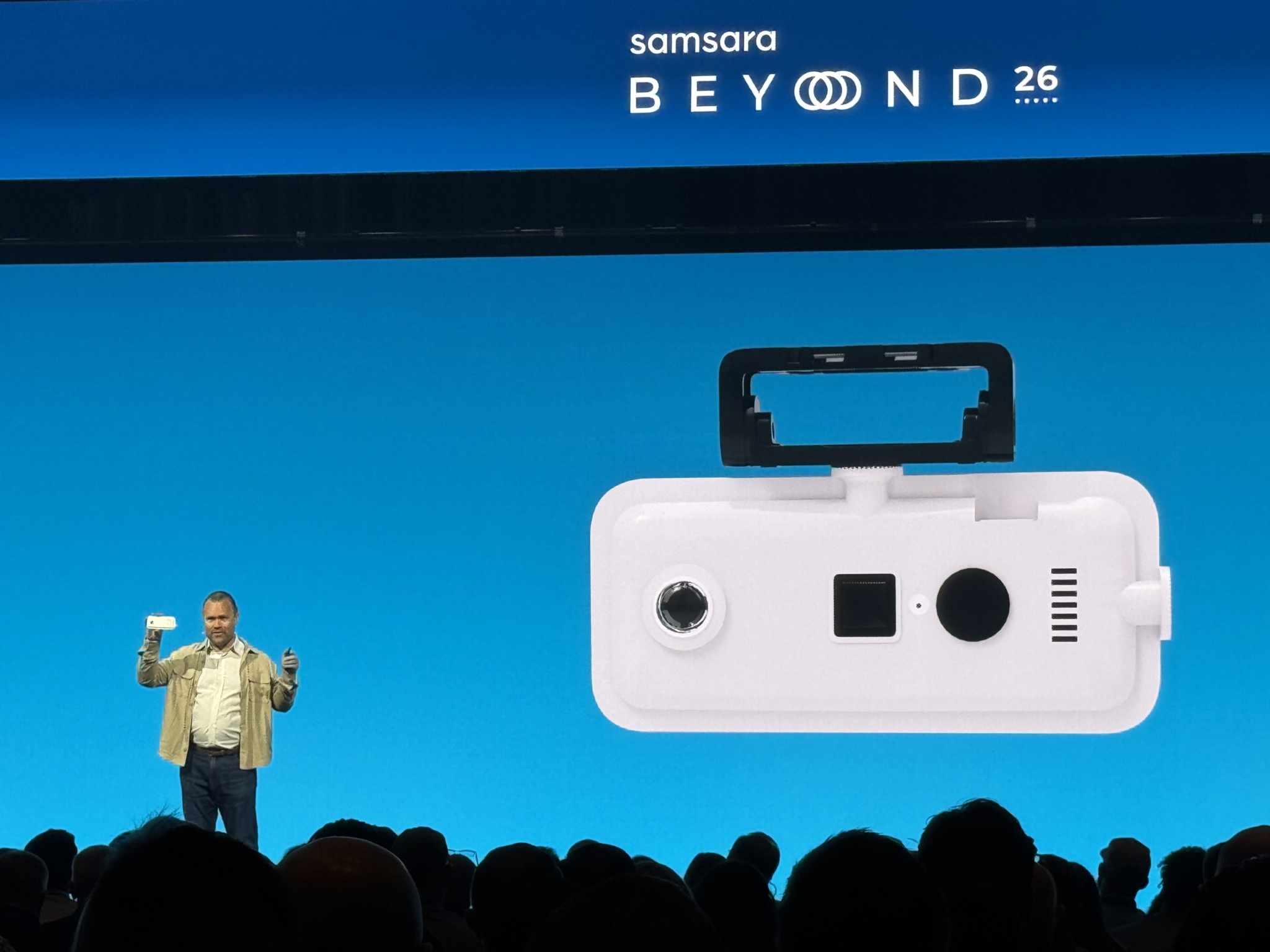
Samsara also introduced a new 360-Degree Camera designed for equipment such as forklifts, telehandlers, baggage carts and construction equipment and other assets. The ‘ultra-ruggedized’ device combines front and rear ultra-wide views into a single navigable image.
The company said the system can provide complete visibility around an asset through a single camera installation, reducing complexity compared to traditional multi-camera systems.
From observation to coaching
The next challenge is determining what to do with all the information generated by cameras and telematics systems.
To address that, Samsara introduced AI Ride-Alongs, a feature designed to replicate one of the industry’s most effective — and least scalable — coaching techniques. “We know ride-alongs work,” Land said during the keynote. “The challenge is they’re almost impossible to scale.”
While traditional ride-alongs allow experienced drivers and safety managers to identify behaviors such as poor mirror checks, distraction or aggressive driving, the problem is that most fleets can only conduct them with a small percentage of drivers, and drivers are on their best behavior if the evaluator is in the cab with them.
According to Land, Samsara analyzed billions of miles of driving data and identified 22 behaviors across six categories that it says are among the strongest predictors of collisions. The system looks for behaviors such as mirror checks, attentiveness, distraction and anticipation of hazards, then comes up with coaching recommendations and automatically assigns targeted training.
For example, Land demonstrated the system using footage from a driver named Tim. In one event, Tim briefly looked down while driving to charge a vape. The AI identified the distraction, recognized the object as a vaping device and automatically assigned coaching content focused on distracted driving.
The insights generated by AI Ride-Alongs and other features also feed into another new tool, called Coaching Priority.
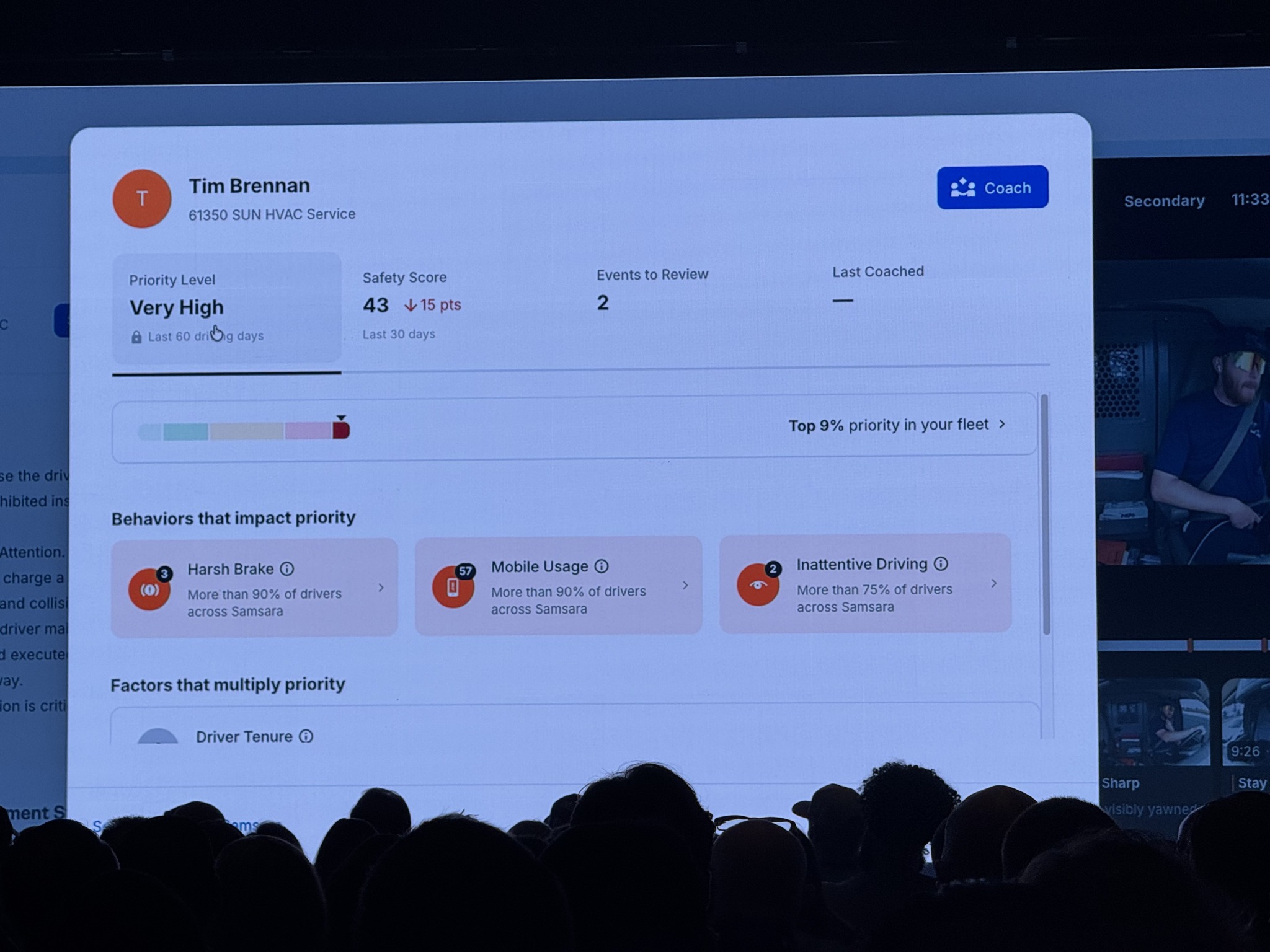
The feature analyzes each fleet driver’s complete history to determine who should be coached first. The evaluation is based on more than 45 risk factors, including road conditions, weather, coaching history and other behavioral patters.
Land showed how Coaching Priority could be used across a fleet of nearly 4,000 drivers. The system identified roughly 300 as very high risk, so safety managers can focus their attention where it can have the greatest impact. At the same time, drivers identified as lower risk can continue receiving automated or self-guided coaching. The goal, Land said, is to help fleets scale coaching programs without treating every driver the same.

Have your say
This is a moderated forum. Comments will no longer be published unless they are accompanied by a first and last name and a verifiable email address. (Today's Trucking will not publish or share the email address.) Profane language and content deemed to be libelous, racist, or threatening in nature will not be published under any circumstances.