Driver behavior key to fuel savings, safety: Panel

Improving fuel economy, cutting costs, and reducing risk may sound like separate goals, but at a Truck World panel on eco-driving and high-tech coaching, speakers made it clear they all start in the same place: the driver.
The discussion, held on the GreenTech Conference stage, brought together Terry Gardiner of Isaac Instruments, Jorge Moraes of K3 GreenTech, and Patrice Veillette of Intact Insurance, who offered an insurance perspective on how driver behavior is shaping fleet performance.
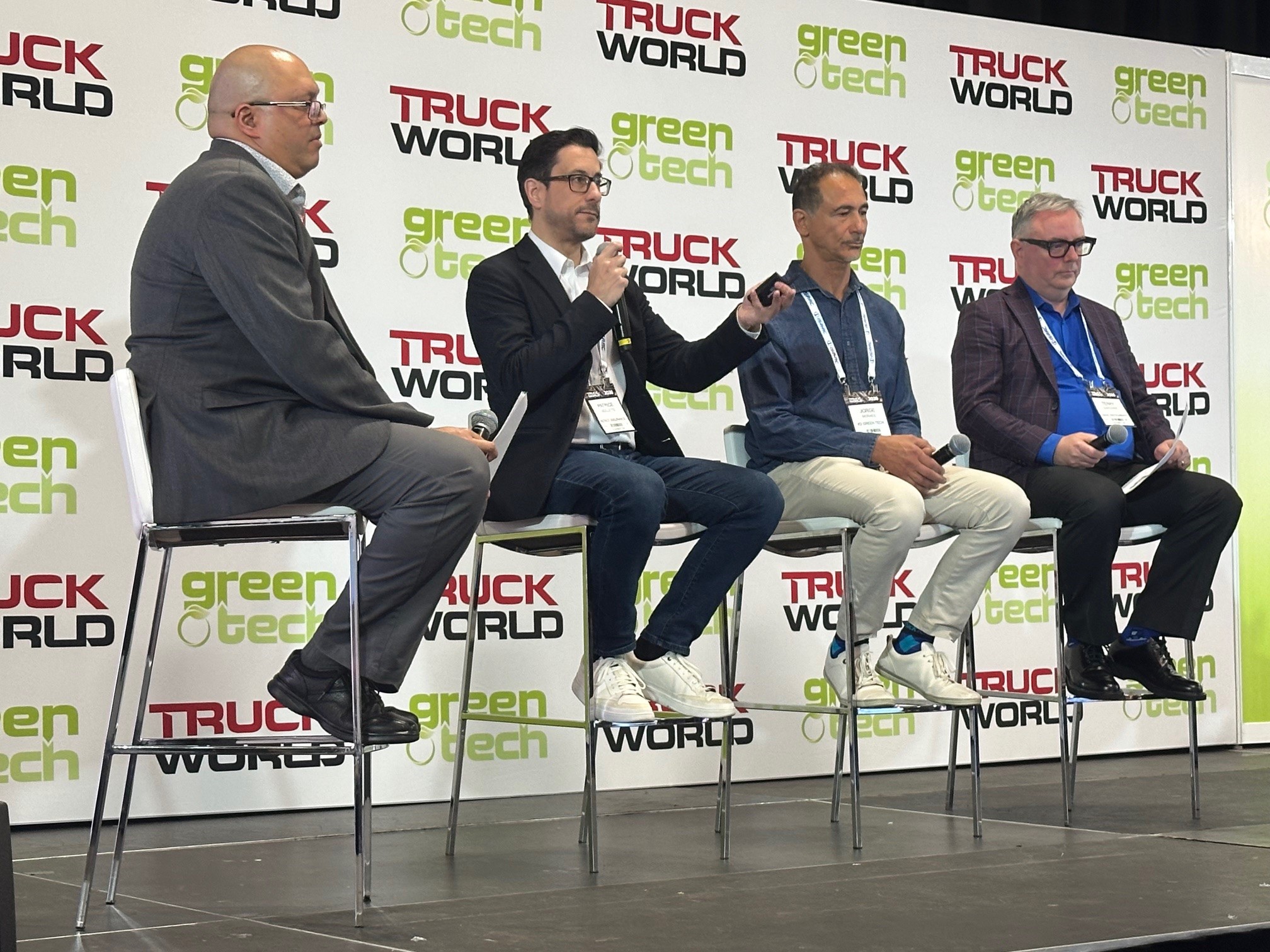
Their message was consistent throughout: fleets don’t need to wait for new trucks or alternative fuels to improve sustainability — they can start by changing how their drivers operate today.
“Small changes in driving behavior can deliver big sustainability and safety gains,” Veillette said.
Driver behavior: The biggest lever
While the industry often focuses on electrification and emerging technologies, panelists said the most immediate gains come from addressing basic driving habits.
Speed, acceleration, braking, idling, and even route selection all have a direct impact on fuel consumption and risk.
“Reducing top speed yields immediate fuel savings,” Veillette said, adding that it also reduces crash severity and insurance costs.
Gardiner put it more bluntly.
“The driver’s foot is on the pedal,” he said. “Nobody influences fuel economy and insurance risk more than the driver.”
That connection between fuel efficiency and safety was a recurring theme. Aggressive driving — hard acceleration, frequent braking, and tailgating — not only burns more fuel but also increases the likelihood of collisions.
Conversely, smoother, more defensive driving improves both metrics.
“You make your drivers more fuel-efficient, you also make them safer,” Gardiner said, citing data showing measurable reductions in hard braking, sharp turns, and collisions as driver performance improves.
From data overload to action
With telematics systems now generating massive amounts of data, the challenge for fleets is no longer collecting information — it’s using it effectively.
“We get millions of data points,” Gardiner said. “But how do we translate that into meaningful change?”
The answer, he said, is simplicity.
Rather than overwhelming drivers and managers with data, fleets need to distill it into clear, actionable feedback. Real-time coaching — such as simple green, yellow and red indicators — allows drivers to adjust behavior immediately.
“Make today better than yesterday,” Gardiner said.
Veillette agreed, emphasizing the importance of identifying the riskiest behaviors first and tackling them in stages.
“Identify, address, coach and monitor,” he said. “You don’t fix everything at once.”
That step-by-step approach was echoed across the panel.
“Trucking is not baseball — there are no home runs,” Gardiner added. “It’s singles and doubles. You grind it out.”
Insurance and cost pressures driving change
From an insurance standpoint, Veillette said the stakes have never been higher.
Rising claims costs, increased litigation, and so-called nuclear verdicts have driven premiums upward, putting pressure on fleets to better manage risk. Telematics data is becoming a key tool in that effort.
By analyzing high-frequency data such as speed, braking events and driving patterns, insurers can more accurately assess risk and reward safer fleets.
Programs leveraging this data are already offering meaningful incentives, with fleets able to achieve significant premium reductions by improving driver behavior.
“There’s not a lot of profit in this industry,” Veillette said. “I still don’t understand why companies are leaving this on the table.”
Technology as an enabler
While all three panelists emphasized the value of technology, they were equally clear that it’s not a silver bullet.
Moraes, whose company focuses on helping fleets adopt efficiency technologies, said many operators are quick to look at electrification without addressing more basic inefficiencies. He compared it to a leaking bucket.
“You have holes — poor driving, bad tire pressure, excessive idling,” he said. “If you don’t fix those, you’re losing money no matter what technology you add.”
That doesn’t mean advanced technologies don’t have a role. Moraes pointed to emerging solutions such as hybrid retrofit systems and AI-powered driver monitoring tools that can detect fatigue and prompt drivers to take breaks.
But he stressed that adoption should be driven by clear business cases, not trends.
“Companies don’t adopt sustainability, they adopt economics,” he said.
Practical steps for fleets
For fleets wondering where to start, the panel offered a consistent answer: focus on what you can control today. That begins with driver training and coaching, supported by telematics and, increasingly, in-cab and outward-facing cameras.
It also means setting realistic targets, calibrating systems to avoid overwhelming drivers with alerts, and building a culture of continuous improvement.
“Start small,” Moraes said. “One truck, one driver, and scale from there.”
Gardiner noted that smaller fleets may actually have an advantage.
“It’s easier to turn a canoe than an ocean liner,” he said, suggesting smaller operators can implement changes more quickly than larger organizations.
Looking ahead
Asked what will define the fleets that outperform in the coming years, Veillette pointed to those that fully embrace data and visibility.
That includes integrating telematics, cameras and analytics into daily operations and using that information to drive decision-making.
“They know everything they do,” he said. “They understand risk and they manage it.”
Ultimately, the panel’s message was less about technology itself and more about discipline.
In a challenging market, where margins remain tight and costs continue to rise, the fleets that succeed won’t necessarily be the ones with the newest equipment.
They’ll be the ones that make the most of what they already have — starting with the person behind the wheel.

Have your say
This is a moderated forum. Comments will no longer be published unless they are accompanied by a first and last name and a verifiable email address. (Today's Trucking will not publish or share the email address.) Profane language and content deemed to be libelous, racist, or threatening in nature will not be published under any circumstances.