Fleets ‘living in a fog’ as costs, tech, and uncertainty collide

Fleets are navigating one of the most turbulent periods in recent memory — balancing rising costs, rapid technological change, and long-term strategic bets with no clear roadmap.
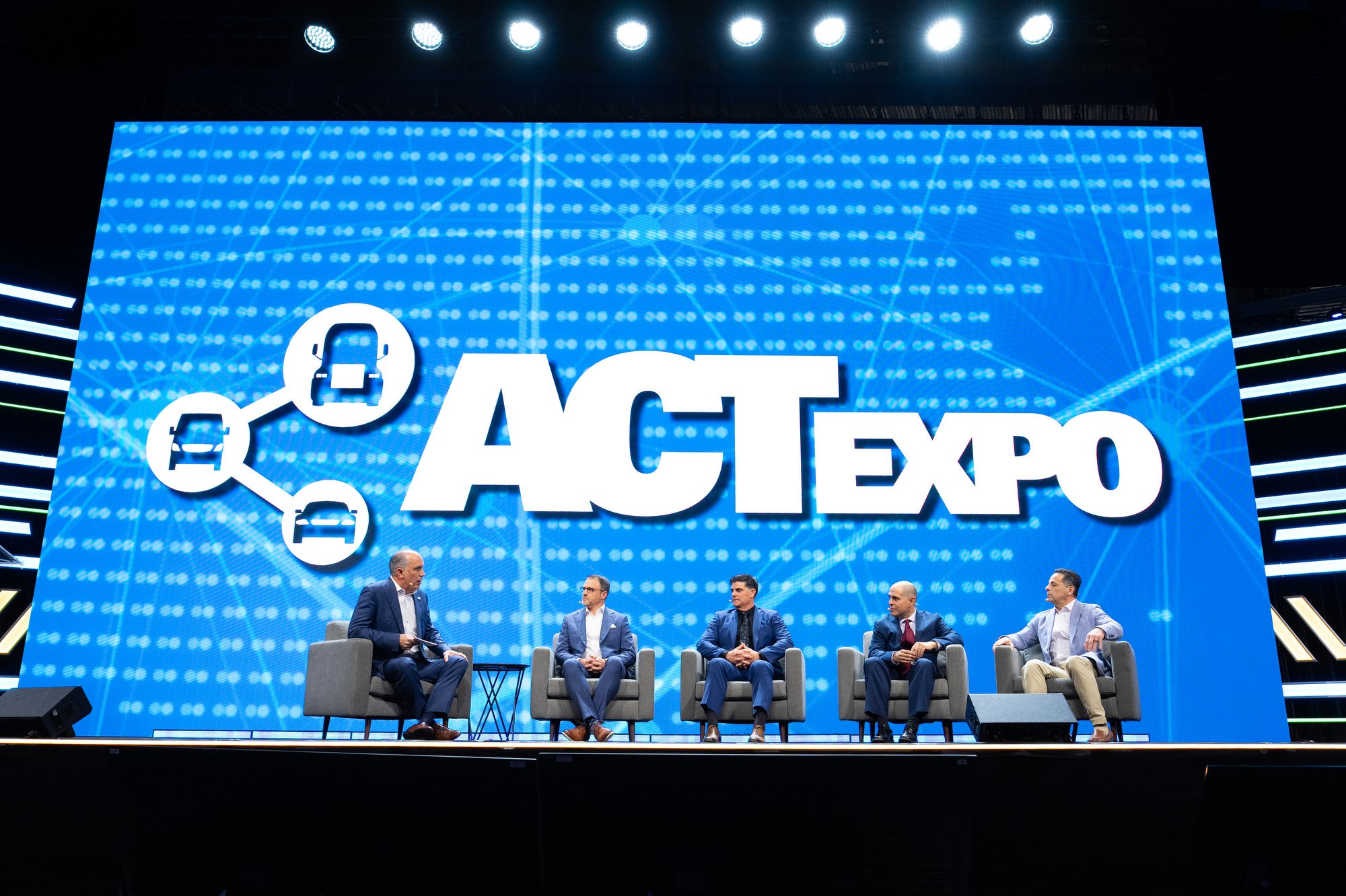
That was the consensus from a fleet-heavy panel at ACT Expo, where operators from Penske, FirstFleet, New York City, and Hermann Services outlined how they’re managing through what one executive described as years of overlapping disruption.
“We’ve been living in a fog,” said Paul Rosa, senior vice president of procurement and fleet planning at Penske Truck Leasing.
That fog has included pandemic-era supply chain shocks, inflation, interest rate hikes, a prolonged freight recession, regulatory uncertainty — and now an explosion of new technologies led by AI.
“What could happen in the next three years is just amazing,” Rosa added.
Data and AI reshape decision-making
For many fleets, the response has been to lean heavily into data — not just to survive the downturn, but to position for what comes next. Penske, for example, has built predictive maintenance and analytics tools across hundreds of thousands of connected vehicles.
“We’ve been using predictive analytics to help customers better plan,” Rosa said, pointing to efforts to reduce breakdowns and improve uptime.
The company has also developed a proprietary platform, Catalyst AI, to benchmark fleet performance across similar operations, identifying opportunities to improve efficiency.
“Knowledge is power,” said Jeffrey Hermann, chairman and CEO of Hermann Services. “When we have the ability to make better informed decisions, we create a more sustainable organization.”
AI adoption accelerating
Panelists agreed artificial intelligence is already reshaping the industry, from maintenance planning to driver recruiting and freight matching. “I don’t think we’re far away from it; I think we’re here,” Hermann said.
But adoption isn’t as simple as flipping a switch. Austin Henderson, chief information officer at FirstFleet, warned that legacy systems can become a major barrier.
“If you’re not plumbed to interact with that data, the opportunity passes you by,” Henderson said.
That means fleets must invest in foundational systems, even if the payoff isn’t immediate. “Plumbing is boring until it doesn’t work,” he added.
While long-term transformation is underway, fleets are also dealing with immediate financial pressures — particularly fuel costs.
Keith Kerman, chief fleet officer and deputy commissioner at New York City’s Department of Citywide Administrative Services, said his operation is facing a $50 million year-over-year increase in fuel expenses.
“Fuel pricing is going through the roof,” Kerman said.
That creates tension between short-term cost control and long-term investment in alternative energy.
“There is pressure to pull back,” he said. “But this is what got us into the problem in the first place.”
Instead, New York City is doubling down — expanding electric vehicles, hybrids, and renewable diesel despite the upfront cost. “I regret the ones we haven’t bought,” Kerman said.
The strategy is designed to insulate the fleet from volatile fuel markets over time.
No one-size-fits-all solution
Across the panel, one theme came through clearly: there is no single technology or strategy that works for every fleet. “We have to understand all of them,” Rosa said, referring to the range of powertrain options.
Penske approaches this by evaluating technologies across different applications, matching solutions to specific duty cycles rather than betting on a single path. “It comes down to what works for the customer,” Rosa said.
That approach reflects the growing complexity of fleet operations, where decisions must account for infrastructure, maintenance, resale value, and customer expectations.
Investment continues despite uncertainty
Despite ongoing volatility, fleets said they are continuing to invest even after several difficult years.
“We’ve endured three really long, painful years of a freight recession,” Hermann said.
For companies that have weathered the downturn, the focus now is on being ready for the next upcycle.
“If the market turns, we don’t want to be behind,” he said.
That means committing capital even when conditions are uncertain — a decision that requires confidence in long-term fundamentals. “Cycles happen,” Hermann added.
Technology isn’t the only pressure fleets are managing. Driver recruitment and retention remain critical, particularly as demographics shift.
“We have to be very creative,” Henderson said.
That includes investing in technology, compensation, and workplace culture — while using data to anticipate changes in the labor market. “We can’t take our eye off the ball,” he added.
Safety tech delivering immediate ROI
While much of the discussion focused on emerging technologies, panelists highlighted the impact of existing tools, particularly in safety. Hermann pointed to AI-powered camera systems as a major step forward.
“They’re not just enforcement tools — they’re coaching tools,” he said.
These systems can identify risky behaviors, reduce accidents, and even exonerate drivers in disputes, helping fleets manage rising insurance costs and litigation risks.
Autonomous trucking remains a long-term opportunity, but panelists said it won’t apply across all operations. “It’s not going to work in every application,” Rosa said.
That said, progress is accelerating, and many see it as a “game changer” once commercialized.
In the meantime, fleets are focused on incremental automation, driver assistance systems, predictive tools, and operational efficiencies.
The biggest risk: doing nothing
If there was one clear warning from the panel, it was this: fleets that wait for certainty risk falling behind.
“Don’t wait for perfection,” Henderson said of investing in new technologies. Technology is evolving too quickly, and the cost of inaction is rising.
“I would encourage fleets to dive into this,” Rosa added.
At the same time, panelists cautioned against chasing every new offering without careful evaluation.
“Not every solution is the right solution,” Hermann said.
There’s no single path forward, and uncertainty isn’t going away anytime soon, panelists agreed.

Have your say
This is a moderated forum. Comments will no longer be published unless they are accompanied by a first and last name and a verifiable email address. (Today's Trucking will not publish or share the email address.) Profane language and content deemed to be libelous, racist, or threatening in nature will not be published under any circumstances.