OEM leaders face ‘stacked uncertainty’ as trucking enters era of rapid change

Truck and engine manufacturers say the industry is entering a period of unprecedented complexity driven not by a single disruption, but by multiple forces hitting at once.
From regulatory uncertainty to accelerating technology change and shifting customer expectations, the challenge isn’t just volatility, it’s the layering of unknowns.
“The stack-up of unknowns is what’s causing the problem,” said Mathias Carlbaum, president and CEO of International Motors.
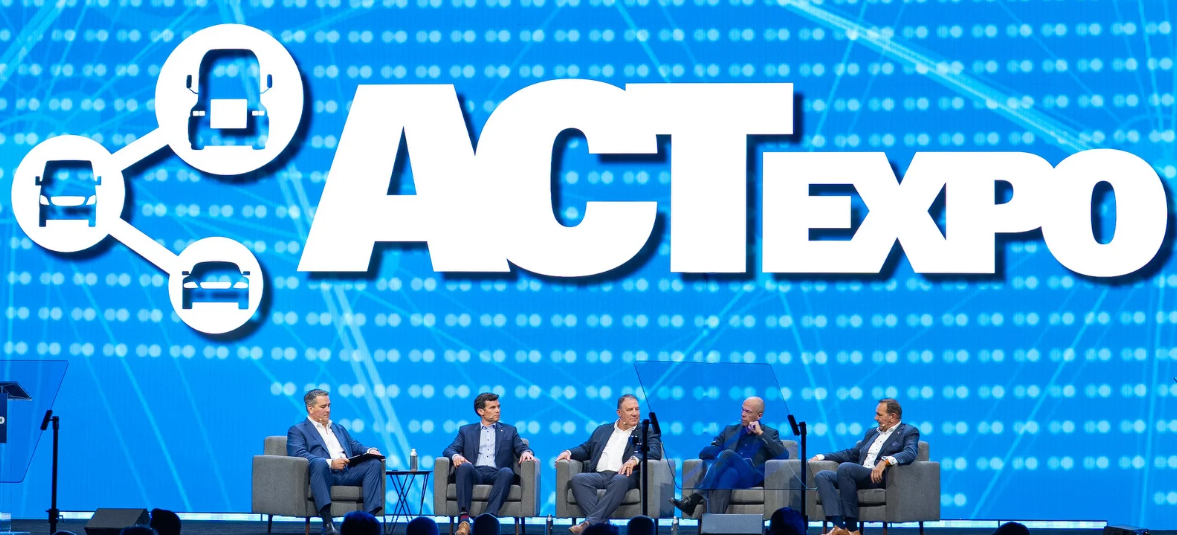
Speaking during a C-suite panel at ACT Expo, Carlbaum joined fellow OEM leaders from Mack Trucks, Volvo Trucks North America, and Cummins to outline how they are navigating what some described as a fundamentally different operating environment.
Cyclical, but different this time
The truck market has always been cyclical, panelists acknowledged. But the current moment feels different.
“There’s always something big going on,” said Peter Voorhoeve, president of Volvo Trucks North America.
While past cycles were driven largely by freight demand and economic swings, today’s environment combines those traditional factors with rapid advances in electrification, software, connectivity, and emissions regulation.
“In the last seven years, more has happened than maybe in the last 70,” Voorhoeve said.
The result is a pace of change that is unlikely to slow.
Customer demand still leads
Despite shifting policy signals — including emissions rule changes and regulatory rollbacks — OEMs said their investment priorities remain anchored in customer needs.
“You look at what the customer wants first,” said Jonathan Randall, president of Mack Trucks North America.
That means focusing on safety, efficiency, and uptime while still meeting regulatory requirements.
“You combine what the customer wants with what the regulator requires,” Randall said.
For Cummins’ Brett Merritt, that balance is driving record levels of investment.
“We are definitely investing more as an industry now than we ever have,” he said. Even for engine suppliers, the pressure is increasing. “You have to deliver regulatory compliance, but also fuel economy, durability, and reliability.”
Software-defined trucks the reality
One of the most significant shifts is the transition toward software-defined vehicles, trucks that rely on centralized computing, connectivity, and over-the-air updates. While the concept has gained traction over the past year, executives said the transition has been gradual rather than sudden.
“It’s not a cliff event,” Carlbaum said. “The vehicle just becomes enabled.”
Advances in computing power and connectivity are allowing OEMs to treat trucks as integrated systems rather than collections of individual components. That shift is already delivering measurable results.
Randall said his company has moved from updating roughly one-third of connected trucks to nearly 90% through over-the-air software updates in just a few months. The goal is continuous improvement, not just at the point of sale.
“You wake up in the morning, and there’s an update waiting,” Randall said, comparing trucks to smartphones.
Digital becomes the new differentiator
As hardware improvements become more incremental, software and services are emerging as key competitive differentiators. “The truck is almost the price of entry,” Randall said.
OEMs are increasingly competing on the services layered on top, including predictive maintenance, uptime management, and performance optimization. That shift is opening the door to new business models.
“You’re selling miles instead of trucks,” Randall said.
Subscription-based models — where fleets pay for usage rather than ownership — are expected to grow as connectivity improves.
Artificial intelligence is also beginning to deliver tangible value, particularly in maintenance and operations.
“We’ve saved over 200,000 maintenance hours through predictive AI,” Merritt said.
AI is enabling fleets to move from reactive to proactive maintenance, identifying issues before they lead to downtime. Carlbaum said the key is unlocking the value of massive data streams generated by connected trucks.
“For decades, we’ve collected data,” he said. “Now we can actually use it.”
Applications are expanding beyond maintenance into route planning, safety, and operations, though panelists said the industry is still early in the adoption curve. “We’ve only scratched the surface,” Merritt said.
Safety is non-negotiable
If there was one area where OEMs were unequivocal, it was safety. Advanced driver assistance systems — including collision mitigation, lane-keeping, and pedestrian detection — are increasingly standard equipment.
“A large part is now standard,” Voorhoeve said.
New features such as side airbags and rollover protection are also being added.
The push is being driven not only by regulation, but by customer demand and liability concerns. “It’s non-negotiable,” Carlbaum said.
Panelists pointed to the rising cost of accidents — including “nuclear verdicts” — as a key factor accelerating adoption.
“A non-injury accident can cost $46,000,” Voorhoeve noted.
A multi-fuel future
Despite growing interest in electrification, OEMs emphasized that no single powertrain will dominate.
“You will need electrification, but you will also need diesel in a big way,” Merritt said.
Natural gas, renewable fuels, and hydrogen are also expected to play roles depending on application.
“You need power of choice,” Merritt added.
Carlbaum said electrification economics will improve as battery costs fall and utilization increases, particularly with the potential for 24/7 autonomous operations. But adoption will vary widely.
“Different customers move at different speeds,” he said.
Cybersecurity a growing risk
As trucks become more connected, cybersecurity is becoming a growing concern.
“It’s a race to stay ahead,” Carlbaum said.
The same data and connectivity that enable efficiency and automation can also be exploited by bad actors, requiring ongoing investment in security systems.
“It has to be part of the product,” Voorhoeve said.
While technology is advancing rapidly, full adoption across the fleet will take time.
Replacement cycles vary widely, from a few years for high-utilization fleets to more than a decade in some applications. “We still sell parts for engines from the 1990s,” Merritt noted.
That means the industry will operate in a hybrid environment for years — with legacy equipment alongside next-generation systems.
Have your say
This is a moderated forum. Comments will no longer be published unless they are accompanied by a first and last name and a verifiable email address. (Today's Trucking will not publish or share the email address.) Profane language and content deemed to be libelous, racist, or threatening in nature will not be published under any circumstances.

Do you have the source for this article? I’m looking for a bit of context to elaborate on a few points.