Fuel spikes, tariff swings keep trucking in ‘constant drift,’ FTR’s Starks says

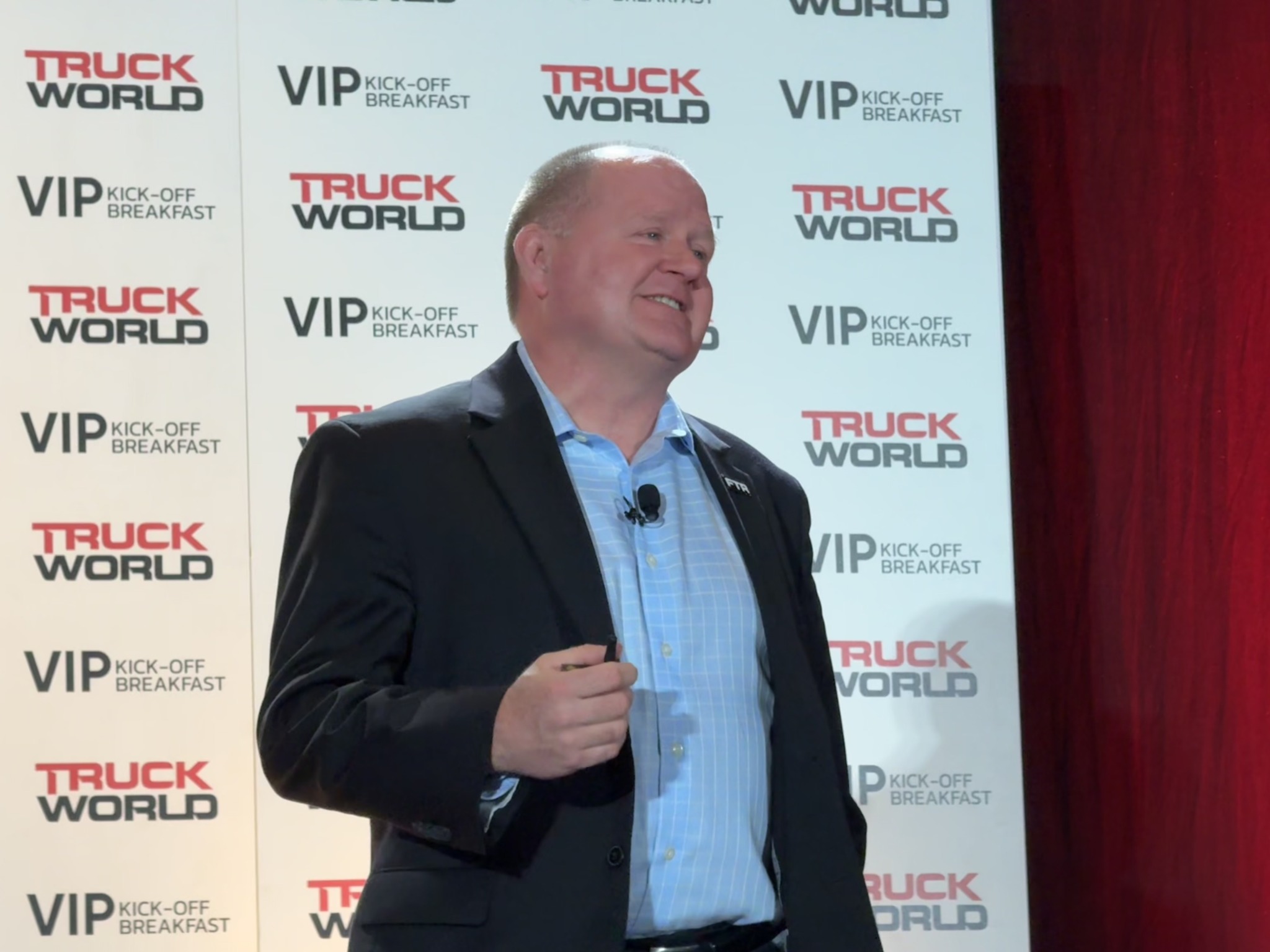
Eric Starks didn’t sugarcoat it. Standing before a packed room at the VIP Breakfast during Truck World, the chairman of FTR opened with a simple question: “How many of you like chaos?”
No hands went up.
“That’s what we’re dealing with right now,” he said.
From geopolitics and fuel prices to tariffs and freight demand, Starks painted a picture of an industry operating in a constant state of uncertainty — one that’s exhausting fleets and making long-term planning increasingly difficult.
“This is a constant drift,” he said. “We’re trying to understand what’s going on, but things are changing so quickly.”
Fuel, geopolitics driving volatility
At the top of Starks’ list of concerns was global instability and its direct impact on trucking’s biggest cost — fuel.
Tensions involving Iran have already driven significant swings in oil markets, with prices spiking sharply before easing slightly. Diesel followed suit, with Starks noting the United States recently experienced its largest week-over-week jump in diesel prices on record.
“I don’t even look at the news first,” he told the audience. “I look at fuel prices first. That tells me if something has materially changed.”
While larger carriers with fuel surcharge programs can generally pass those costs along, smaller operators — particularly owner-operators — are feeling the squeeze.
“They have to pay for fuel today and recoup it weeks later,” Starks said. “That creates a huge amount of strain in the system.”
Even when rates adjust to reflect higher fuel costs, the cash flow lag can create serious financial pressure, especially for smaller players with limited access to capital.
Tariffs, trade and policy whiplash
Beyond fuel, Starks pointed to U.S. trade policy as another major source of instability.
Tariff rates have swung wildly in recent months, at times climbing above 30% before being scaled back amid legal challenges and policy reversals. That unpredictability, he said, is just as damaging as the tariffs themselves.
“Details matter,” Starks emphasized. “We hear these announcements, but without the details, you can’t assess the impact.”
The uncertainty is forcing companies to delay or rethink major investments, including decisions about reshoring manufacturing or restructuring supply chains.
“Why would you spend billions to bring production back to the U.S. when policy could change in two years?” he asked.
That hesitation is already showing up in trade patterns.
While imports into the U.S. remain strong overall, Starks noted a shift away from direct shipments from China, with goods increasingly routed through other Asian countries. At the same time, imports from Mexico are rising while Canadian imports have declined — a trend partly driven by shifts in automotive manufacturing.
He also warned the U.S.-Canada-Mexico trade relationship could face further disruption.
“I believe the administration is going to blow up [the Canada-U.S.-Mexico trade agreement],” Starks said, suggesting a move toward bilateral deals could come as early as this summer.
Freight market: Stable, but not strong
Despite the macroeconomic turmoil, the trucking market itself is showing signs of resilience — at least on the surface. Freight volumes have been relatively flat for several years, which Starks said has created confusion in the industry.
“This is not a freight recession. This was a rate recession,” he explained.
In other words, demand hasn’t collapsed — but pricing power has been weak, squeezing margins across the industry. Now, there are early signs of improvement.
Spot rates have climbed and, notably, held their gains — even after weather-related disruptions that typically cause only temporary spikes.
“What surprised us is they didn’t come back down,” Starks said. “They held.”
After adjusting for fuel, rates have stabilized, suggesting carriers are at least recovering their increased costs.
“That made me feel a little bit better,” he added.
Still, the recovery remains uneven.
Flatbed markets are outperforming, with both load volumes and rates climbing steadily, while dry van freight is improving more gradually. Intermodal demand is also mixed, with modest domestic gains offset by weaker export activity.
One of the more surprising dynamics in the current market is what’s happening with capacity.
The industry has shed trucking jobs in recent months, and enforcement actions — including renewed focus on English-language proficiency requirements in the U.S. — have sidelined some drivers. But overall, Starks said capacity reductions have been modest.
Annualized, enforcement-related out-of-service orders account for less than 1% of capacity, and relatively few involve Canadian carriers. Starks said only 68 Canadian drivers have been placed out of service for English language proficiency inadequacies. More than 60,000 drivers have been found noncompliant with English language requirements, but only about 16,000 have been placed out of service.
Starks said the contrast is because noncompliant drivers near the Mexican border are turned back but not placed out of service.
New carrier entries and exits are roughly balanced, meaning the total number of fleets hasn’t declined significantly. Yet utilization is rising.
That’s a key metric, Starks stressed, because it reflects how efficiently available trucks and drivers are being used.
“Utilization continues to go up and up,” he said. “That’s where the pressure starts to build.”
As utilization tightens, it creates upward pressure on rates, even without a major reduction in overall capacity. Fielding a question on why capacity is stubbornly clinging on despite harsh market conditions. “Everybody’s been saying we need to get capacity out of the system,” Starks said. “That’s the wrong way to think about it.”
Instead, he argued, sustainable recovery depends on freight growth — not simply forcing weaker carriers out.
“If you pull too much capacity out and then freight comes back, everything goes crazy,” he said. “You can’t find drivers, can’t get equipment — and the cycle repeats.”
Economic outlook: Cautious optimism
Looking ahead, Starks expects modest economic growth in the U.S., with GDP hovering around 2%. But that headline number masks underlying challenges.
Consumer spending is slowing, job growth has stalled, and inflation — particularly in services — remains elevated. Those factors suggest interest rates will stay higher for longer, limiting investment and growth.
At the same time, freight demand remains closely tied to goods consumption, which has lagged behind services in the post-pandemic economy.
“We need to see growth in goods,” Starks said. “That’s what turns this market.”
Until that happens, the recovery is likely to remain gradual.
“There are green shoots,” he acknowledged. “But it’s not a sharp rebound.”
If there was a constant theme to Starks’ keynote, it was uncertainty. From global conflict and fuel prices to trade policy and freight demand, the industry is navigating a complex and rapidly shifting landscape.
That’s creating a disconnect between what fleets see on the ground — improving rates and tightening utilization — and the broader economic signals, which remain mixed at best.
“The messaging depends on what you want to focus on,” Starks said. “You can say things are great, or you can say things are terrible.”
The reality, he suggested, lies somewhere in between.
Have your say
This is a moderated forum. Comments will no longer be published unless they are accompanied by a first and last name and a verifiable email address. (Today's Trucking will not publish or share the email address.) Profane language and content deemed to be libelous, racist, or threatening in nature will not be published under any circumstances.

A set argument against a Pre-Buy I’ve read yet.