Blinded by the light: Today’s headlights offer better visibility, but at a cost to oncoming traffic

Whether or not you appreciate the brightness and clarity of modern LED headlights depends on which side of the beam you’re on.
Over the past 30 years, vehicle lighting has shifted from simple, standardized incandescent sealed-beam lamps to a variety of advanced technologies such as LEDs and high-intensity discharge lamps. These newer headlights produce a white or bluish-white light that appears brighter than those traditional lamps.
Interestingly, they are not necessarily brighter in terms of luminance, but the “whiter” color of the light gives that impression. Also, the light they cast causes glare in the eyes of drivers in oncoming cars.
A study published this spring by the American Automobile Association (AAA) found six in 10 drivers say glare is a problem after dark. Nearly three-quarters of those affected believe it has worsened over the past decade.
Other studies from the RAC, a British automotive services company, and the U.S. Insurance Institute for Highway Safety (IIHS) came to similar conclusions. Between 75% and 89% of respondents found headlight glare from oncoming vehicles annoying in the least and “probably dangerous.”
While drivers report that whiter (LED-type) light is harder to look at, those same drivers say they prefer these systems in their own vehicles for visibility. Many drivers routinely complain that their own headlights are not bright enough.
Are LED headlights actually brighter? Has their focus, or aim, changed? Why are they so annoying to look at? Have they proved any safer than traditional incandescent headlights? Let’s dig in.
Improved visibility: at what cost?
One needn’t look far to find someone with a near-miss story about glare from oncoming headlights.
Anecdotal accounts suggest the brightness of oncoming LED headlights hinders low-light visibility. In darkness, the pupils of the eye dilate, or open wider, to allow more light to enter the eye.
When exposed to bright light, the pupils quickly contract, or narrow, limiting the amount of light entering the eye, making the scene ahead appear darker.
Many drivers complain about “temporary blindness” following a close pass of a vehicle with bright white LED headlamps, but crash data do not support the theory that those annoying lights are contributing factors in nighttime crashes.
According to IIHS, glare was a factor in only 0.1%-0.2% of nighttime crashes. Those glare-related crashes were disproportionately associated with older drivers, older vehicles, and undivided low-speed roads. Lane departures were the most common result of glare, accounting for more than half the crashes.
Poor lane markings, on the other hand, coupled with reported glare issues, do move the crash-frequency needle slightly.
Meanwhile, IIHS says previous research has demonstrated that improved headlight visibility reduces the risk of single-vehicle night-time crashes in vehicles equipped with LED lights.
Brightness vs glare
Back in 2003, the U.S. National Highway Traffic Safety Administration began investigating the impacts of headlight glare related to then-emerging LED and HID (high-intensity discharge) headlamps.
The study, An Investigation of Headlamp Glare: Intensity, Spectrum and Size, determined that drivers experienced two types of glare:
- Disability glare, where headlights actually reduce a driver’s ability to see objects, hazards, pedestrians, or lane markings due to scattering of light within the eye. This also has a pronounced effect on peripheral vision.
- Discomfort glare, where headlights appear irritating, dazzling, or painfully bright, but the driver can still see adequately.
Brightness comes into play here, but it’s mostly a matter of color perception rather than an actual increase in the light intensity.
LED headlamps can be colorized by manufacturers to produce the desired tint to the light (sometimes seen as pinkish or blueish). The color spectrum of the light can also be designed into the chemical compounds used to make the LED lamp.
These vary from redish (warmer) to blue-white (cooler). You can see this when buying common household LED lightbulbs. They are often labeled as warm white, cool white and daylight.
You’ll also find a corresponding color temperature number on the package. These numbers are represented on the Kelvin scale from 2,700-3,000K (warm white) to 4,000-5,000K (cool white) and 5,000-6,500K (daylight).
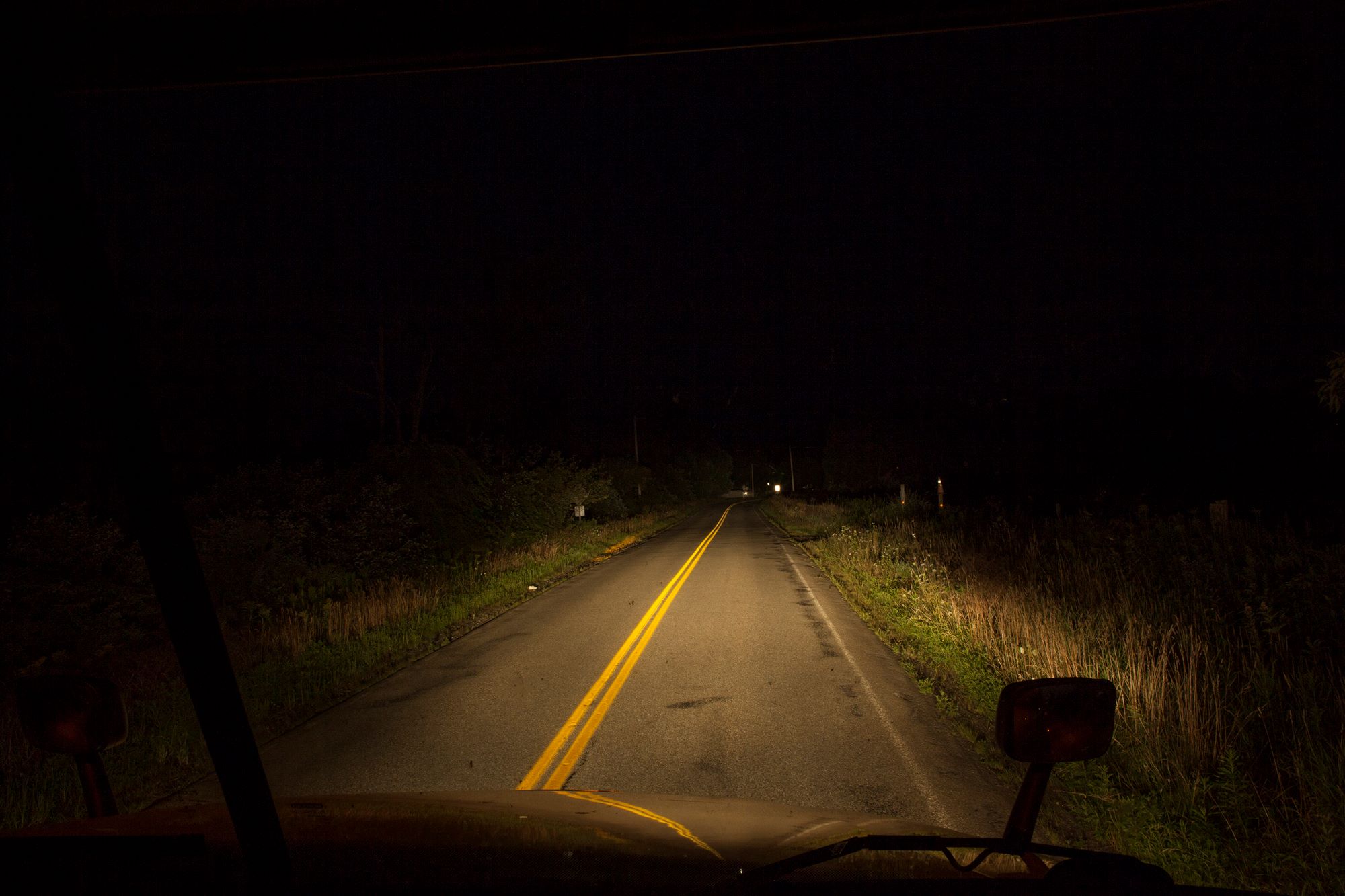
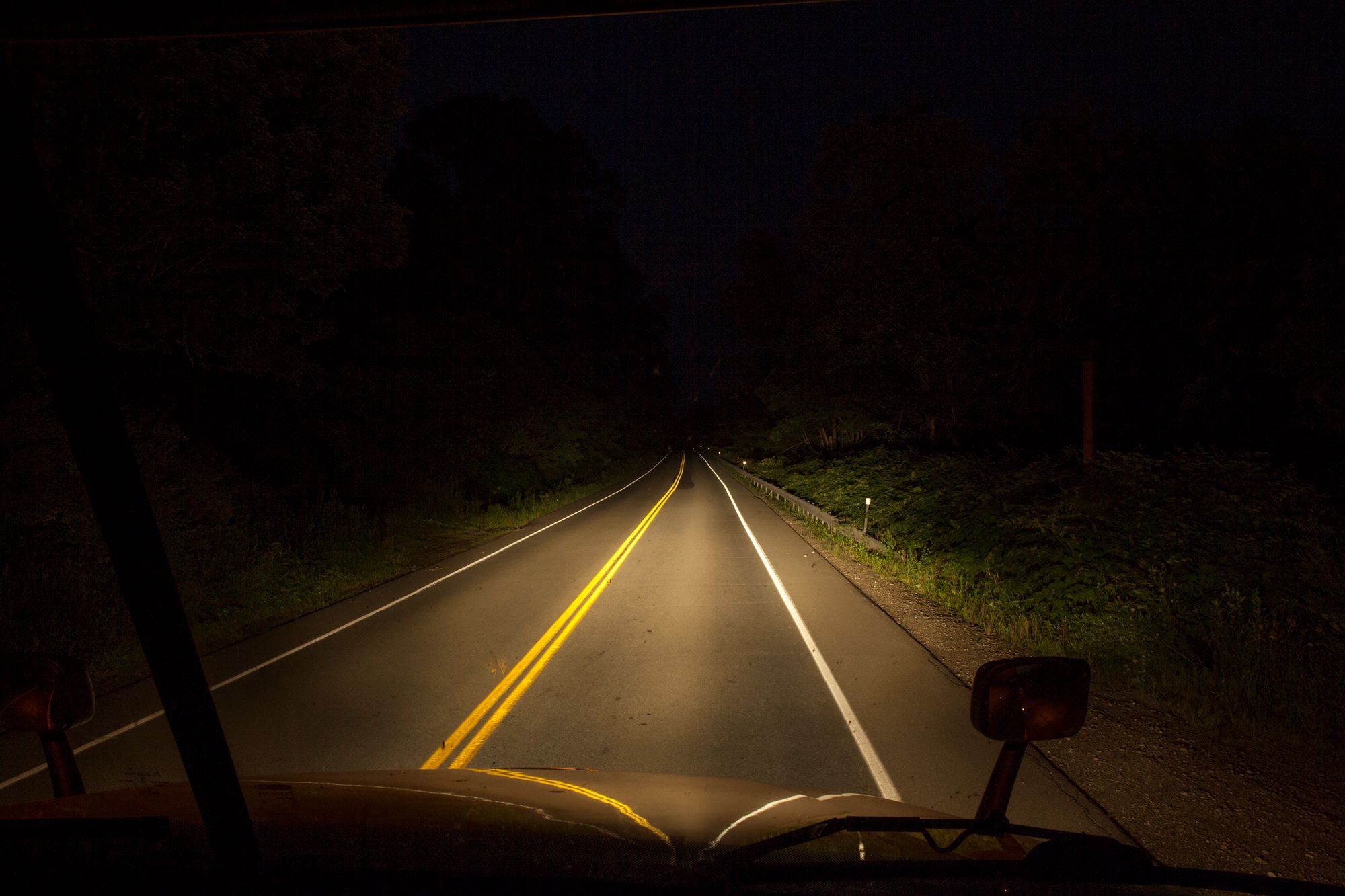
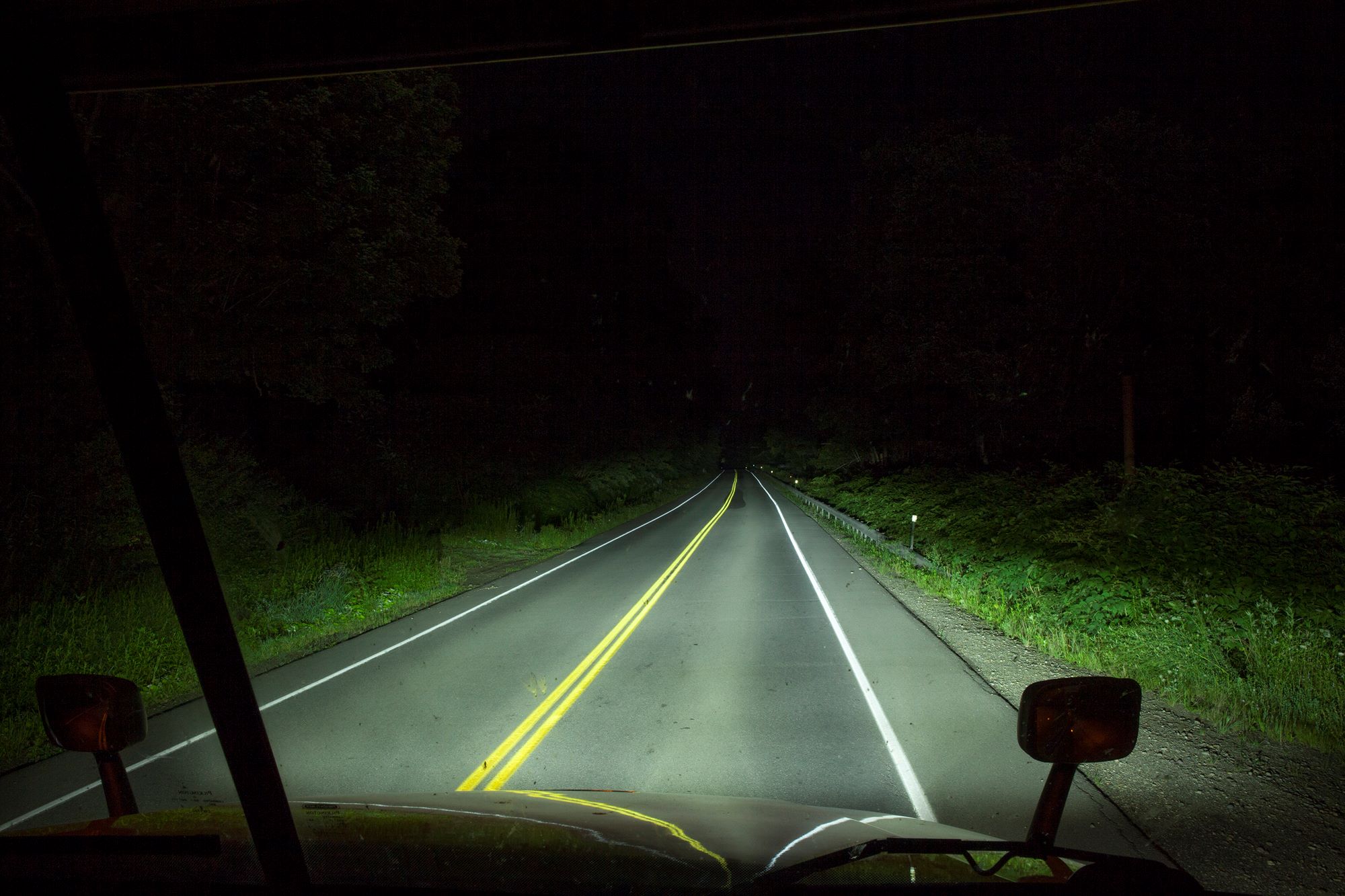
While the “brightness” of the blue-rich white LED headlamps is desirable in a headlamp from the user’s perspective, high levels of blue produce more disability glare for other road users.
Because blue light has a shorter wavelength than red light, it tends to scatter as it passes through the eye’s cornea and the lens, and again as it passes through the fluid and bits of debris within the eyeball before reaching the retina.
This gives a veil-like luminance, or haziness, to the final image the eye registers. Individuals with cataracts may also see halos around bright light sources such as LED headlights.
What’s changed in headlights?
While headlights have evolved, they are still heavily regulated. The American Federal Motor Vehicle Safety Standard 108 and Canada’s Technical Standards Document No. 108 establish standards for luminance, beam patterns, and minimum and maximum brightness targets for areas within the dispersion pattern.
Those standards haven’t changed much over the years, but headlight manufacturers now have different tools for meeting those standards.
Are headlights actually brighter today? Sources we spoke to said yes, they are. “If you were to measure the total lumen output, the total amount of light that they’re putting on the road, I think you’d find that it is higher today than back in the days when we used filament bulbs,” one industry lighting expert told me.
The headlight beam pattern is regulated by Standard 108. Manufacturers are required to direct a certain amount of light to specific areas of the beam. The dispersion pattern is regulated, too. How high, how wide; more light straight ahead, a little less off to the sides.
Previously, this dispersion was accomplished with sculpted lenses on sealed beam headlights, then manufacturers started using dedicated bulbs and complex reflectors to aim the light to various points in the dispersion pattern.
There are different design techniques or different ways of producing this beam pattern, but manufacturers all have to meet the same basic requirement.
Until now, we have used the term “brightness” to describe the light output from headlights. It’s really a little more scientific than that. The term “lumens” is used to describe the output of the LED. Think of lumens as water.
Lighting companies can distribute that amount of light any way they want to. They can focus it into a very tight beam, or just spread it widely all over the place, in all directions at once. It’s still the same number of lumens that you’ve started with.
Candelas, or candle power, is the measured intensity of the light at a single point. If that light if focused into a tight beam, you get a really high candela — or candle power measurement — at that point. But if you spread the light everywhere and measure the same point, you get a much lower candle power number from the same number of lumens.
The regulated beam
The headlight dispersion pattern is partially regulated. There are a few dozen points in the beam that must meet a prescribed light output, measured in candela on a test stand.
The OE must meet those measurements to qualify the light, but there are also areas of the beam that are not regulated. This gives manufacturers some discretion in designing their headlights.
If a manufacturer does a good job of putting light into usable areas, it’s beneficial to society overall. If they do a poor job, it could be detrimental.
Is there a solution to headlight glare?
It turns out this is a very complex problem. Volumes of material have been written on the subject and various research agencies and regulators are actively studying it. Regulators face competing priorities: those of improving nighttime driving visibility versus the impact of the brighter lights on other road users.
The challenges are compounded by some basic physical challenges: improperly aimed headlights, taller vehicles such as pickup trucks and commercial vehicles with higher headlight mounting positions, and cars driving with weight in the trunk, tipping the car down at the rear.
Then we have the aftermarket headlight products advertising brighter-than-original-equipment performance that may not even comply with Standard 108.
Somewhere on the horizon, though, are adaptive driving beam (ADB) headlights. Instead of switching between high and low beams, ADB continuously shapes the beam pattern, maintaining high-beam illumination where the road is empty while dimming portions of the beam that would shine into another driver’s eyes.
Canada greenlit this technology in 2018, but adoption stalled because the United States didn’t move forward with it until 2022. It’s available here now, but it’s found mostly on high-end passenger cars such as Audi, BMW and Mercedes.
The European Union will make ADB technology mandatory on all passenger cars and light trucks in July.
There are several technologies already on the market for heavy trucks with similar acronyms, but they function differently
Some OEMs already offer automatic high beams (AHB), which automatically switch high-beam lights on and off when another vehicle approaches.
Next is the adaptive front-lighting system (AFS). AFS has nothing to do with glare control. Instead, it changes where the headlights point. The headlight mount swivels right to left and up and down, aiming headlights into curves, for example.
Dimmable mirrors and sun visors, maybe?
Further out on the horizon, photosensitive glass could provide some glare relief. A company called Gentex has been making dimmable rearview and external mirrors for passenger cars for decades using electrochromics — the science of darkening a material using electricity.
They are fairly expensive and usually found on high-end autos.
So far, these types of mirrors have yet to appear on heavy trucks. But one product that might be exceptionally useful to truck drivers is dimmable sun visors.
They fold down like a traditional visor but include transparent dimmable panels that can variably darken as desired, reducing glare from the sun when it’s low in the sky.
Gentex vice president of marketing and corporate communications, Craig Piersma, told trucknews.com the company has explored options for heavy trucks, but found installing dimmable mirrors would be complex and costly.
“Truck drivers have been using aftermarket products for years to deal with glare,” he says. “And they have been very quick to go to camera-based systems as well. Dimmable mirrors are not out of the realm of possibility. It’s just a matter of meeting the right OEM that wants to develop something unique.”
Conversations about LED headlight glare have been going on for years, and there is still no easy or inexpensive answer. Earlier this year, Transport Canada launched a public survey to gauge public sentiment. The response was tremendous. The CBC reported that more than 142,000 responses had been received midway through the survey period. Clearly, bright headlights are a hot topic.
Have your say
This is a moderated forum. Comments will no longer be published unless they are accompanied by a first and last name and a verifiable email address. (Today's Trucking will not publish or share the email address.) Profane language and content deemed to be libelous, racist, or threatening in nature will not be published under any circumstances.
-
“Tesla already has the answer.” European cars had active matrix headlights long before Tesla.
A lot of people have slightly reduced vision and night time can make it a bit harder. A person should consider glasses for right driving even though in general they don’t need them. I have nighttime glasses for unfamiliar roads.
One more item on this particular method of lighting shortcomings. In severe ice or wet snow. Coupled with subzero temperatures, promotes total coverage of head light and turn signals not to mention trailer marker tail lighting. Stop lights and turn signals are essential useless. Unless the driver stops and clears the lights off manually. LEDs produce no heating element, unlike the SEA bulbs. I have personally had to contend with this when issue many times. Even on my personal vehicle. Brighter but also creating a visual hazard after dusk.
I agree that the lights coming at me are blinding me. Driving a semi for 50 years. On a divided highway 100 vehicles coming at you is like looking at the lights on a night baseball game.
It amazes me how long this has been going on AND basically nothing has changed…
Except it’s getting worse.
If you’re riding a bike or walking by the side of the road it’s really dangerous.
I find that headlights from a reputable manufacturer(mine are Trucklite) are easier to accept, aftermarket headlights from less reputable manufacturers tend to have very broad light patterns.

Tesla already has the answer. “Matrix Headlights”. You may notice Teslas have the brightest headlights but don’t cause glare. Infact they drive with the high beams on all the time at night regardless of the traffic around them. That’s because each lamp has hundreds of pixels which change constantly for the cars around them. When a Tesla sees another car in either direction, it shuts off certain pixels to create a shadow around the other car. It lights up the road, ditches and signs hundreds of yards ahead, but not the other car. The problem is those lights cost $1600.00 each and require Tesla’s amazing software which lesser cars don’t have and probably never will. But the answer does exist.