Cummins targets Canadian heavy-haul fleets with new RT-160 HE axle

Cummins debuted its new Meritor RT-160 HE tandem drive axle on April 16 during the Truck World show in Mississauga, Ont., positioning it as an efficiency-focused upgrade to its long-standing RT-160 platform designed specifically for heavier-duty Canadian applications.
The new axle builds on what Cummins describes as a proven, decades-old design, adding targeted improvements in lubrication, weight, and efficiency without altering the core architecture.
“Basically, this is built off the legacy RT 160 Series heavy-duty and vocational 10-drive axle,” said Ben Bradley, director of field sales, East and Canadian regions at Cummins, in an interview with trucknews.com. “What we’ve done with it is we adapted some of the principles from MT40-14X HE which is a high efficiency linehaul axle.”
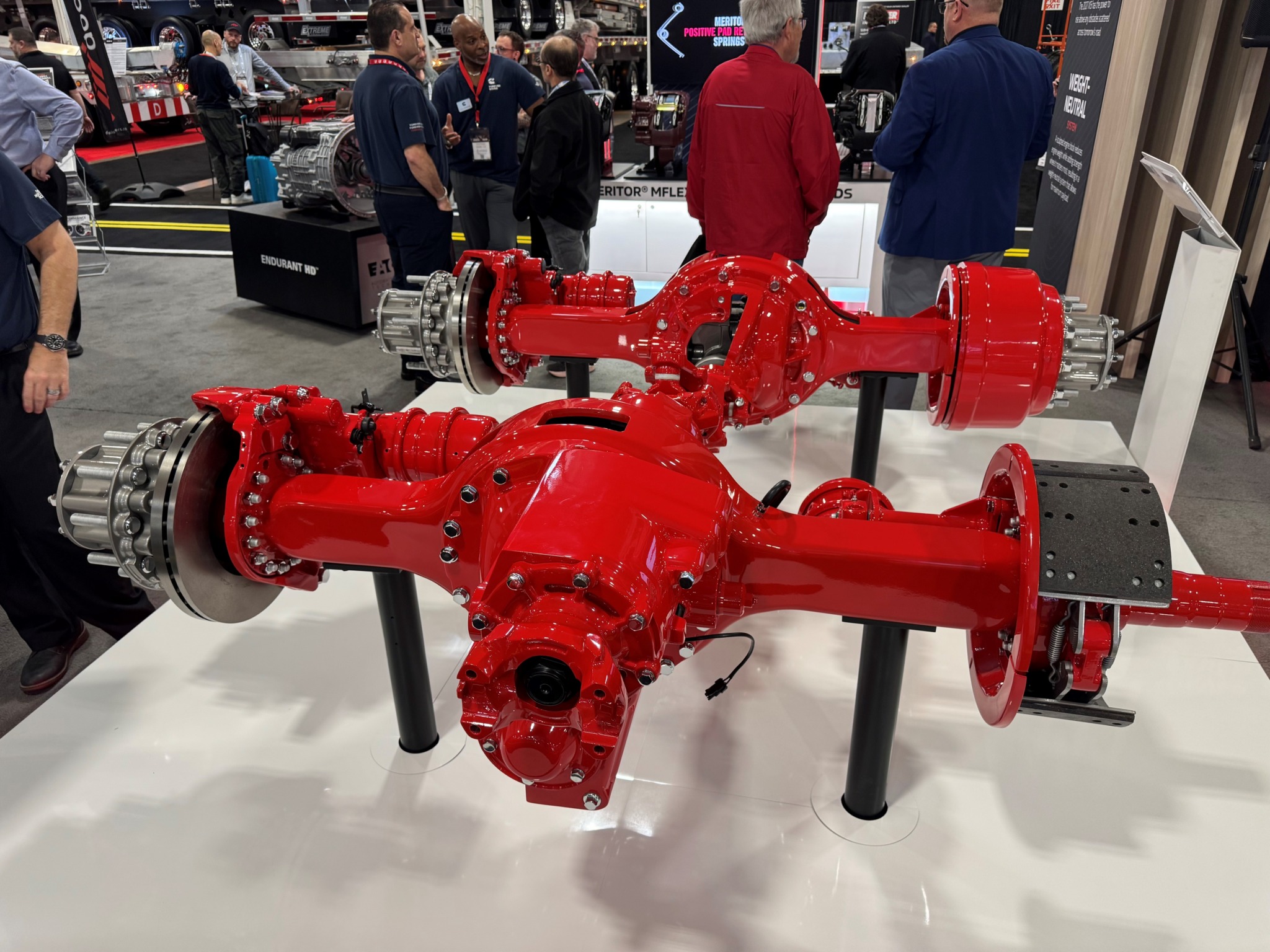
Unlike some high-efficiency axle offerings developed primarily for U.S. linehaul operations, the RT-160 HE was engineered for heavier duty cycles. “This was really designed with the Canadian market in mind,” Bradley said.
The axle supports gross combination weights of up to 185,000 lb. and is available in 40,000- and 46,000-lb. gross axle weight ratings, with axle ratios ranging from 3.07 to 4.89.
It is intended for longhaul and heavy-haul applications where fleets log high annual mileage under heavier loads, Bradley said. The axle, that has been in development for around two to three years, will enter production in Q1 2027.
Lubrication system drives efficiency gains
The most significant change is the addition of the Meritor Lube Management System (MLMS), now integrated into both the forward and rear-rear carriers.
The system eliminates the need for a pump in the forward carrier, reducing heat and weight, and uses the axle’s own rotation to manage lubricant flow.
Bradley said there is about 5.1 liters less fluid in each carrier, and as the ring gear rotates, it splashes lubricant up into a loop where it is caught by a baffle at the top. At road speed, he said, the system takes excessive lubricant and keeps it out in the legs of the axle housing.
“What that does is less heat, less churning of the fluid, less parasitic loss, improves efficiency,” Bradley said.
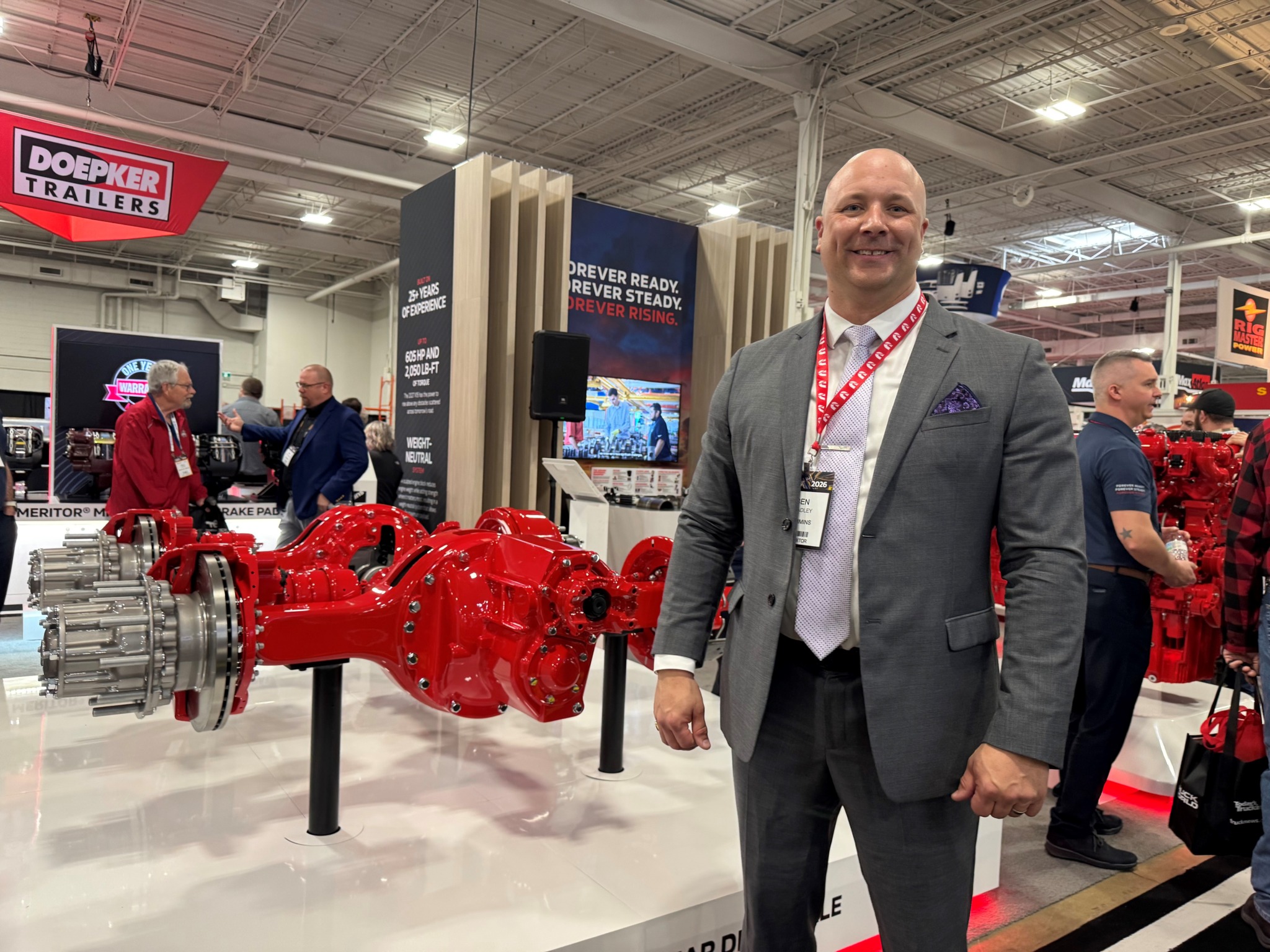
Cummins says the RT-160 HE delivers about a 1% fuel efficiency gain over the previous model in linehaul applications.
The MLMS system also reduces operating temperatures by up to 15°F and is compatible with low-viscosity 75W-80 lubricants, while lowering overall lubricant volume.
On top of lubrication improvements, Cummins optimized it with an integrated bearing cage, resulting in fewer leak points, lighter weight and easier serviceability, with the changes delivering about a 35-lb. weight advantage over the legacy RT-160.
Bradley emphasized that even with the updates, the axle maintains the durability that made the RT-160 widely adopted.
“The 160 series has been around for decades, and it’s been a very good, pretty much bulletproof axle. Customers really like it. So with the development of this product, we didn’t want to change the overall design of it, because it’s a proven design…We just wanted to try to improve efficiencies where we could without reducing the robustness or the reliability of the accident.”
But despite being based on an existing platform, the RT-160 HE will not be offered as a retrofit, as it would require significant structural modifications, including changes to the axle housing and internal components, making it difficult to justify economically, Bradley explained.
Cummins has already deployed field test units with Canadian fleets to validate performance in real-world conditions.
“There are some field test units out there, currently still running, doing lube oil analysis at specified intervals. And then also [we are] working with them to compile data as to, are they seeing that 1% efficiency gain? And if so, if they were to go with this product moving forward, what kind of an ROI would they see on that?”
Bradley said the ROI will vary depending on location of operations, application, mileage, and fuel prices, but pointed to both fuel savings and lower maintenance costs as key contributors.
Since the system reduces lubricant volume by about 5.1 liters per carrier, it lowers costs at each service interval. Bradley estimated fleets could save approximately $70 to $80 per oil change on lubricant alone, depending on application.
“Any little bit of an efficiency advantage is going to give you some payback,” Bradley said.
Drain intervals remain similar to the previous model, with linehaul applications reaching up to 500,000 miles (800,000 km).
“Obviously, we always recommend doing lube samples with testing so you can gage exactly where the quality and consistency of a lubrication is in your specific application, but we have not drastically reduced what the drain intervals will be specifically,” Bradley added.

Have your say
This is a moderated forum. Comments will no longer be published unless they are accompanied by a first and last name and a verifiable email address. (Today's Trucking will not publish or share the email address.) Profane language and content deemed to be libelous, racist, or threatening in nature will not be published under any circumstances.