John Bickner’s pursuit of the ‘Impossible Spec’

Many people don’t believe the words Super-B and fuel economy have any place in the same sentence. John Bickner doesn’t buy that. His bold push for fuel efficiency has moved his average fuel mileage from 4.54 mpg 10 years ago to better than 9 mpg (Imperial) today.
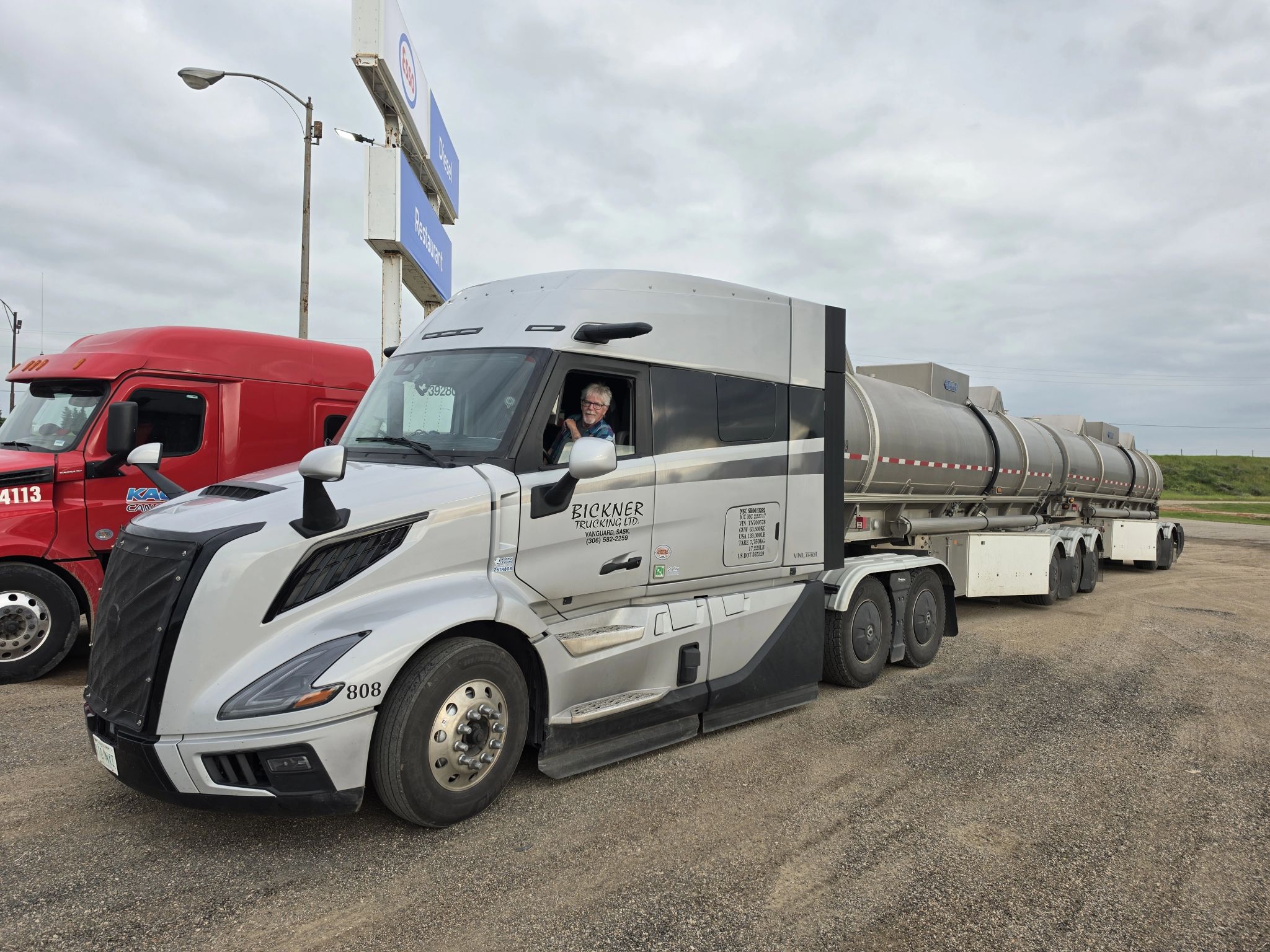
Bickner Trucking, based 250 km west of Regina in Vanguard, Sask., hauls Super B-train grain hoppers and liquid fertilizer tankers at 63,500 kg GVW. It’s roughly a 50/50 split of loaded and empty miles — 57% loaded. Payloads on the liquid tankers run around 45.5 metric tons, or about 100,000 lb.
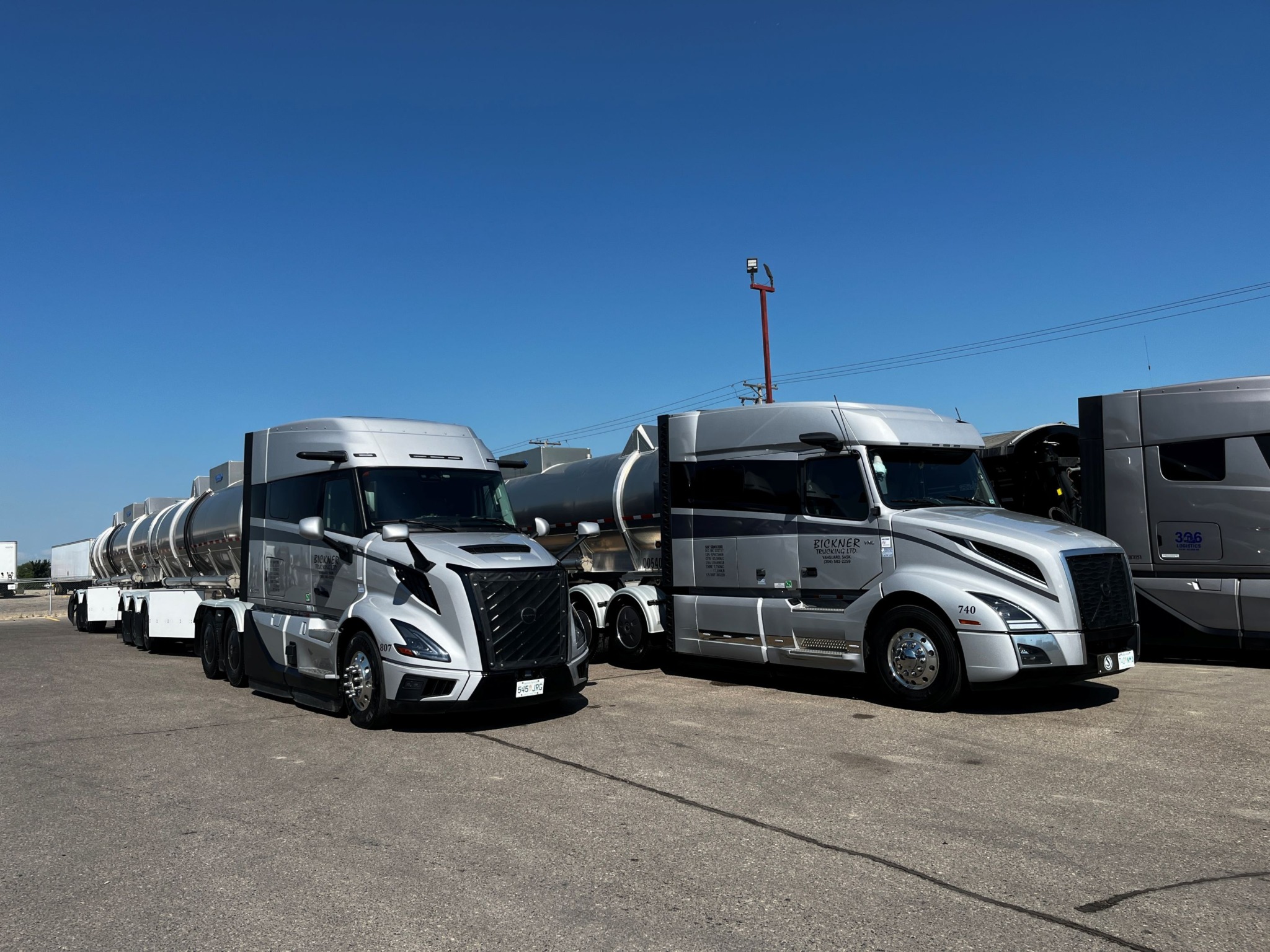
Clocking 9+ mpg under loads like that is nothing short of remarkable.
Trucknews.com interviewed Bickner last fall about the development and evolution of his truck spec’.
The first truck in the fleet to go with the downsped powertrain is now coming up to 400,000 km. Its lifetime fuel mileage is 8.56 mpg. That’s a bit lower than the average of his three newest trucks, he says, because when the truck went into service, he hadn’t yet optimized the trailer aerodynamics.
“The work the tank builders, Advance Engineered Products, did on the trailers has added about one mile per gallon (improvement),” Bickner told trucknews.com. “Our average during the first three weeks of July for our two newest units, 807 and 808, was an identical 9.38 mpg. That’s 7.81 mpg U.S.”
Bickner’s basic tractor spec’ reads as follows:
- Volvo VNL mid-roof sleeper
- D13 TC I-Torque 455/1,850 lb.-ft. with I-See, Eco-Roll, Adaptive Cruise
- I-Shift 13-speed overdrive with crawler gears
- Dana Spicer AdvanTek 40 rear axles 40,000 lb., 2.47:1 ratio
- Michelin wide-base single drive tires
To fleets familiar with Super-Bs, this spec might seem a bit odd. A more typical general purpose Super-B spec’ might include a 500 hp engine, an 18-speed gearbox, and 46,000-lb. rears with 3.08:1 or 3.24:1 gears.
“We’ve been running 40,000-lb. rears forever here on the prairies,” says Shawn Hornoi, president of Sterling Truck & Trailer Sales/Hornoi Leasing in Regina. “There’s a lot of manufacturers in Western Canada that run 40s on heavy weights because we are primarily flat.”
Hornoi says fleets running into B.C. or east to Ontario and the Maritimes opt for the 500-hp engines and 46,000-lb. rears because of the grades. Low-beds, heavy-haulers and the oilfield crowd get heavier axles. Those guys need them, he says.
“The bulk haulers prefer the 40s for the lighter weight; more payload.”
When Volvo introduced the I-Torque spec’ for the D13, its high-torque, low-rpm characteristics opened the door to taller gear ratios. They tried 2.64:1 and found there was still room to go lower. The 2.47:1 ratio hit the sweet spot.
The 455/1,850 lb.-ft. D13 I-Torque turbocompound engine produces full torque from 870-1,200 rpm, and full horsepower from 1,250-1,700 rpm.
Bickner spec’d his truck to cruise at 97 km/h (60 mph) at about 900 rpm, which is perfect on flat ground, even at 63,500 kg (140,000 lb.) gross combination weight.
If he runs into a bit of a hill or a stiff head wind, he drops a gear and still runs at 1,200 rpm or so where the horsepower is to beat the wind, and it’s still very fuel efficient.
“It’ll pull in both gears and it’ll hang on in both gears and just work,” Hornoi adds. “That powertrain is pretty ingenious.”
The impossible spec’
Early in his pursuit for greater fuel efficiency, Bickner came across some online discussion groups in the U.S. where fuel economy gurus like Kevin Rutherford, Joel Morrow, Henry Albert, Jamie Hagen, and others touted the benefits of their deeply downsped drivelines.
Using their spec’s as a baseline, and factoring in the extra weight and extra axles of his Super-Bs, Bickner calculated he should be able to improve his fuel economy by 22%, up to 8.5 mpg, if he could get the right axle ratio.
The idea was to build a truck with a turbocompound engine that offered an efficiency range from 900 to 1,300 rpm.
That would give him two gears where he could run in overdrive (13th gear) in the mid-900 rpm range, while still having direct (12th gear) running in the mid-1,200 range in the wind or on a grade.
Based on engine data, Bickner claims the truck runs in top gear 76% of the time.
“We’d have full torque in 13th gear, and full horsepower in 12th gear,” Bickner says. “That’s why a 2.47 rear-end is more efficient than a 3.55. It’s closer to one-to-one.”
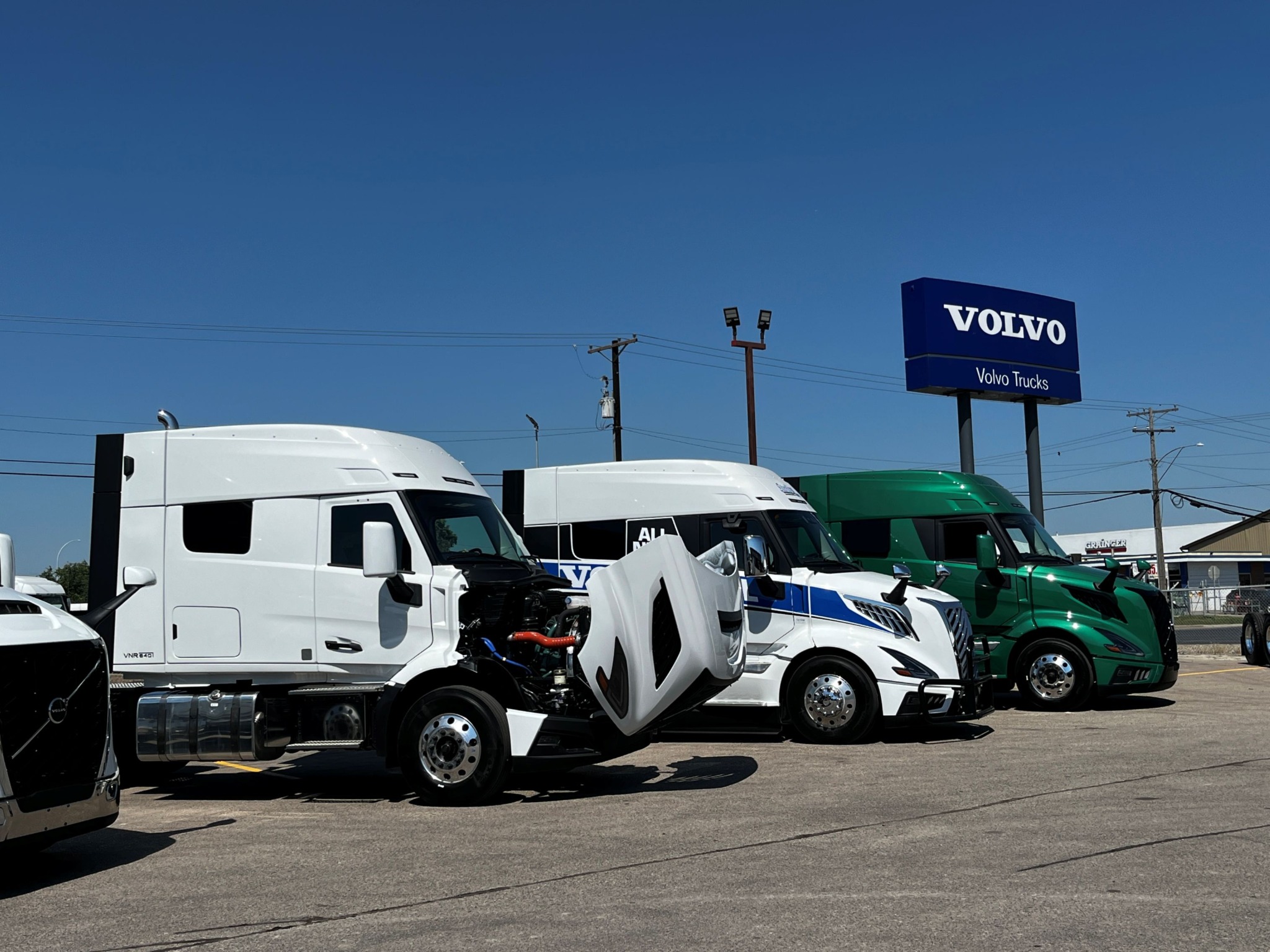
But convincing others it would work was another matter. The spec’ he was after hasn’t received engineering approval for Super-B weights. “We were told it was impossible,” Bickner says.
After many discussions with various component suppliers, and some serious cajoling from the Crazy Canucks, Volvo agreed to build the truck Bickner wanted for evaluation.
That gave rise to Unit 740 in 2024. Since then, 13 more have entered service for testing and evaluation in several fleets in similar duty cycles. Hornoi told trucknews.com, he has another dozen on order.
“They are all performing well,” Hornoi says. “Not all of them have the full spec’ package Bickner is running, but they are all looking at the extras now too, based on John’s success.”
Highly customized
Bickner’s trucks aren’t an off-the-shelf spec’. He’s gone deep on engine parameter settings and added several options tied to reducing fuel consumption. They are all widely available and Bickner says they are working for him.
He worked tirelessly with Volvo setting engine parameters, focusing on two in particular. The first is a “gentle launch” option that limits torque output at launch. It ramps engine revs up slowly, providing just enough torque to get the truck moving. Remember, the D13 TC I-Torque delivers full torque at less than 200 rpm above idle.
“Part of that is driveline preservation, part is fuel savings,” Bickner says.
The other setting he worked hard on was optimizing eco-roll, allowing the truck to coast when momentum will do the work diesel fuel usually does. He’s also using Volvo’s I-See predictive cruise control. It’s programmed with the routes he runs and can optimize throttling and coasting based on the terrain and conditions.
“With everything dialed in, the truck more or less drives itself as efficiently as possible,” Bickner told trucknews.com. “Not to take anything away from my drivers, but I saw proof of that this month when my two newest trucks turned exactly the same fuel mileage — 9.38 mpg — over a two-week period.”
Sterling Truck & Trailer Sales in Regina recently held an open house billed as A Day with the Fuel Efficiency Experts to showcase and share Bickner’s ideas and achievements.
Invitations were extended to the vendors Bickner partnered with on this project. Hornoi says the event was well received by the fleets that attended. They were treated to presentations by the suppliers, and of course the informal Q&A continued most of the day.
If there was one message repeated throughout the day, it was that exceptional fuel economy doesn’t come from a single breakthrough product or idea. Instead, it’s the cumulative effect of a handful of incremental improvements working together.
“The whole concept of the unit is to lower your drag as much as possible,” Bickner explained. “You don’t need as much horsepower when you lower your rolling resistance.”
Allies in fuel efficiency
In addition to the basic truck spec’ shown above, Bickner’s conversations with the American fuel economy folks led him to these add-ons, which he believes are furthering the cause. The individual improvements may be small, but they add up.
In alphabetical order:
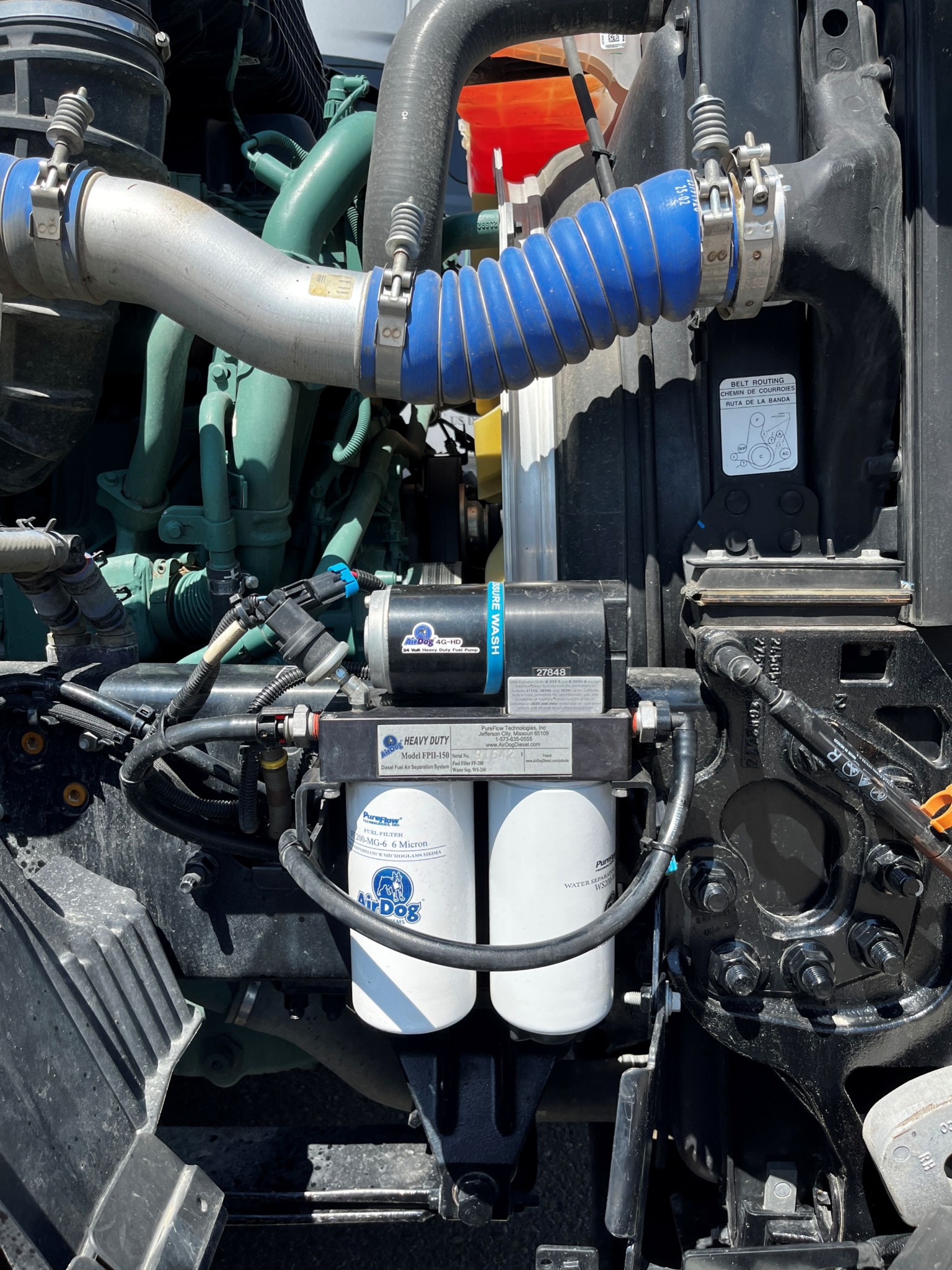
- AirDog Heavy Duty Fuel Systems: The system removes entrained air water, vapor and contaminants from the fuel, increasing fuel mileage and injector life.
- Centramatic wheel balancers: He runs the balancers at all wheel positions, including drive and trailer axles. He’s seeing 350,000 to 400,000 km from Michelin X-One Multi T trailer tires.
- Doctor Preload bearing adjustment tool/Temper-Loc spindle nuts: Using proprietary lock nuts, the tools allow technicians to accurately and repeatably adjust wheel bearings to SAE standard light preload settings. Bickner says tires run truer with very little shoulder wear.
- Dragonfly Energy lithium power pack: Bickner runs all hotel loads including electric air-conditioning off the Dragonfly power pack. He uses two AGM batteries for starting and lighting. The Dragonfly helps reduce weight and extends battery life.
- Ecofins Vortex Generator: Bickner is using these to smooth the airflow across the tractor/trailer gap. Not a huge improvement, but drivers report cleaner air flow and better mirror visibility on wet roads.
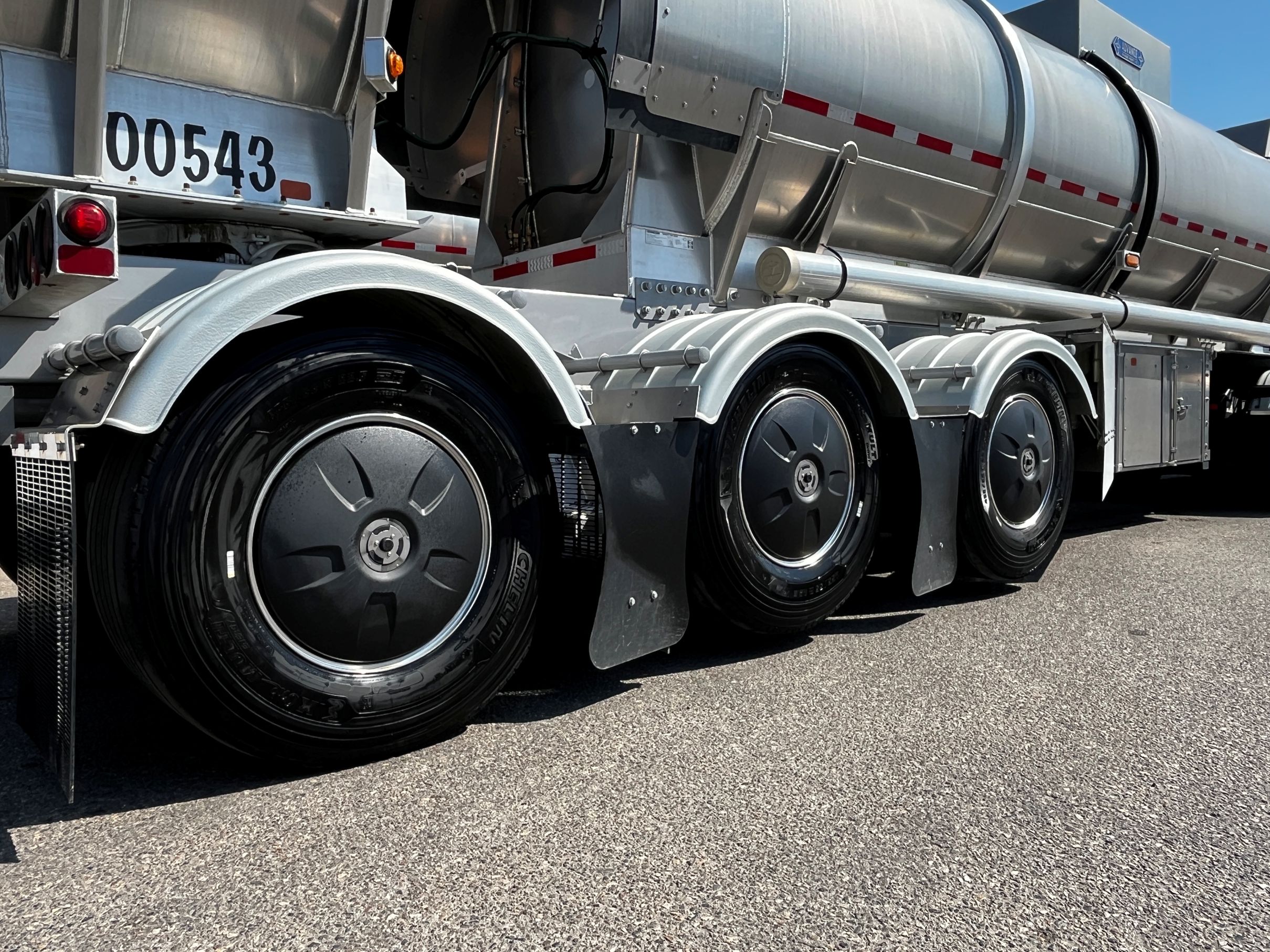
- FlowBelow Aero: Standard drive wheel fairing kits on all units, with custom fabricated (not available for sale) trailer kits.
- HotShot’s Secret fuel additive and friction reducer: He uses FR3 Friction Reducer lube treatment in wheel-ends, transmission and rear ends, and Everyday Diesel Treatment to provide constant lubrication, and cetane boost.
- Merlin Solar system: Keeps the batteries topped up while reducing load on the alternator, which ultimately saves a bit of fuel. Bickner expects to see five years from his AGM batteries because of the solar top ups and the reduced loads from Dragonfly.
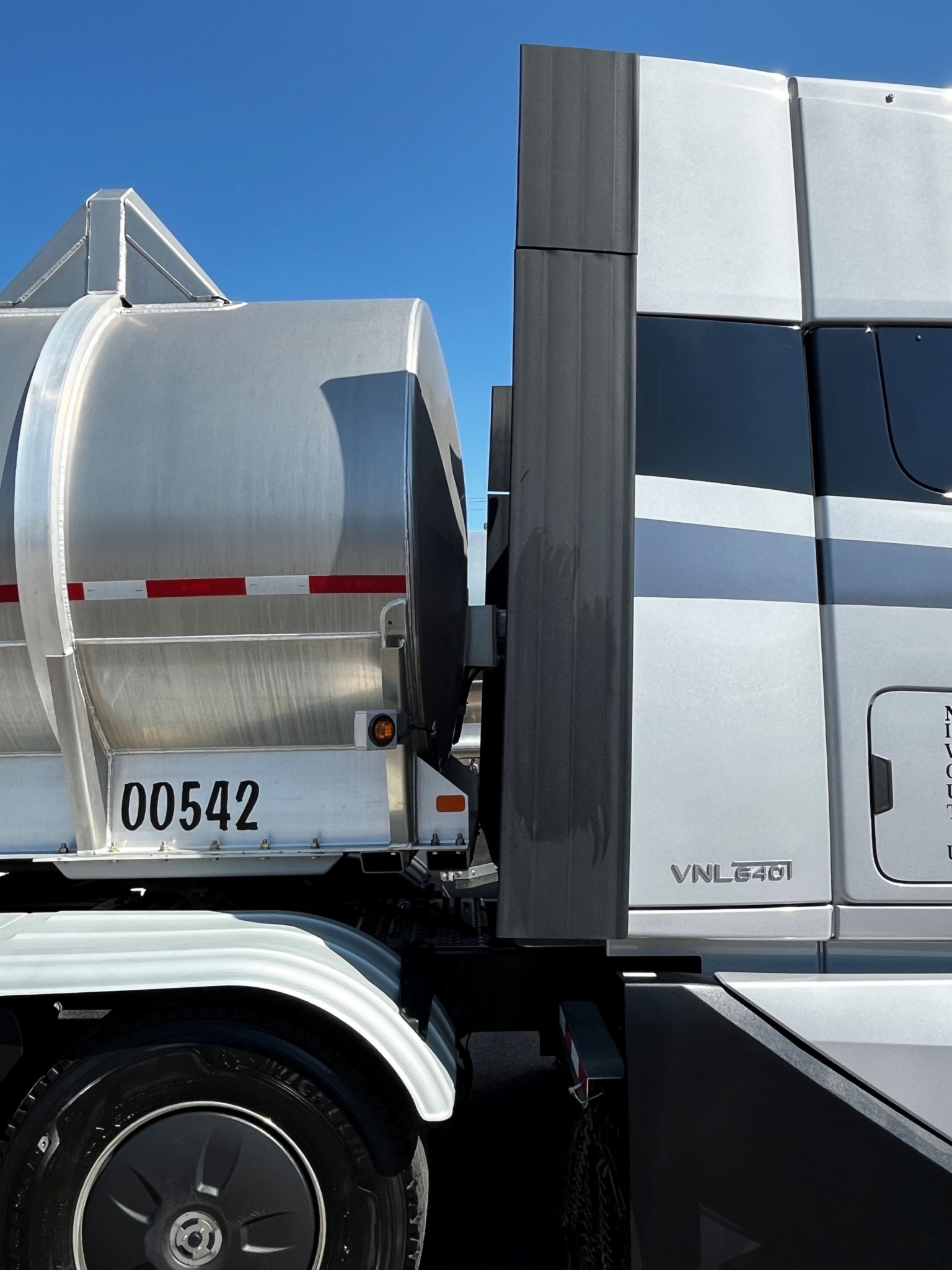
Significant credit has to go to the trailer manufacturer, Advance Engineered Products Group of Regina. Engineers there fabricated gap-reducing fairings for the back of the lead trailer and tapered fairing for the rear of the second trailer to smooth air flow over the units.
The pump boxes below the trailers were aligned longitudinally rather than crossways to reduce drag, while a tapered kit was added to the front of the box. Side skirts were added to tridem and tandem axles on both trailers to minimize drag.
Advance’s Bert Wilson told trucknews.com they looked at every possible surface they could modify.
“We are happy with what we’ve accomplished already, but we aren’t done,” he says. “We are still looking at what we can do with the roll-over protection and the loading hatch box on top of the trailers.”
For Bickner, the whole concept of the unit is to reduce drag as much as possible. The difference between his optimized spec and a classic non-aero tractor with big power and 3.09:1 gears, he says, is 120 hp.
“Because of my aero, low rolling resistance tires, my lubes, etc., simulations showed I need around 240 hp at 100 km/h, while my high-powered friend needs about 360 hp to maintain the same speed,” he says. “The extra horsepower comes at a huge cost.”

Have your say
This is a moderated forum. Comments will no longer be published unless they are accompanied by a first and last name and a verifiable email address. (Today's Trucking will not publish or share the email address.) Profane language and content deemed to be libelous, racist, or threatening in nature will not be published under any circumstances.