NACFE report warns technician shortage threatens adoption of new truck powertrains

A new report from the North American Council for Freight Efficiency (NACFE) says the trucking industry’s technician shortage is becoming an even greater challenge as fleets adopt a wider mix of diesel, natural gas, battery-electric and hydrogen-powered trucks.
The report, Messy Middle Powertrain Service & Maintenance, examines how fleets, OEMs, dealerships and repair shops will need to adapt to support multiple powertrain technologies simultaneously.
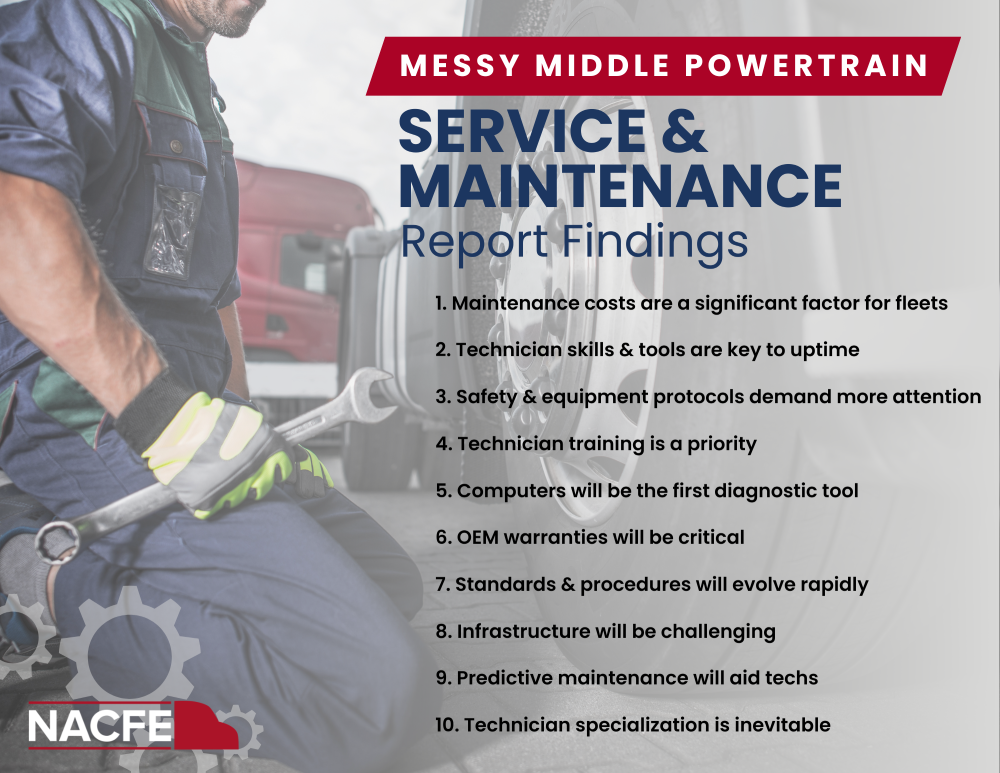
“The greatest challenge facing all new powertrain technologies is the need for well-trained technicians and well-equipped maintenance shops,” said Rick Mihelic, NACFE’s director of emerging technologies. “The best powertrains are useless if the vehicles cannot be maintained in the field.”
The report says maintenance costs now extend well beyond vehicle repairs, encompassing technician training, specialized shop equipment, software licensing, facility upgrades and ongoing certification requirements.
It also concludes that technicians will require new skill sets in areas such as electrical systems, power electronics and software diagnostics, with computers increasingly becoming the primary service tool.
“There is no legacy knowledge that will pour over. That’s the biggest problem,” said Dr. Mark Quarto, CEO of Quarto Tech Services. “The largest technology competency gaps are in the areas of electrical, electronics, software, power electronics, and electric machines.”
Among the report’s key findings, NACFE says technician training will require continuous updating as vehicle technologies evolve, while OEM diagnostic software and predictive maintenance tools powered by artificial intelligence will play an increasingly important role in maximizing uptime.
The report also notes that servicing battery-electric, hydrogen and natural gas vehicles requires more stringent safety procedures than conventional diesel trucks, and that maintaining behind-the-fence fueling and charging infrastructure will become an increasingly important part of fleet maintenance operations.
NACFE predicts technician specialization will become unavoidable as fleets operate a broader mix of powertrain technologies, potentially requiring additional staffing to cover the growing range of expertise needed to keep trucks on the road.
Have your say
This is a moderated forum. Comments will no longer be published unless they are accompanied by a first and last name and a verifiable email address. (Today's Trucking will not publish or share the email address.) Profane language and content deemed to be libelous, racist, or threatening in nature will not be published under any circumstances.

I have been saying for 5 years we have a shortage of heavy truck and equipment mechanics
Maybe we along the gov of Canada work to train more and see if we can import 500 from Cuba on a eight month contract from April to early Dec this would help
We can not expect a red seal mechanic to work for less than $42 hour plus a $4 hour tool fund.