Trailer orders remain strong in May, but analysts warn against reading too much into the surge

U.S. trailer orders continued their recent rebound in May, with both ACT Research and FTR reporting order volumes above 20,000 units as fleets cautiously returned to the market.
FTR reported May net trailer orders totaled 20,189 units, up 1% from April and 249% higher than the unusually weak order intake recorded in May 2025. The total was also well above the 10-year May average of 11,649 units.
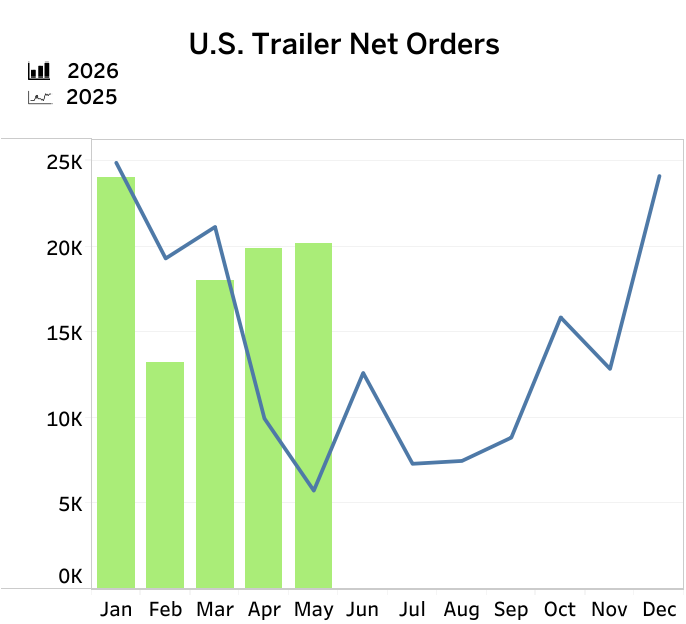
ACT Research’s preliminary data painted a similar picture, estimating net orders at 20,700 units, a 7% increase from April and 237% higher year over year.
While the numbers suggest improving fleet confidence, analysts at both firms stopped short of declaring the start of a broader trailer market recovery.
“Despite the stronger May order intake, the market still does not appear to be entering a broad-based upcycle,” said Dan Moyer, senior analyst of commercial vehicles at FTR. He noted demand remains concentrated in replacement purchases, fleet-specific needs, dry van trailer replacement, and continued strength in the flatbed segment.
Jennifer McNealy, director of commercial vehicle market research and publications at ACT Research, said the timing of the industry’s traditional order cycle appears to have shifted.
“This year’s cycle initially looked like it had been delayed a few months, as the order upticks that should have started in September or October of last year didn’t actually begin until December,” McNealy said.
She added that improving freight rates may now be helping support demand.
The stronger order activity comes as analysts continue to track a gradual recovery in freight markets after an extended downturn. Rising spot market rates and improving carrier sentiment have boosted optimism, though fleets remain selective about major equipment purchases.
McNealy said ACT has been watching to see whether improving freight fundamentals would translate into stronger trailer demand or whether fleets would continue prioritizing tractor purchases.
“Based on the May data, we now know there was at least one more month of improved order intake in the pipeline,” she said. “But it remains to be seen how the final month of Q2, as well as how Q3, will unfold.”
Production levels tell a more cautious story.
FTR reported U.S. trailer builds fell 6% month over month in May to 16,553 units and were down 1% compared to the same month a year ago. Year-to-date production was essentially flat at 79,482 units.
The fact that orders continue to outpace production suggests manufacturers remain hesitant to significantly ramp up output despite stronger demand signals.
Trade policy uncertainty is also clouding the outlook.
Moyer warned that trailer manufacturers and buyers are facing growing cost pressures, including higher steel tariffs under Section 232 and the prospect of additional anti-dumping and countervailing duties on imported van trailers and trailer components.
The U.S. Department of Commerce is currently investigating imports of van trailers and subassemblies from Canada, Mexico and China, following petitions filed by a coalition of U.S. trailer manufacturers. Preliminary countervailing duty findings released earlier this month largely spared Canadian manufacturers, but anti-dumping determinations are still expected later this summer.
Moyer said the evolving tariff landscape could benefit domestic trailer builders by making imported products more expensive, but it could also create new challenges.
“This situation may create opportunities for domestic manufacturers and suppliers,” he said. “But those opportunities also could tighten build slots, extend lead times, and strain the supply of components or labor.”
The result, he added, could be firmer trailer pricing and less predictable order patterns even if overall demand remains relatively stable.
For now, May’s order activity suggests fleets are becoming more willing to invest in trailers as freight conditions improve, but analysts remain cautious about predicting a sustained market upswing.

Have your say
This is a moderated forum. Comments will no longer be published unless they are accompanied by a first and last name and a verifiable email address. (Today's Trucking will not publish or share the email address.) Profane language and content deemed to be libelous, racist, or threatening in nature will not be published under any circumstances.