Provincial rule patchwork increasing trucking costs by 8%, trade expert says

Canada’s patchwork of provincial regulations is costing the economy an estimated $1.6 billion annually and increasing trucking service costs by more than 8%, according to interprovincial trade expert Ryan Manucha, who said harmonization efforts now underway could deliver significant benefits to carriers and the broader economy.
The C.D. Howe Institute senior fellow identified trucking as one of the clearest examples of how internal trade barriers continue to create costs and inefficiencies despite the existence of a national transportation framework.
“You have a national framework, but it gets implemented differently at the provincial level,” Manucha said during the Private Motor Truck Council of Canada’s annual conference in Niagara Falls, Ont. “As soon as you get provincial fragmentation, in my mind, that’s an internal trade barrier.”
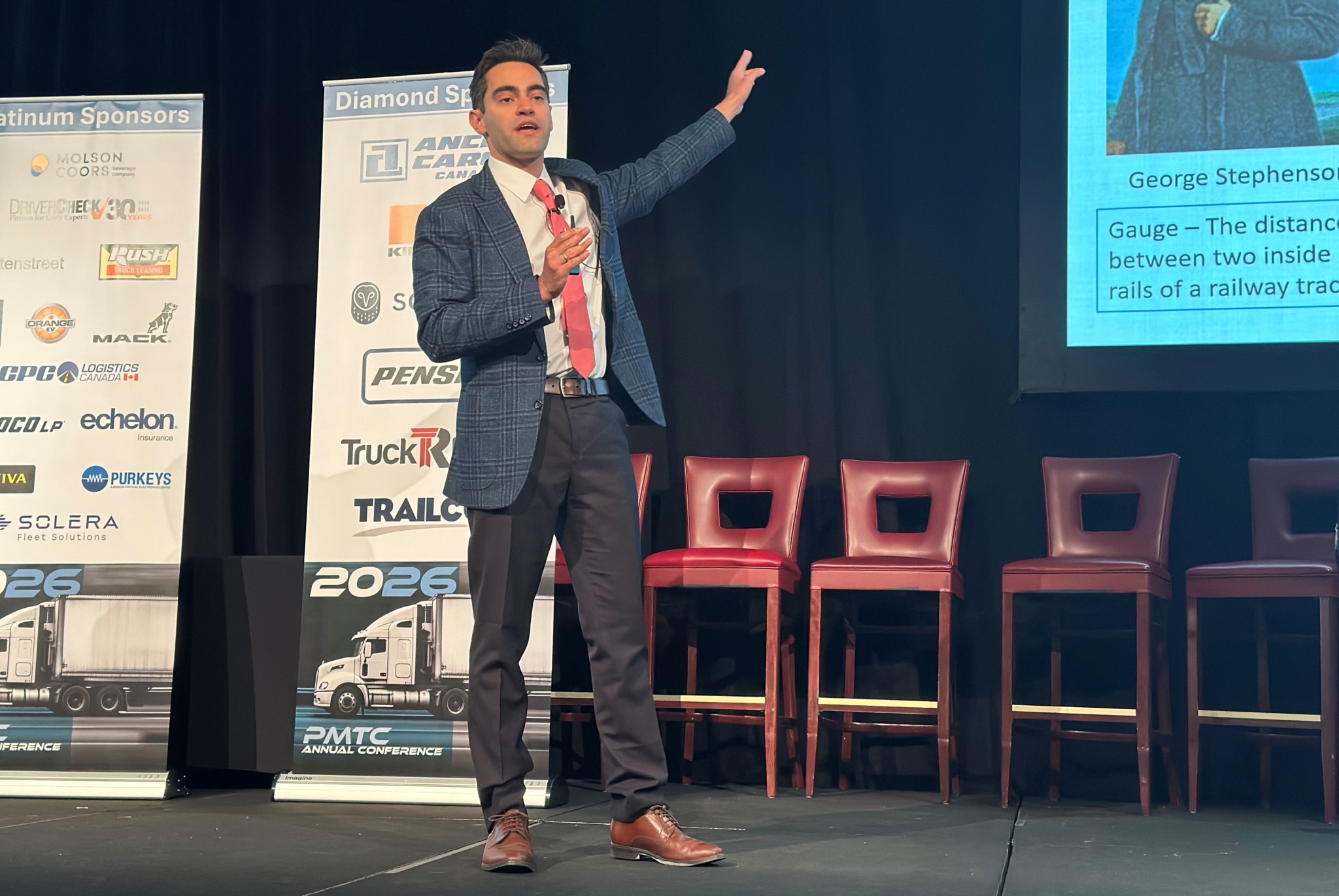
He pointed to differences in how provinces administer safety compliance programs, citing Ontario’s Commercial Vehicle Operator’s Registration system and Alberta’s Carrier Profile and Safety Fitness Rating framework as examples of varying approaches that carriers must navigate. Those differences create additional compliance burdens, separate audit regimes, and administrative costs that eventually flow through the supply chain, he said.
According to research Manucha conducted with University of Calgary economist Trevor Tombe, trucking regulations remain one of the most significant examples of internal trade barriers in Canada. The study examined issues including non-uniform overweight and oversize permitting corridors, differing long-combination vehicle qualification requirements, and equipment requirements that can change at provincial borders.
“Our estimates came out to being about a $1.6 billion drag on the Canadian economy,” Manucha said. “Essentially, it’s the patchwork in trucking rules and regs on trucking services, augmenting the cost by 8.3%.”
Compounding regulatory costs
The impact extends beyond trucking companies themselves, he added. Freight often crosses multiple jurisdictions and may move through several stages of production before reaching consumers, causing regulatory costs to compound throughout the supply chain.
Manucha argued that internal trade barriers affect issues Canadians care about most, including affordability, labor mobility and productivity. While public attention has often focused on restrictions involving alcohol sales across provincial borders, he said those examples obscure broader economic consequences.
He compared current regulatory fragmentation to historical examples where incompatible standards created inefficiencies. One example involved differing railway gauges in pre-Confederation Canada, requiring goods to be transferred between railcars at colonial borders because tracks were not standardized. Similar frictions continue to exist today when regulations differ between provinces, he said.
Strengthening east-west trade
Momentum for change accelerated following renewed concerns about Canada’s economic relationship with the United States and growing interest in strengthening east-west trade. Over the past year, provincial governments have signed numerous memorandums of understanding aimed at reducing internal trade barriers and improving labour mobility.
Trucking has become one of the highest-profile sectors targeted for reform.
Manucha said provincial and territorial governments recently finalized a memorandum of understanding focused on trucking regulations after years of discussions among technical working groups and regulators. While implementation work remains, he described the agreement as a meaningful step toward addressing concerns raised by the trucking industry.
“I read it through, and I say, ‘Hey, this does tackle a number of the issues that the Canadian Trucking Alliance had identified,’” Manucha said. “This seems to tackle some of the core issues.”
Harmonizing requirements
The agreement includes measures aimed at harmonizing requirements in some areas while pursuing mutual recognition in others. Mutual recognition allows one jurisdiction to accept standards, qualifications or approvals issued by another jurisdiction without requiring identical regulations. Manucha said that approach has gained traction because achieving complete harmonization across all provinces can be difficult and time-consuming.
He pointed to Australia as an example of a country that successfully adopted broad mutual-recognition policies decades ago. According to Manucha, Australia credited those reforms and related policy changes with improving labor mobility and contributing to economic growth.
The same principle could help address labor shortages in Canada, he suggested, particularly as governments pursue major infrastructure and resource-development projects that require workers to move easily between jurisdictions. Additional certification requirements, repeated training courses and varying provincial standards can slow workforce mobility and increase costs for employers and workers alike.
Generating measurable long-term increases in provincial GDP
Manucha also highlighted economic modelling, suggesting significant gains could result from even modest reductions in internal trade barriers. Research by Tombe found that a 10% reduction in barriers across all provinces would generate measurable long-term increases in provincial GDP, while a coordinated national effort would produce even larger benefits.
“Canada’s $2-trillion economy, the internal trade barriers, if they were to be lifted tomorrow, would boost the economy by about $210 billion,” Manucha said. “That’s about 8% growth to Canada’s GDP.”
While acknowledging that implementation remains challenging and that governments must balance economic benefits against policy objectives, Manucha said recent developments show progress is possible. Trucking, he noted, has become one of the most visible examples of governments attempting to move from discussion to action on internal trade reform.

Have your say
This is a moderated forum. Comments will no longer be published unless they are accompanied by a first and last name and a verifiable email address. (Today's Trucking will not publish or share the email address.) Profane language and content deemed to be libelous, racist, or threatening in nature will not be published under any circumstances.