Waabi says AI driver successfully transferred to Volvo truck without retraining

Autonomous trucking developer Waabi says it has achieved what it describes as an industry first: transferring its virtual driver from one autonomous truck platform to another without requiring any additional training or engineering work.
The Toronto-based company announced its AI-powered driving system, the Waabi Driver, was successfully integrated onto a Volvo VNL Autonomous truck developed by Volvo Autonomous Solutions. According to the company, the system operated autonomously on both highways and surface streets from its first mile without requiring new real-world data, simulation data, fine-tuning or software modifications.
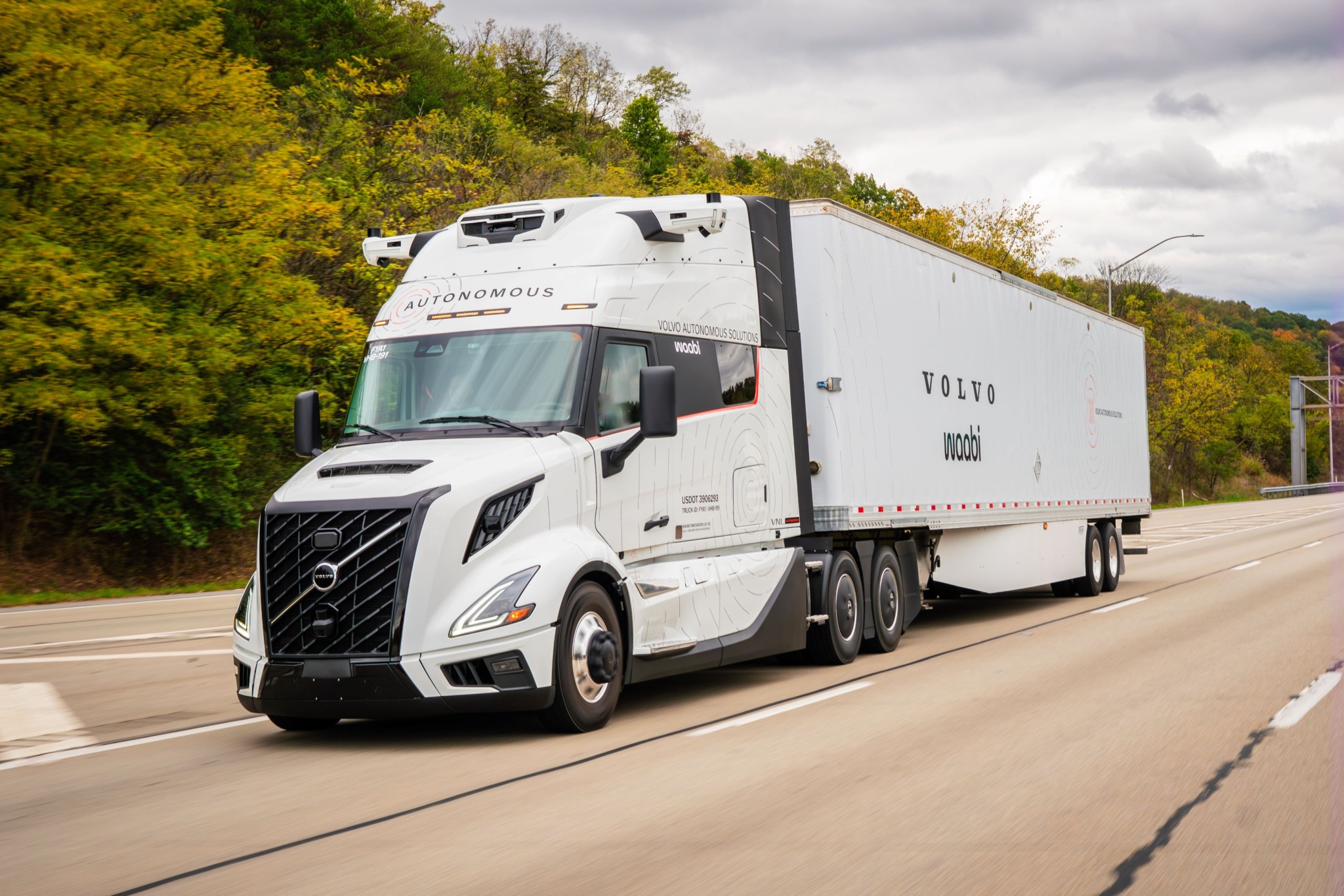
Waabi describes the achievement as “zero-shot generalization,” meaning the AI system was able to adapt immediately to a different truck platform despite changes in vehicle dimensions, sensors, control systems and physical characteristics.
The Waabi Driver had previously been trained to operate a Peterbilt 579 autonomous truck.
The announcement addresses one of the major technical hurdles facing autonomous trucking. Traditionally, moving an autonomous driving system from one vehicle platform to another has required extensive engineering, validation and additional data collection before commercial deployment, Waabi says.
It argues its AI architecture was designed from the outset to function more like a human driver, applying learned driving skills across different vehicles rather than requiring retraining for each new platform.
The company also says the AI has expanded beyond highway driving, adding operation on urban surface streets and more complex driving environments.
“Road testing the Volvo VNL Autonomous, integrated with the Waabi Driver, on public roads is an important proof point of our partnership with Waabi,” said Nils Jaeger, president of Volvo Autonomous Solutions. “It also demonstrates the scalability of Volvo’s autonomous truck platform, which is designed to integrate different vehicle models and virtual drivers to enable a wide range of use cases and applications.”
Waabi founder and CEO Raquel Urtasun said the demonstration represents more than an autonomous trucking milestone.
“For the first time in the industry, we have shown that a virtual driver can generalize across fundamentally different embodiments without requiring a single training example — neither real or simulated — or fine-tuning,” she said. “This capability has the potential to transform far more than transportation.”
The companies say the ability to deploy the same autonomous driving system across multiple truck platforms could accelerate commercialization by reducing the cost and time required to introduce autonomous technology into new vehicle models.
Have your say
This is a moderated forum. Comments will no longer be published unless they are accompanied by a first and last name and a verifiable email address. (Today's Trucking will not publish or share the email address.) Profane language and content deemed to be libelous, racist, or threatening in nature will not be published under any circumstances.

So, when more machines are taking the jobs from people, without alternative and worthwhile jobs to go to, where does that leave us as a society? Millions of people out of work, but corporations saving money on short terms plans, only to not have customers because we have no money to purchase their products… So much for learning to code