Fleets say shared charging can cut costs, solve infrastructure challenge: Pembina

As fleets face charger costs ranging from $65,000 to $1 million per unit, they are willing to share charging infrastructure rather than build their own.
Early adopters of electric trucks in British Columbia have a significant interest in shared charging hubs, peer-to-peer charging networks and subscription-based charging services, according to a new report from the Pembina Institute released June 17.
The report argues that both of today’s dominant charging approaches — private depots and public station chargers — face significant barriers. While the issue with private depots is that it requires fleets to bear the full cost of purchasing, installing and maintaining infrastructure, the public charging networks struggle to justify expansion because electric truck adoption remains too low to ensure consistent utilization.
Sixteen shorthaul and urban fleets surveyed think “as-a-service” charging models could help address both challenges by spreading infrastructure costs across multiple users and improving charger utilization rates, with all interviewed operators saying they are willing to adopt at least one shared or “as-a-service” charging model.
Pembina explored seven alternative charging models in the study. The shared charging options are classified as charging point operator (CPO)-led hub, multi-fleet cooperation, business-fleet collaboration, and peer-to-peer (P2P) shared charging. As-a-service models explored are Charging-as-a-Service (CaaS), Truck-as-a-Service (TaaS), and Battery-as-a-Service (BaaS).
Shared charging hubs emerge as preferred option
Among all the options, CPO-led hubs emerged as the most popular, with 80% of respondents saying they would be likely to adopt the approach.
Under the model, a third-party charging provider owns and operates a charging site shared by multiple fleets – an attractive model for carriers largely because it eliminates the need for significant upfront capital investment, researchers found.
Peer-to-peer charging received similar support. This option would enable fleets with underutilized chargers to make them available to others through a shared platform. Fleets already owning charging infrastructure see this as an opportunity to generate additional revenue while improving charger utilization. However, some carriers raised concerns over what opening private facilities to outside fleets would mean for security and safety.
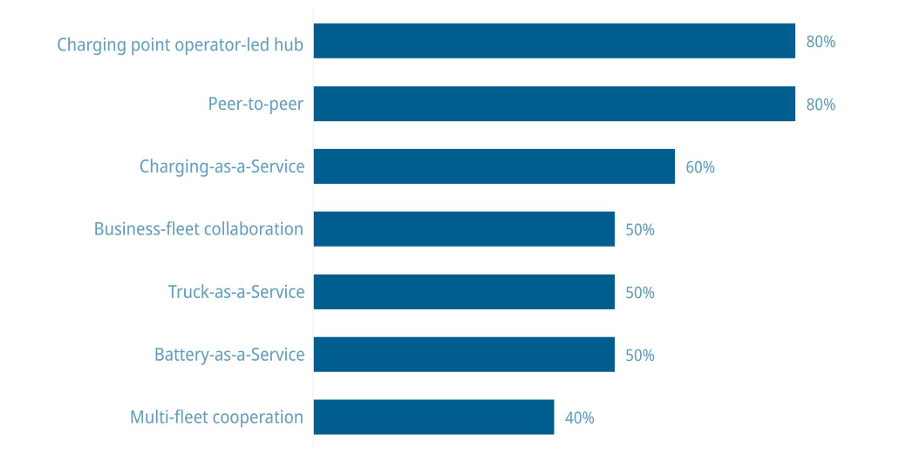
Charging-as-a-Service emerged as the most popular subscription-based option, and the third most popular overall, with 60% of all fleets expressing interest. Under the model, a third-party provider installs, owns and manages charging equipment at a fleet’s facility in exchange for recurring service fees. Respondents favor the arrangement because it offers many of the operational benefits of private charging while eliminating the need for major capital investments.
And private fleets expressed particular interest. All private fleets interviewed, with two exceptions, reported being very likely to adopt the CaaS model. The first exception cited insufficient parking spaces for trucks as a key reason for not considering CaaS. The second exception, a small private fleet, noted that CaaS did not make financial sense for them. Instead, they “would prefer a model with greater ownership, allowing them to generate carbon credits and earn revenue by selling them.”
Other models attracted more limited support.
Multi-fleet cooperation arrangements, where several fleets fund and own charging infrastructure together, were the least popular and received a likelihood-of-adoption rating of about 40%, or six out of the 16 surveyed fleets. While carriers liked the idea of having control over charger location and access, some expressed concerns about the higher upfront investment required compared to third-party-operated charging hubs.

Battery-as-a-Service, which replaces charging with battery swapping, also generated interest but lower adoption intentions. Respondents cited the limited availability of battery-swapping technology and service providers in Canada, as well as uncertainty about future industry standards and compatibility across vehicle platforms.
Under the Truck-as-a-Service model, a provider (often a truck manufacturer) leases electric trucks to a fleet at a fixed rate, which includes exclusive parking and charging access all in one package. While the approach can simplify electrification and reduce upfront costs, carriers aren’t fond of the idea because the provider retains ownership and control of the vehicles and charging assets.
Business-fleet collaboration models also attracted interest from about half of the respondents. Under the arrangement, a shipper, retailer or other large customer helps fund charging infrastructure used by the carriers that serve it. Fleets see value in gaining access to charging at reduced rates — or, in some cases, no cost — without having to make a major capital investment themselves. For the customer, the model can help advance sustainability goals while reducing emissions across its transportation network.
However, unlike public or shared charging hubs, access is typically limited to a specific customer and its designated transportation partners, reducing flexibility for carriers operating outside that network.
Keeping cost in mind
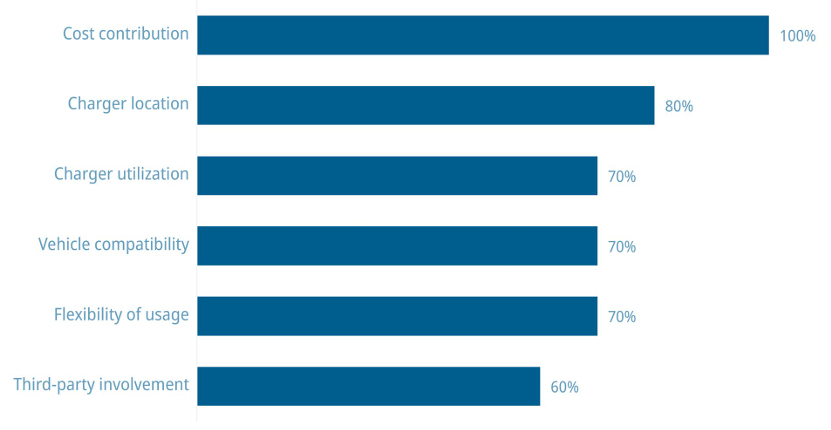
The report found economics remain the biggest driver of adoption.
Seventy per cent of respondents said they would adopt a shared charging model if membership fees were 50% lower than their current fuel costs. Another 20% said they would consider participation if costs were 5% to 10% below current fuel expenses.
Researchers also noted an opportunity for commercial truck parking operators. Some fleets reported already paying approximately $700 per month for parking and suggested that charging-equipped truck parking facilities could address both parking and fueling needs through a single service.
Location was identified as an important factor in making the decision by 80% of respondents. Fleets say existing commercial truck parking facilities and retail locations are preferred for shared charging infrastructure.
They also highlighted the need for additional charging sites along Highway 1, particularly in Burnaby, Coquitlam, Surrey and Langley, reflecting the importance of locating infrastructure near established freight corridors.
While fleets expressed strong interest in alternative charging models, the report identified several policy barriers that could slow deployment.
Among the biggest challenges is a potential conflict between government funding programs and how shared charging systems operate. Researchers noted that programs such as the federal Zero Emission Vehicle Infrastructure Program require funded chargers to be publicly accessible, while many shared charging models rely on reserved or restricted access to guarantee availability for participating fleets.
Respondents called for dedicated funding support for shared medium- and heavy-duty charging infrastructure or carve-outs within existing programs to ensure fleets pursuing shared charging arrangements are not excluded from incentives.
Policy uncertainty was also cited. Some respondents said shifting government priorities around electrification and climate policy have made them more cautious about committing to long-term infrastructure projects.
Another gap that was identified by nearly all respondents was the lack of awareness and understanding of shared and “as-a-service” charging models. Changing that would increase their likelihood of adoption.
Have your say
This is a moderated forum. Comments will no longer be published unless they are accompanied by a first and last name and a verifiable email address. (Today's Trucking will not publish or share the email address.) Profane language and content deemed to be libelous, racist, or threatening in nature will not be published under any circumstances.

In my opinion the gov should limit aid to purchase electricit trucks to a max of $75 000 per truck and $250 000 per year to a max of $750 000 over 5 years but the Fed gov of Canada should pay 50% of the cost of the land and and changing stations and the cost of the parking lot and a safe place for the drivers to relax and have a healthy meal.. I would like to see cities like Toronto and Vancouver where there is higher density of people so the polution affects more people with priority given to local delivery units and in city busses. I also think at peak demand times we should have natural gas generator of at least 5 000 kills watts so we do get hit with peak time power costs. To use electricity with batteries elsewhere will be too expensive in.my opinion and trips over 150 kms round trip
Why should Canada have more strict standards than Mexico or India that we compete against?