Motive Vision, Part 2: New tools, including Atlas, AI Coach, drive Motive’s automation push

Fleet operations have become increasingly overwhelmed by disconnected systems, growing volumes of operational data, and the manual work required to coordinate responses across safety, maintenance, compliance, and driver management workflows.
During Motive’s user conference, Vision, in Nashville, Tenn., company CEO and co-founder Shoaib Makani said the industry’s challenge is not just visibility anymore, but the growing gap between identifying operational problems and responding to them fast enough to prevent disruptions.
“The things that matter most — a fatigued driver, a critical fault code, a major service issue — get addressed only as fast as a manager can get to them. Your performance is capped by the limits of human attention. Automation breaks that ceiling,” he said.
This is why Motive unveiled a series of AI-driven automation and workflow tools that — among others — included Atlas, Motive’s AI assistant, expanded AI Coach functionality, Driver Rewards, and integrations connecting fleet data directly into several generative AI platforms.
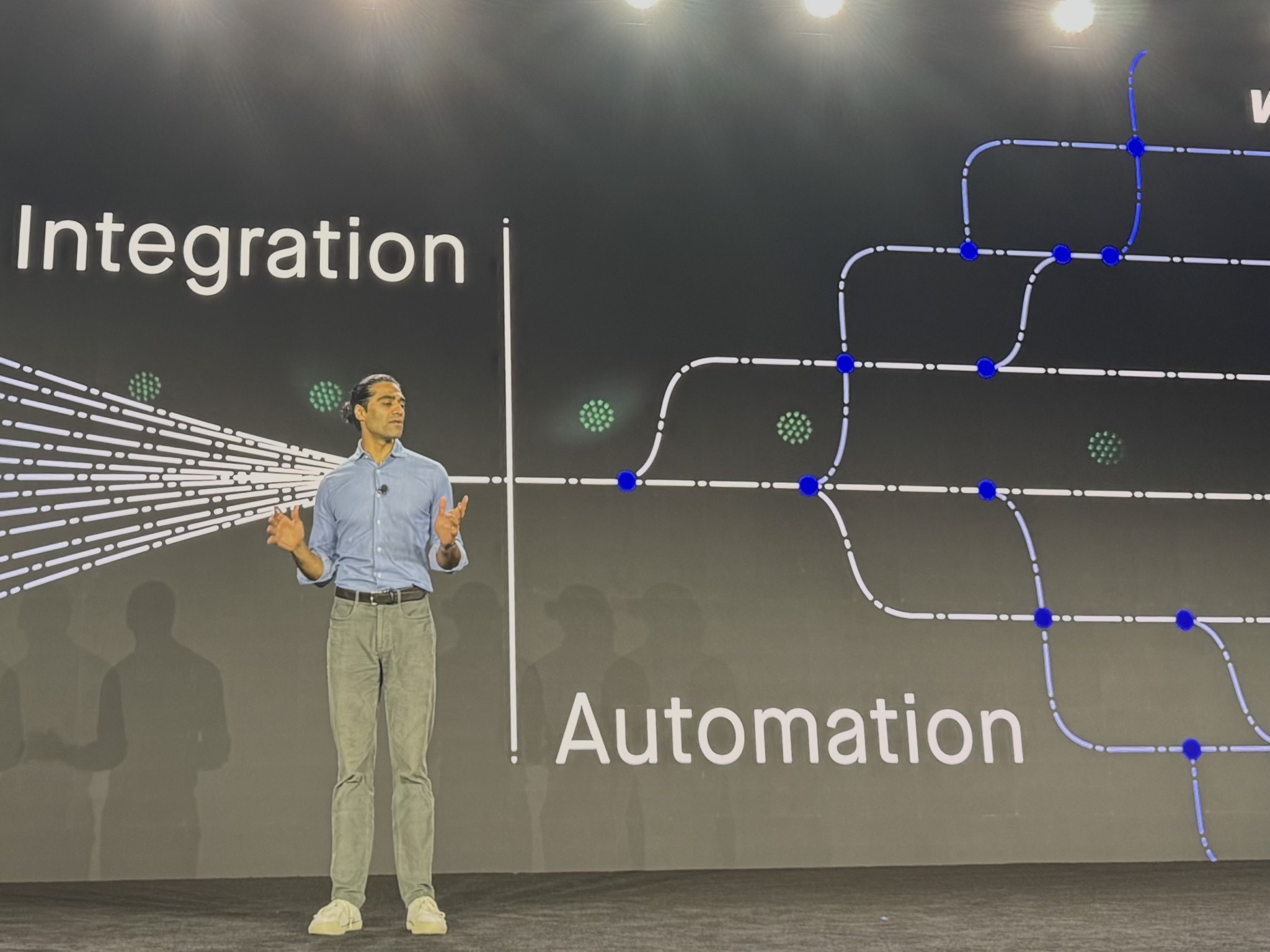
“We hear this from so many of you: There is simply too much manual work in your operations, but the real problem isn’t the time that it consumes. It’s that today some of your most important work only happens when a person becomes aware of an issue. Someone has to get an alert, make sense of it, and then act,” Makani said. “[With automation] the right action happens at the right moment, whether or not anyone is watching.”
At the heart of the company’s focus on automation is Motive AI, he explained, which shows up across the Motive platform in three key ways. It delivers insights that help carriers make sense of raw data, empowers intelligent assistants that enable conversational interactions, and then powers agents that do the work for fleet managers.
Atlas
One of the releases is Atlas, Motive’s AI operational assistant capable of analyzing safety, fuel, compliance, and maintenance data to generate recommendations, automate administrative workflows, and coordinate operational tasks.
“Atlas is Motive’s new AI-powered assistant, built into every part of the platform. It understands your fleet data, your drivers, your workflows, it remembers context, and when you ask it to do something, it doesn’t just tell you how, it does it,” said Emily Parsons, Motive’s senior director of product, during the keynote on May 27. “Last year, we set out to cut the time between question and answer by introducing Motive Analytics and AI Answers,” she said. “But you also told us getting the answer is just the first step.”
During a live demonstration, Atlas generated a morning briefing for fleet managers by scanning safety, compliance, fuel, and operational data to surface active issues that would require the manager’s attention.
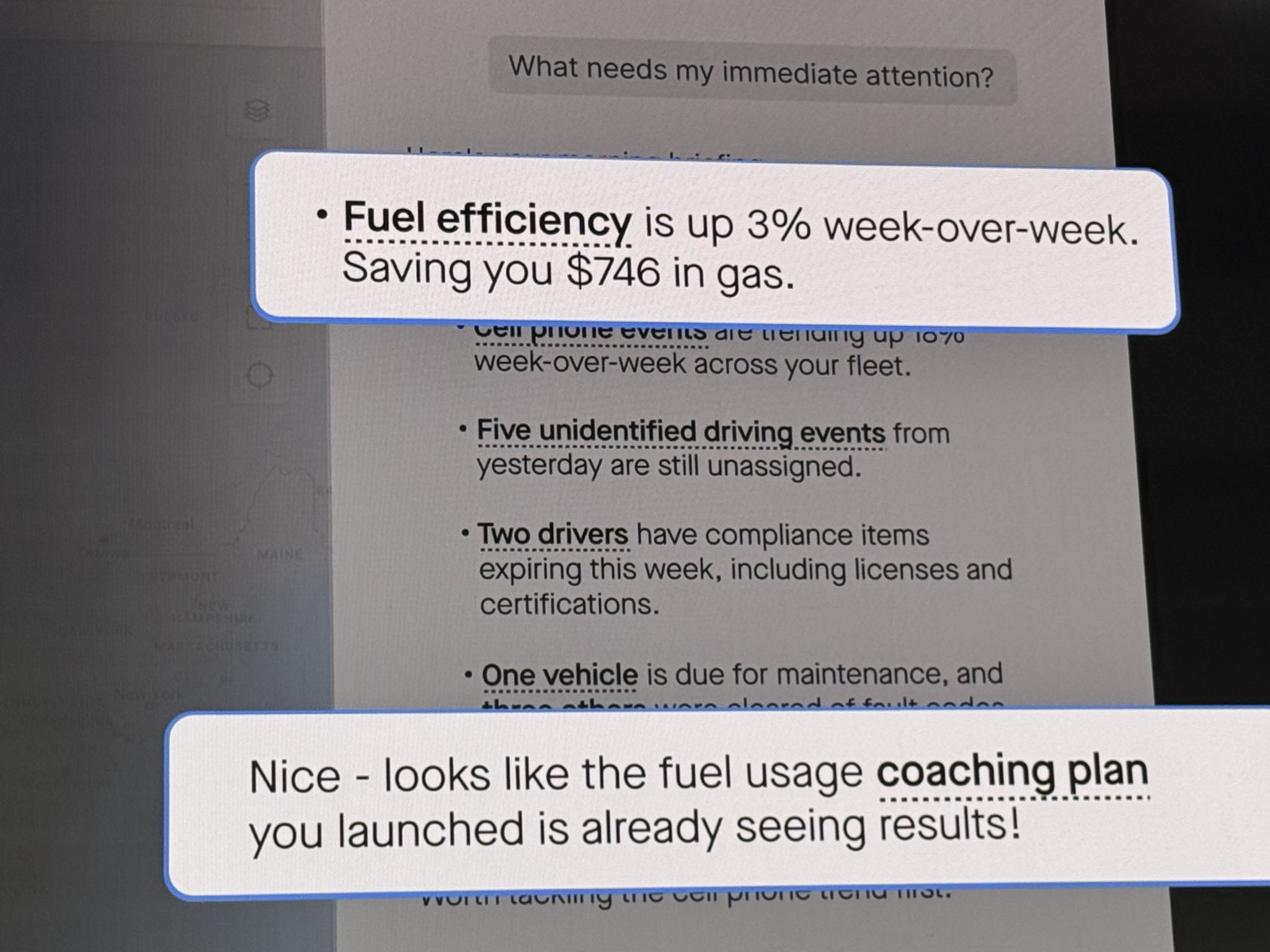
In one example, the system identified rising phone use behind the wheel among specific drivers before incidents occurred. Parsons, acting as a manager, then told Atlas to generate customized messages to drivers. It reviewed driver histories, event counts, and safety scores before drafting personalized coaching messages to affected drivers in roughly 10 seconds, a task she said previously could consume the better part of managers’ mornings.
“That’s exactly the kind of thing a fleet manager might not catch until something bad happens,” Parsons said while discussing the distracted driving example. “Atlas caught it before anyone else even sat down this morning.” She added that similar automation capabilities can be applied across expense reports, compliance workflows, and bulk driver management tasks.
She also teased that Atlas will soon integrate with external generative AI platforms, including ChatGPT, Claude, Microsoft Copilot, and Gemini through Model Context Protocol (MCP) integrations. In a related demo, Parsons showed Claude pulling information from insurance documents, email history, Motive safety data, and external industry benchmarks to generate a report for insurance rate negotiation preparation.
In-cab partner for drivers
But Atlas doesn’t just live on a laptop or in a chat window; it lives in every vehicle, too, she said, while presenting Atlas as an in-cab voice assistant integrated directly into AI Dashcam Plus.
Parsons described the system as a hands-free “partner on the road” designed to help drivers manage any type of issue without taking their attention away from driving.
In another demonstration, she acted as a truck driver who used the voice chat to sign in to the vehicle. That, and all commands that followed were initiated with a “Hey, Atlas” command.
Further into the presentation, when asked to identify the next fuel stop along the route, Atlas did not just locate the closest station – despite that being the original request – but it analyzed the vehicle’s fuel level, nearby pricing, and available discounts through Motive’s discount network before recommending the most cost-effective stop.
And when asked about the current route conditions, Atlas analyzed live traffic conditions against the delivery schedule, estimated the driver was running roughly 15 minutes behind, and offered to notify dispatch automatically with an updated estimated arrival time.
Motive also demonstrated how Atlas could proactively intervene during safety and maintenance events. If fatigue is detected as a regular behavior during the trip, it will prompt the driver to pull over safely.
Interpreting fault codes works in a similar way. When the system detects fault-code alerts, it triggers plain-language instructions explaining the issue and recommending immediate action before costly breakdowns occur.
During one real-life example presented alongside a Motive customer on stage, Atlas automatically notified a driver they had entered a wildfire risk zone and reminded them to follow company wildfire safety policies. The wildfire zones can be updated through geofences managed externally, allowing fleets to respond to changing conditions without requiring managers to constantly manually monitor maps or contact drivers individually.
Atlas assistant, MCP integrations, and in-vehicle voice assistant capabilities are expected later this summer.
AI Coach, Driver Rewards focus on retention, positive reinforcement
Motive also expanded its workforce management tools with updates to AI Coach, Performance Hub, and Driver Rewards, in efforts to improve driver retention, as the company estimates fleets can spend as much as 13,000 to replace one driver.
“2026 is a year of automation for your workforce,” said Dinesh Coca, Motive’s director of product management, during the keynote. “We’ve closed the loop. AI identifies the risk, AI Coach delivers the intervention, Driver Rewards reinforces the right behaviours, and Performance Hub gives you the intelligence to continuously improve your program, your rules.”
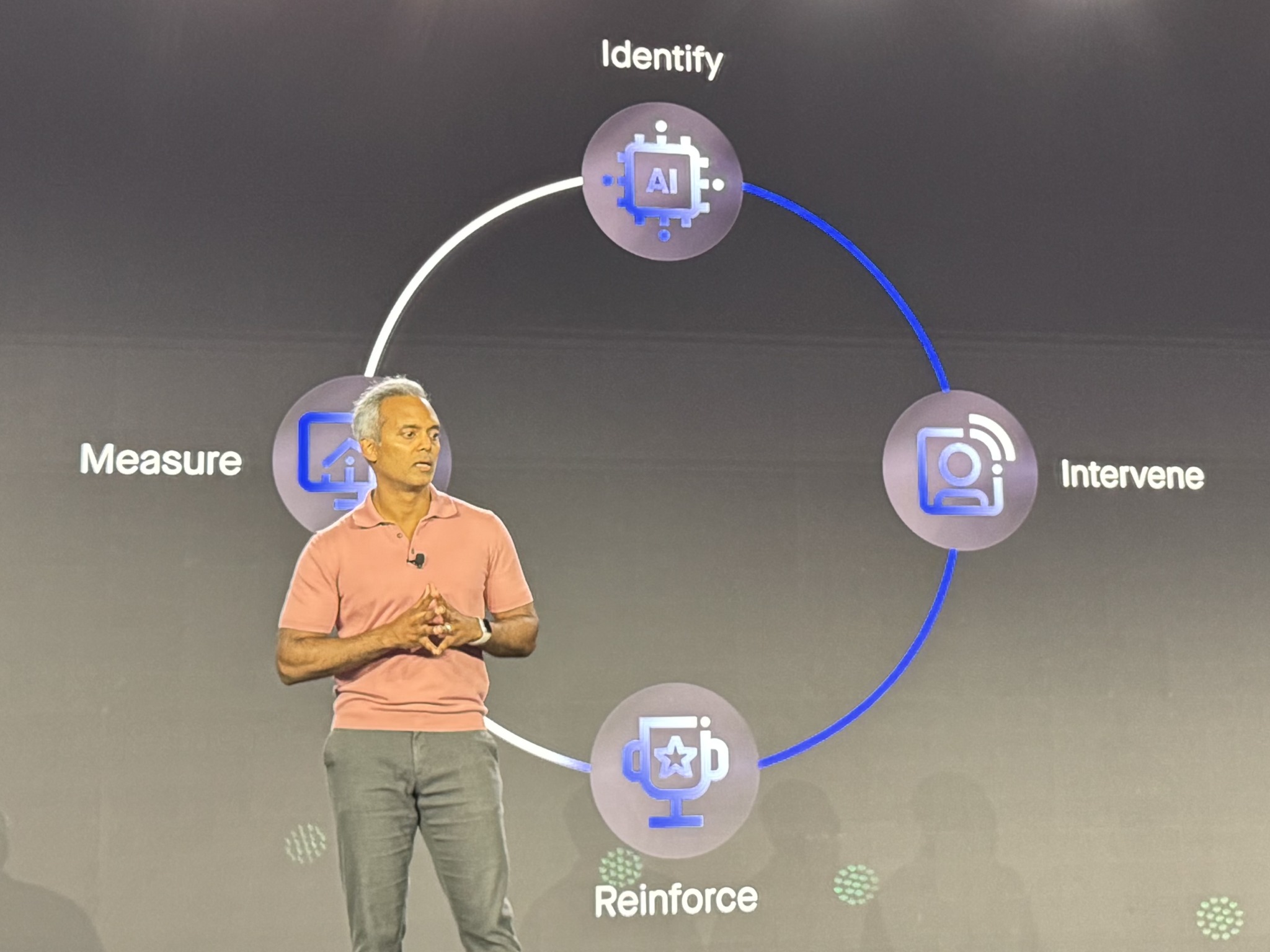
Coca said AI Coach has already delivered more than 250,000 personalized coaching sessions, saving managers more than 100,000 hours while helping fleets maintain more timely and consistent coaching across operations.
“Drivers who actively review their AI coaching sessions see an eight times greater safety score improvement and a 50% drop in total events, with critical risks like cell phone usage dropping all the way to zero,” he added, and shared an example of one large fleet, claiming that it saw every unsafe driving behavior decrease by more than two-thirds after implementing AI Coach.
The company also expanded AI Coach with additional avatar customization for ‘an even more familiar face’ for drivers to see, and the ability for fleets to upload company-specific policies and regional rules so that coaching sessions align even closer with internal operational guidelines.
Coca also introduced automated reminders that are designed to ensure drivers do not miss coaching sessions, along with positive-recognition capabilities that congratulate drivers when it records extended periods with no safety events.
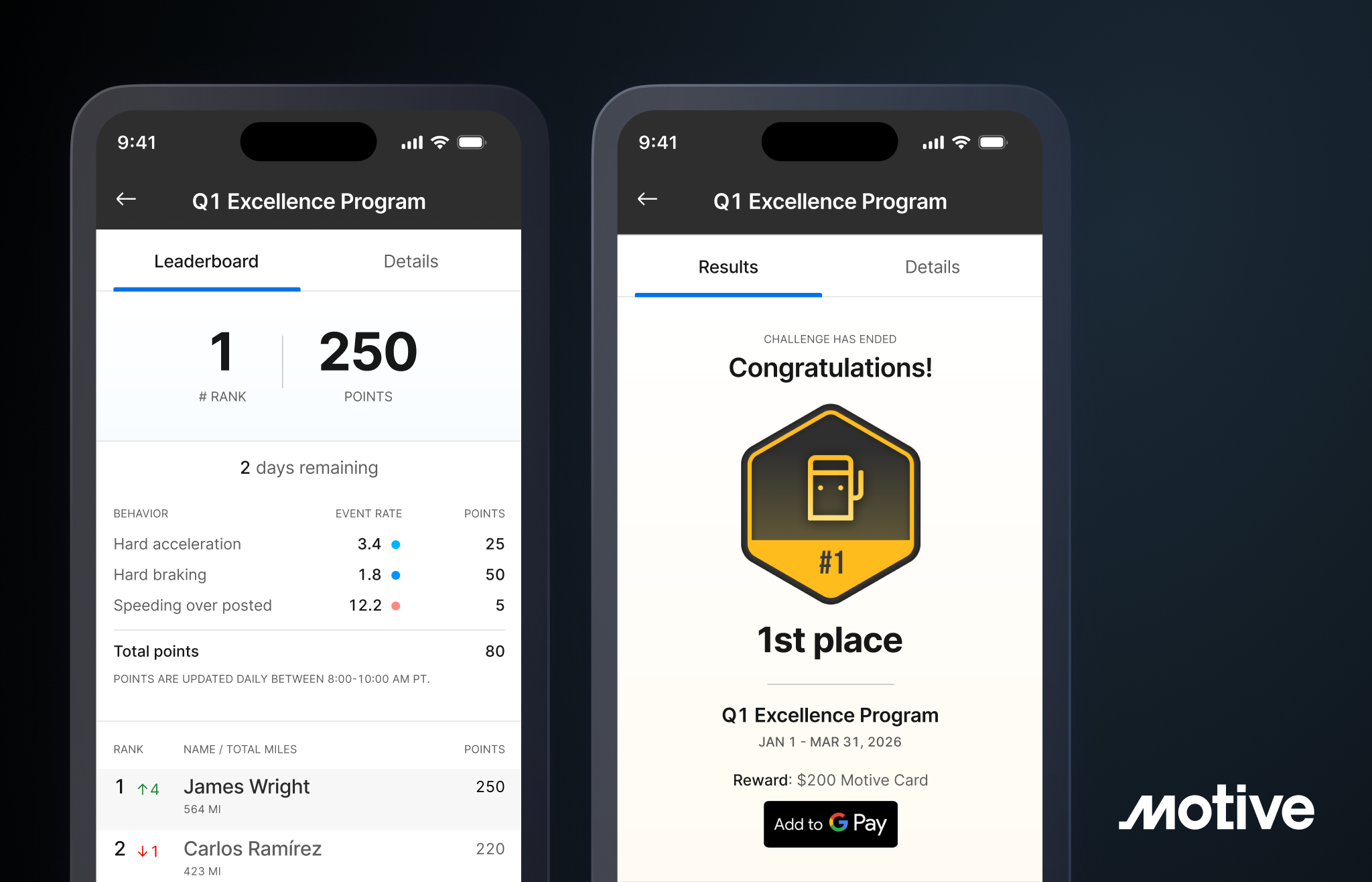
“Now, when they have a clean week with no events, AI Coach reaches out to congratulate them, ensuring that your best people feel valued, not just monitored,” he said. “Intervention is essential, but to truly change behavior, you also have to motivate your employees and celebrate what’s going right…Driver Rewards automates that motivation and the recognition.”
The platform allows fleets to build challenges around specific operational behaviors such as fuel-efficient driving, or reduced idling or harsh braking event, while automatically tracking performance and identifying winners in real time.
Drivers can also convert earned rewards into cash deposited directly onto Motive Cards through the platform’s integration with Motive’s payment ecosystem.
While much of the company’s Vision 26 keynote focused on automation and AI-driven response systems, executives emphasized that those tools rely heavily on the visibility infrastructure introduced earlier in the presentation, including AI Dashcam Plus and AI Omnicam Plus.

Have your say
This is a moderated forum. Comments will no longer be published unless they are accompanied by a first and last name and a verifiable email address. (Today's Trucking will not publish or share the email address.) Profane language and content deemed to be libelous, racist, or threatening in nature will not be published under any circumstances.