Spatco ties Motive tech, AI coaching, rewards to 35% accident reduction

Spatco Energy Solutions says it has reduced accidents by about 35% since rolling out Motive’s AI-powered coaching and driver rewards tools across its fleet, but fleet director Rodney Fetters says the technology only worked after the company stopped treating cameras as punishment.
The company, which operates about 1,400 trucks across 39 locations in 14 states and runs roughly 8 million miles (12.8 million km) per month, became a Motive customer in October 2025 after evaluating several providers. Driver privacy and trustworthy AI were the key criteria making the decision, Fetters told trucknews.com, adding that the biggest concern was introducing inward-facing cameras without alienating drivers.
“Our CEO was incredibly nervous about losing people, putting cameras in vehicles that were inward and outward facing,” Fetters said.

But with Motive cameras, he said, footage is not visible to managers unless unsafe behavior or a triggering event occurs. “AI is always watching you, but none of us can see you until something is unsafe.”
He said some drivers were concerned at the beginning of the rollout, but Fetters went as far as letting drivers log into his computer and check the system themselves to prove, with full transparency, that the inward‑facing camera settings weren’t turned on and to build trust around driver privacy.
That rollout was a significant shift from the company’s earlier approach to cameras and driver monitoring. At first, before Spatco switched to Motive, only drivers in Florida, Georgia, and Texas — the highest litigation-risk states in the country — had cameras, along with drivers who’d been involved in accidents.
“If you were somewhere else, if you’re in Baltimore [for example] and you have an accident — oh, we’re gonna put a camera in there. That’s as punitive as it gets,” Fetters recalled of the company’s early strategy.
Instead, he wanted the technology to be tied to coaching and recognition rather than punishment.
That philosophy stems partly from advice he received from a horse trainer when he asked about motivation: “I was like, what works better for a horse, the carrot or the stick? He goes, ‘Actually, it’s apples, but if you ever have to go to the whip, the race is over.’ It’s like, watch the jockey, the jockey will show the horse the whip to hold it in front of their eyes, like, ‘I’m gonna hit you with this if you don’t go’, but when you start hitting him with it, he goes, ‘It’s just like people, they don’t respond.’”
Earlier in the day, Fetters shared that story during a morning keynote at Motive’s Vision 26 conference in Nashville, saying the analogy became central to how Spatco introduces all its technology now.
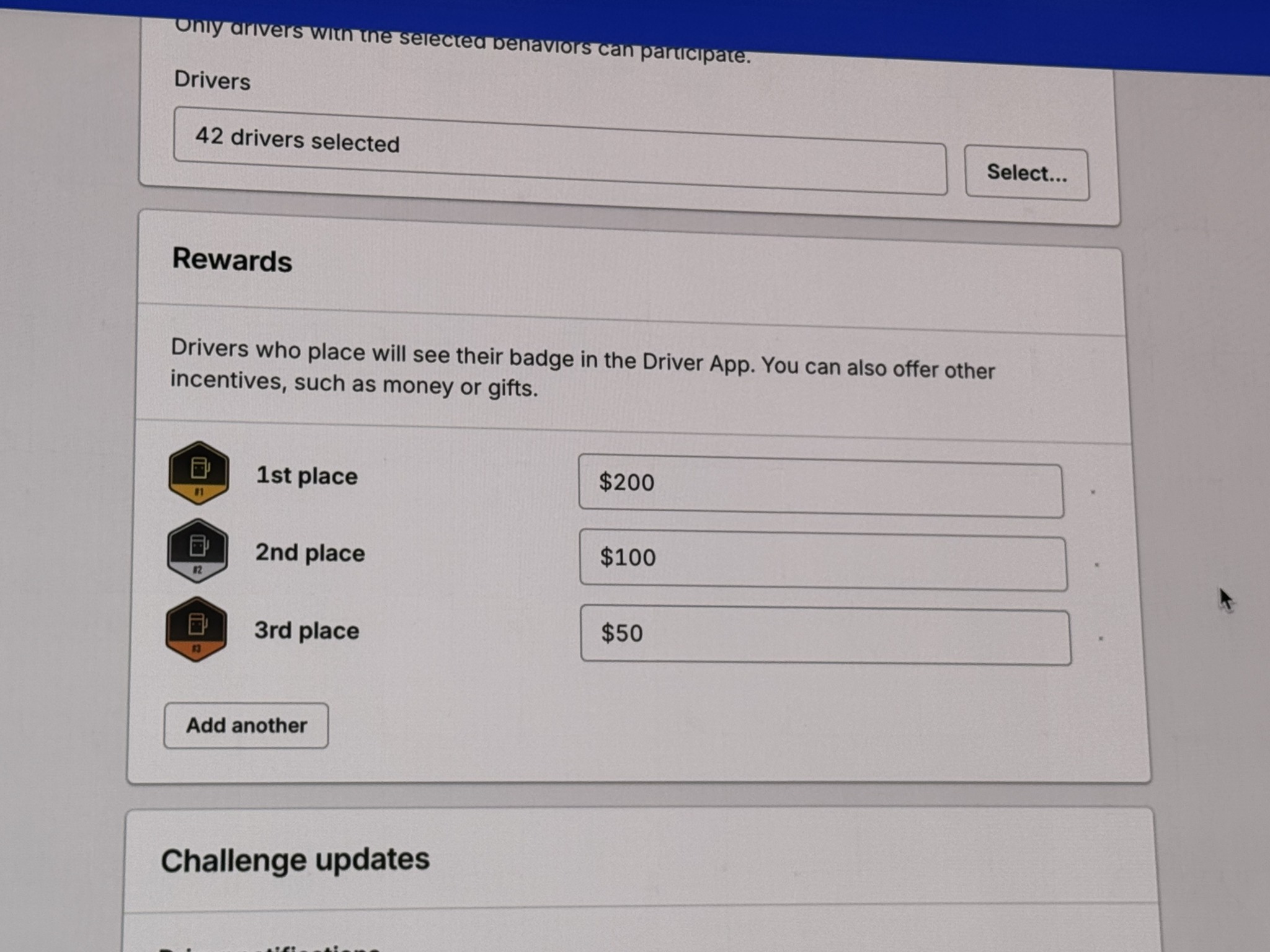
The cameras rollout was paired with driver engagement and recognition tools, including Motive’s new Driver Rewards platform, launched at Vision last week, which automates safety challenges, leaderboards, scoring, and payouts. Rather than rewarding drivers with the fewest incidents, Spatco used Motive’s data to build a more nuanced scoring model tied to exposure, engagement, and safety performance.
“We started with: if you run the most miles, you’re at the most risk,” Fetters said. “Then, we added caveats to that.”

Initially, the company focused on the top five performers based on that combination of mileage and safety metrics. But Fetters said the data also revealed a challenge: some low-mileage drivers consistently maintained perfect scores while remaining largely invisible in reward rankings. The company has since been adjusting the reward logic to better recognize different driver profiles, including lower-mileage drivers with strong safety performance.
“I’d say it probably took 20 minutes,” Fetters said, addressing the concern of extra time needed to learn to use the program and adjust it on the go.
The fleet also launched challenges tied to behaviors such as harsh braking, aggressive turning, and distracted driving, using Motive’s event detection and scoring systems. “I said, ‘Don’t let the camera talk to you; do what you’ve got to do so it doesn’t tell you, ‘hard-braking event detected, harsh turn, harsh acceleration.’ Get to their competitive side.”
The competition approach resonated well. Fetters said all 13 people in one of the locations achieved perfect safety scores during the recent monthly challenge. “Everyone scored 100 in the month of May, and I’m so proud to be able to go share that with them.”
The rollout also marked a move away from partial and reactive camera deployment toward fleetwide consistency. Now that all drivers are in the same box, it helps the morale as well as removes the stigma of ‘only bad drivers getting the cameras in their cabs’.
Beyond rewards and coaching, Fetters told trucknews.com that Motive’s reporting and automation tools reduced the amount of manual administrative work previously tied to spreadsheets and data analysis.
“There’s reports that are already in there that you can pick,” he said, explaining that the system allowed him to filter and match truck numbers, drivers, mileage, and safety scores without building spreadsheets from scratch.
He recalled working with a Motive representative to customize the company’s reporting dashboards and filters.
“The system allows you to do less work again back in spreadsheets,” Fetters said. “When he said VLOOKUP, [an Excel command] I started shaking… I just forgot basically how to use a spreadsheet because I didn’t use it, didn’t need it.”
Instead of spending hours compiling reports and sorting data manually, Fetters said the platform freed up more time for one-on-one conversations.
“To me, doing the right things is making the phone call that someone’s not expecting… ‘Hey, guess what, you did [a] great job,’” he said. “And then that leaves a mark with them instead of the, ‘Well, you almost hit that deer,’ you know? ‘No, you almost hit the deer, and you didn’t. Thank you. Like, I don’t have a truck to fix now.’”
The way of approaching coaching conversations after safety events changed, too, because AI is now able to understand context and reduce the amount of false alerts. Technology helped protect drivers in legal disputes, too.
At the keynote, Fetters shared the example of a five-vehicle crash involving one of Spatco’s drivers who was later sued alongside the company for gross negligence.
“We were being sued for gross negligence, saying we were speeding, and we were driving erratically,” he recalled. According to Fetters, footage and speed data from the Motive system showed the truck was travelling 46 mph in a 45 mph zone and demonstrated that another driver caused the collision.
The experience later turned that driver — one of the company’s biggest skeptics — into an advocate for the technology.
“That guy, who’s allowed his voice against [cameras] to be put in his vehicle — and I’m the one that did the install — two weeks later, he’s being named as a separate defendant in the lawsuit. When he tried to apologize to me for all the things that he had said that may have been negative, I said, ‘Here’s what I want you to do. Don’t apologize to me, but I want you to champion this and help everybody. You’re a single dad, you could have lost a lot in this lawsuit, not just our insurance, but your own.’ So he did that, and that was great, because it not only helped everybody at that location, but he traveled a lot and knew a lot of different people, and it just worked out.”

Have your say
This is a moderated forum. Comments will no longer be published unless they are accompanied by a first and last name and a verifiable email address. (Today's Trucking will not publish or share the email address.) Profane language and content deemed to be libelous, racist, or threatening in nature will not be published under any circumstances.