Samsara aims to take guesswork out of maintenance decisions with new AI capabilities

Samsara found that for some fleets, maintenance can account for roughly 10% of operating costs, yet deciding which repairs deserve immediate attention still heavily depends on experience, service manuals and a technician’s judgment.
At its Beyond conference in Las Vegas, the company unveiled Maintenance Insights, a tool designed to help fleets go beyond decoding fault codes by assessing their severity, estimating repair costs, identifying warranty coverage and modeling what could happen if a problem is left unresolved.
The announcement is part of Samsara’s broader push to use artificial intelligence (AI) to ‘automate the grind’ of everyday operational tasks. Throughout the keynote, company leaders argued that fleets are collecting more data than ever from vehicles and equipment, but often lack the time needed to interpret it and act on it.
Maintenance was just one of the examples.
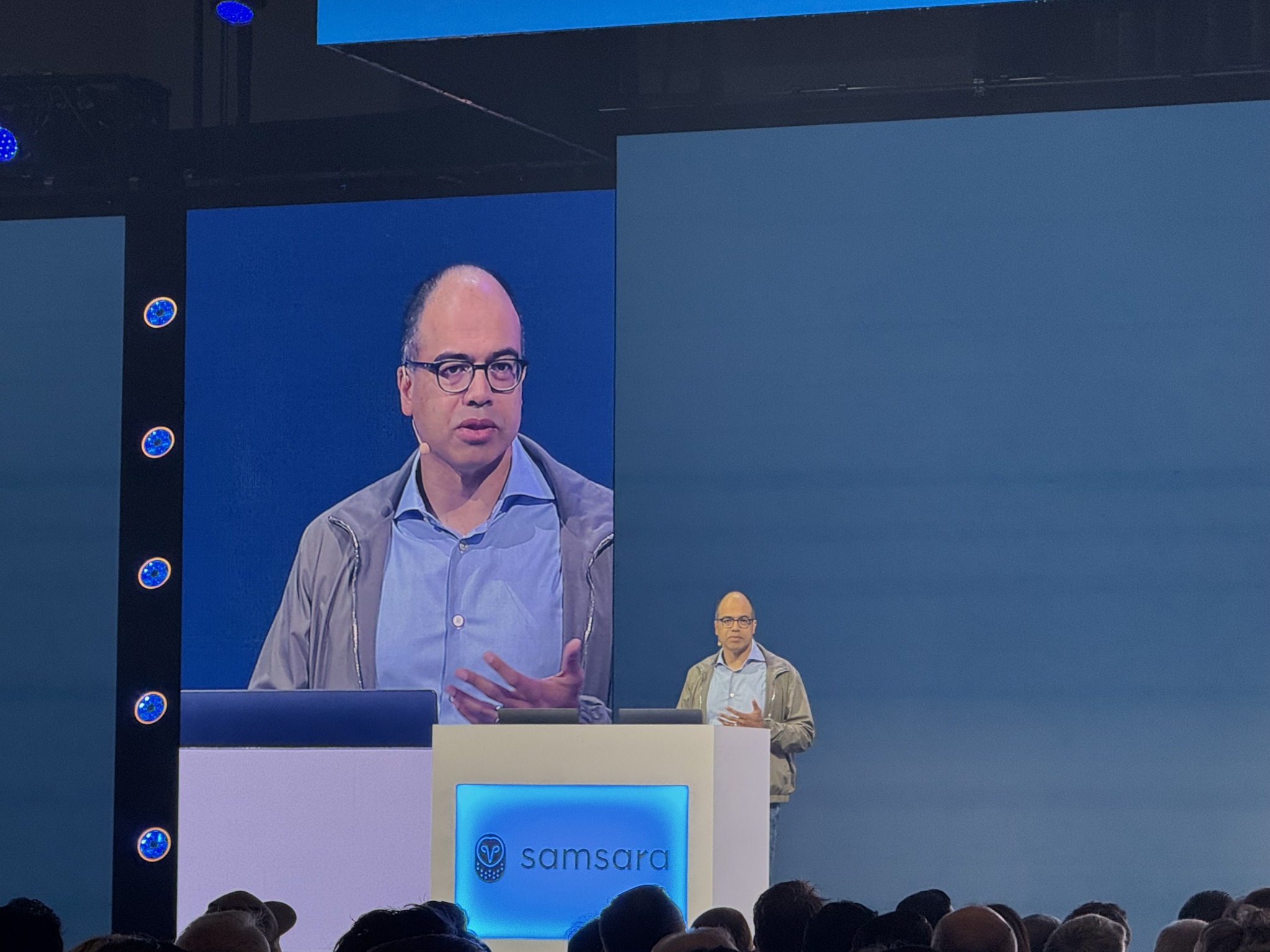
Sanjit Biswas, Samsara co-founder and CEO described scenarios where technicians often arrive to work before dawn, reviewing inspection reports, investigating check engine lights and deciding which vehicles need attention first. Many of those decisions still rely on experience and manual processes, he argued.
To showcase how Maintenance Insights works, Biswas pulled up a demo of a fleet operating more than 1,000 vehicles.
Instead of presenting managers with a long list of alerts and fault codes, the platform automatically prioritized vehicles based on urgency, highlighting which units required immediate attention and which could wait.
He then clicked into a specific truck, a 2024 Freightliner Cascadia, equipped with a Detroit DD13 engine. The vehicle had generated fault code 3251, tied to an exhaust pressure sensor issue.
“I don’t know about you guys, but I’m not a diesel mechanic, so it’s really handy to have a tool that encodes these kind of cryptic numbers,” Biswas said as the code appeared on screen. “What the system has done is basically crack the service manual and said this is what 3251 means. There’s a lot of text on the screen. This is explaining what exactly the fault code’s referring to, what the recommended actions are.”
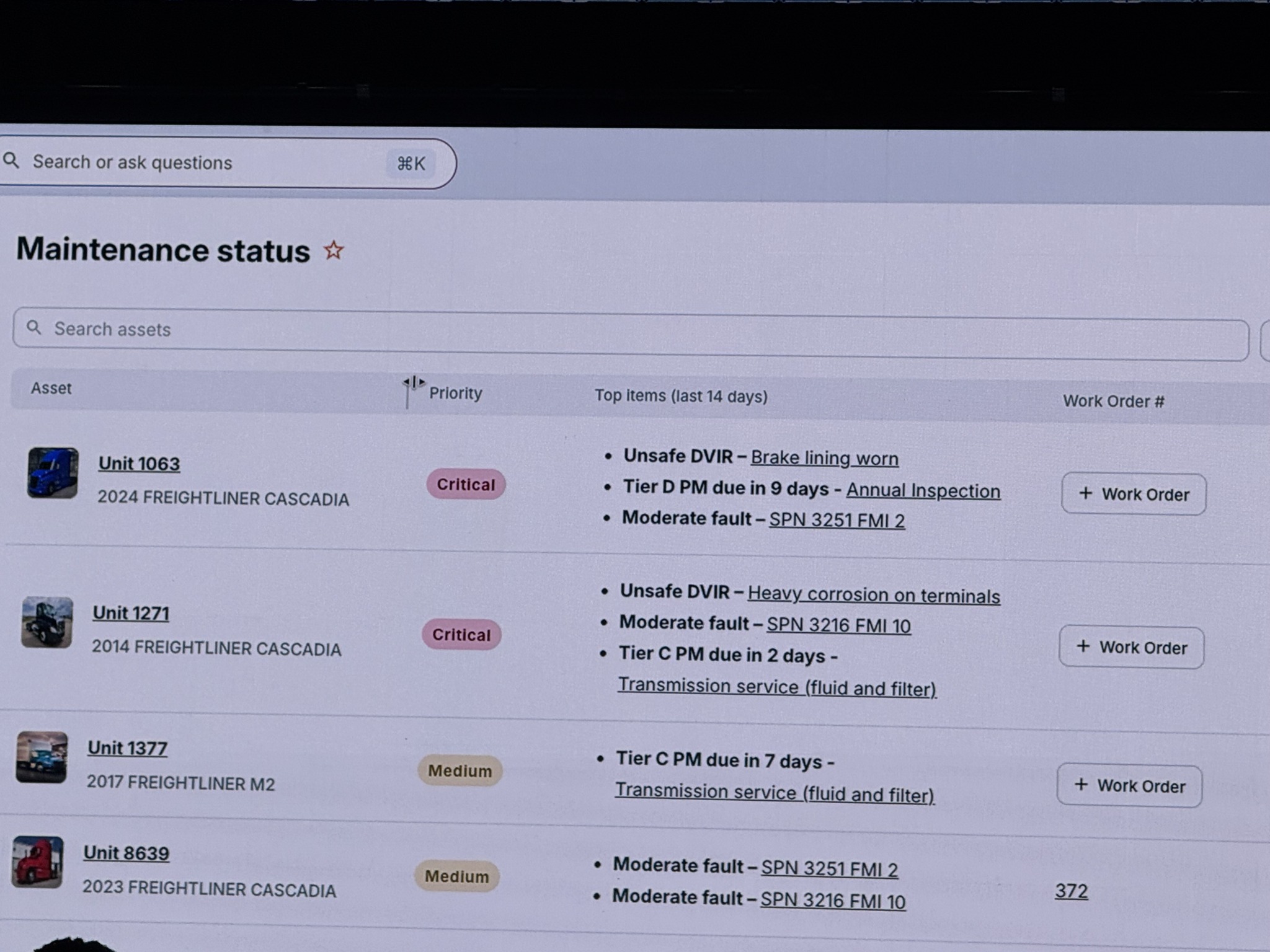
A lot of fault codes are just informational, he added. “They’re FYI, and that’s helpful, but it doesn’t mean we need to do anything about it. In this case, the AI is telling us, ‘Hey, this is a moderate fault’, and you might be wondering, well, how does it know that?”
The answer lies in the scale of Samsara’s network, Biswas explained, saying that the platform is deployed across millions of vehicles and has observed thousands of fault-code combinations over more than a decade.
“In fact, for the Detroit DD13, which is a very specific type of engine, we’ve seen over 107,000 of them, and we’ve seen what happens to them over time,” Biswas said.
That historical data allows the platform to estimate how frequently specific faults occur and what typically happens when they are ignored.
In the next part of the demo, the platform analyzed the data and estimated the repair would cost between $100 and $800 if addressed immediately. It also calculated a 22% probability that the issue would escalate into a more serious fault within roughly 500 miles if left unresolved.
If that happened, repair costs could climb to approximately $2,800. If no action is taken then, the situation will result into a third, most severe fault code, where the repairs could cost up to $3,900.
Such visibility can help maintenance managers decide if the driver can finish the day or has to turn around, and enable more confident decision-making. In the demonstration, the recommendation was to allow the driver to complete the route before scheduling repairs.
But with repairs come warranty questions.
“Most of you are buying hundreds or even thousands of trucks every single year. You negotiate specific warranty coverage with your OE partners based on workloads you have,” Biswas said. “You can now upload all of those warranty docs into Samsara, and the AI can be aware of it. So, when you click a button like ‘check warranty coverage’, the AI is able to look at this fault code, compare it to what’s covered under the warranty, and tell you whether it’s something that you can get paid back for or not.”
In the Cascadia example, the exhaust pressure sensor repair was determined to be covered under warranty.
The platform then offered to generate a work order automatically.
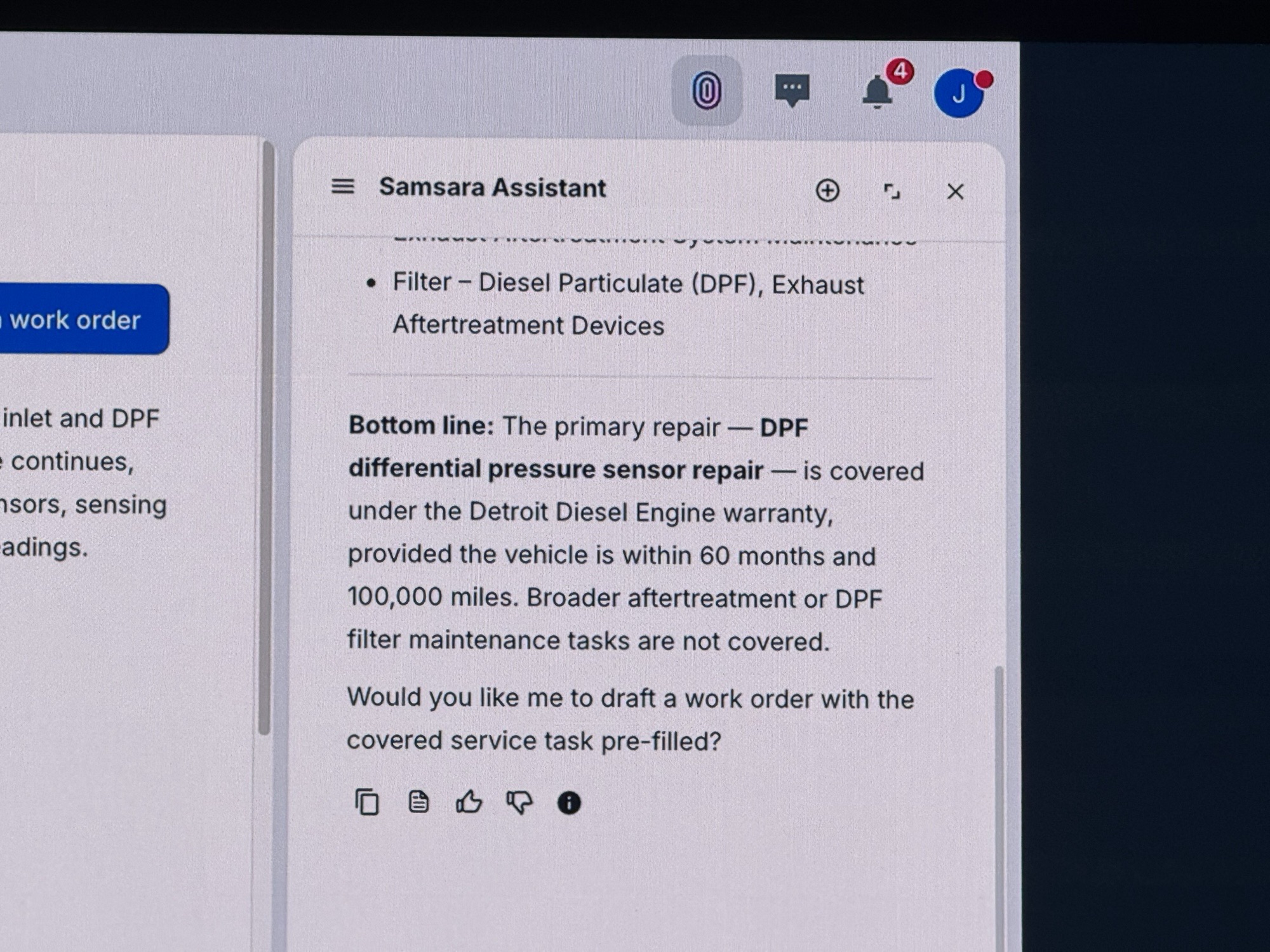
After receiving approval, the platform pulled vehicle information required for the repair order, including odometer readings and engine hours, and automatically filled it. It also reviewed the uploaded warranty documents and identified the supporting documentation required for the claim.
“So, like I said, this specific repair is covered by our Detroit Diesel warranty, but usually you have to submit some other documents, some photos, a couple of checklist items,” Biswas explained. “It’s gone, ingested that PDF, figured out everything we need to do, and streamlined it and put it right here.”
Biswas then contrasted the process with traditional maintenance workflows, saying the whole process might have taken up to two hours back in the day.
The final part of the demonstration expanded the scope from a single truck to the broader fleet.
“If one truck has this issue, what about the others we bought in the same batch?” Biswas asked.
Using a natural-language prompt, the platform searched more than 1,000 vehicles for similar fault patterns and identified additional units experiencing the same exhaust pressure sensor issue. It then offered to generate work orders for those vehicles as well.
A workshop for AI agents
As customers want to explore more of AI capabilities, Samsara also introduced Agent Studio, a no-code platform designed specifically for customers to build their own tailored, AI-powered workflows.
Describing it as “a workshop for your AI ideas,” Biswas said customers can create and customize agents in plain English without writing code. He added the tool is now available in open beta.
While the first demo focused on weekly KPI reporting, the second showcased driver communications capabilities. Using a geo-fence trigger, an AI agent automatically called a driver approaching a designated location and delivered site-specific instructions.
“This is the kind of call that every one of us would like to have for a driver, but no one can practically run, because you’d have to make thousands and thousands of these calls a day,” Biswas said. “But, like I said, AI doesn’t mind, and it’s infinitely scalable.”

Have your say
This is a moderated forum. Comments will no longer be published unless they are accompanied by a first and last name and a verifiable email address. (Today's Trucking will not publish or share the email address.) Profane language and content deemed to be libelous, racist, or threatening in nature will not be published under any circumstances.