OEMs push deeper tech partnerships to build connected and software-defined trucks

Truck manufacturers are no longer trying to build every piece of connected technology themselves. Instead, they’re redesigning trucks around partnerships with technology companies and moving safety systems, cameras and telematics from aftermarket add-ons to the factories.
International Motors, Daimler Truck North America (DTNA) and Samsara argued factory integration is the foundation for the next generation of commercial vehicles, as it will lead to deeper and better diagnostics, over-the-air software updates, predictive maintenance and a more seamless driver experience as trucks become increasingly software-defined.
The transition also represents a major philosophical shift for the OEMs.
“Not a long time ago — perhaps two years ago — we were still in a kind of competition position,” said Huber Mastelari, vice president of service contracts and connectivity at International Motors, during a panel discussion at Samsara’s Beyond conference in Las Vegas. “Our own team, they were trying to develop our own cameras, our own systems. But finally, I’m happy to share that’s not the case anymore.”

He said that instead of building competing telematics and safety platforms, OEMs are now focusing on what they do best – making the truck itself — while leaving it up to the technology companies to develop connected systems.
“We need to be open to partnerships, and we have tech companies such as Samsara with a much better product offering,” Mastelari said.
According to Samsara itself, it was customer demand that led the company to launch its pre-delivery installation (PDI) program last year, allowing fleets to order trucks that arrive with Samsara hardware already installed and ready to activate. The program has grown from two OEM partners to 12 in less than nine months.
Factory integration is the goal
But panelists all agreed that PDI itself is not the final destination but an initial step on the co-development journey.
“We see it as a starting point. From there, we evolve,” said Dragan Brocilo, director of connected vehicle solutions at DTNA. “We’ve been working towards a factory-installed solution, and we really see that as the next step. And where we truly provide that integration of our onboard components, your onboard components, your edge compute, our cameras, your cameras — the permutations are many — but I think here’s where we can truly drive value with that integration.”
The difference isn’t simply where the hardware is installed.
Brocilo described PDI as an “aftermarket-grade” solution, while factory-installed technology meets automotive-grade engineering standards. He said that means every camera, sensor and software interface must go through the same design, integration and validation process as the rest of the truck. While he admitted this will make the development slower, it will ultimately lead to a much deeper level of integration.
Mastelari added that redesigning a truck to accommodate connected technology can take years. Developing a new platform typically requires three to five years, while changes that seem straightforward — such as repositioning a windshield, modifying a dashboard or accommodating new camera hardware — can involve engineering teams spread across the United States, Germany, Sweden, Brazil and other regions.
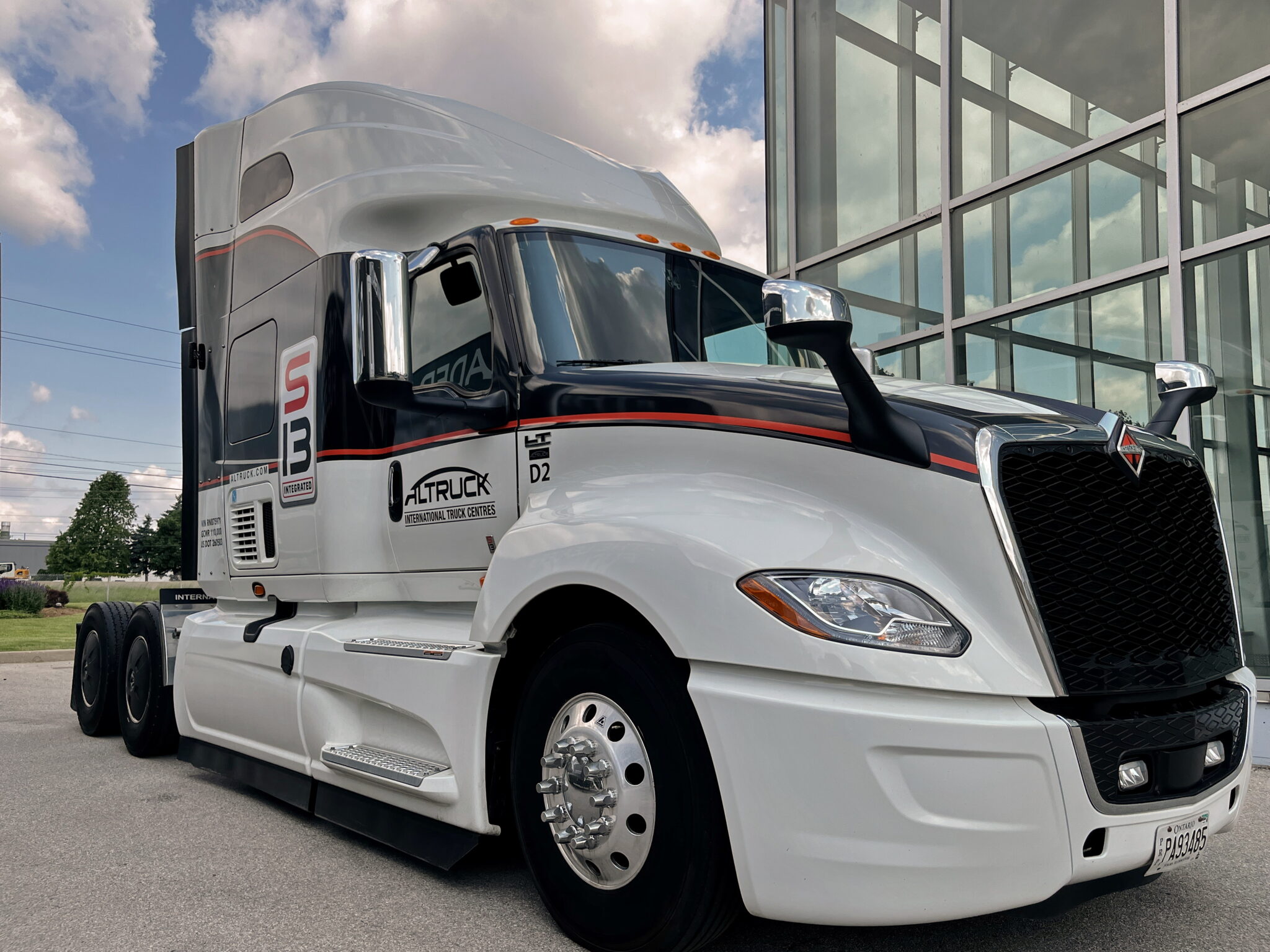
Those projects also compete with higher-profile priorities such as powertrains, autonomous driving and electrification, he acknowledged, making customer demand an important factor in determining what gets built.
That is why Mastelari encouraged fleets to keep pressing OEMs for integrated safety and connectivity. “We need your help first. I need to bring that to your attention. Please keep asking for truck, let’s say, adjustments. Keep talking to your purchasing department, to your dealers, to the ones you are dealing with. Please help us to convince the entire organization that we need to update, we need to move on with our product.”
Less hardware, deeper integration
Future “powered by Samsara” solutions, for example, will be able to use factory-installed cameras, displays, speakers and microphones instead of adding separate hardware throughout the cab, said Tom McNeela, vice president of hardware product management at Samsara.
Rather than mounting another display, the truck’s existing screen could automatically display the appropriate camera view depending on what driver needs in a moment, from activating a turn signal or getting a pedestrian collision warning.
“We have the alerts to the driver, harsh braking, for example, there’s an audio play. Imagine when we’re integrated, we can still have that audio notification, but we’ll actually turn down the infotainment system, so that the driver actually hears that without any background noise,” McNeela said.
“And this week we saw some of the agents communicating over the [communications module] on the main stage, and imagine now that that same process, the same execution takes place, but now that audio is working through the cab audio, the microphone has been ideally positioned by the OEM, it’s been optimized, so that audio quality is just spot on, and it’s a real smooth transition between an interaction with a Samsara agent versus listening to the radio or listening to other podcasts… We could see where we’re going to limit driver distractions and actually highlight driver notifications to improve that driver safety.”
Building the software-defined truck
Those capabilities also move the industry closer to software-defined vehicles, as today’s trucks rely on dozens of electronic control units, many of which were not designed to support modern connected services, International’s Mastelari said.
DTNA’s Brocilo described software-defined vehicles as a “necessary technological leap” that will consolidate many of those computing functions into a small number of high-performance computers, making broader over-the-air updates and richer vehicle integration possible.
Mastelari said that while International currently has about 1.2 million trucks operating across the U.S. and Canada, fewer than 60% of trucks built during the past five years are running the latest software. This is potentially affecting fuel economy and preventing drivers from benefiting from the latest features.
“Some features are not working on your trucks today because you haven’t been able to bring that truck to one of our dealers for a physical software update,” Mastelari said.
The issue isn’t just frustrating for fleets who lose productive operating time, he added. It’s costly for manufacturers, too. “Don’t think that we are happy to ask you to go to one of our dealers, because every time when you go to our dealers for a software update, behind the scenes, we are paying for that labor cost as well,” he added.
Predictive maintenance: the holy grail
The panelists also pointed to predictive maintenance as another long-term benefit of deeper integration. However, that will be introduced gradually as confidence in AI continues to improve in the future.
Mastelari said the goal extends beyond simply predicting that a component will fail. Instead, he envisioned “maintenance orchestration.”
While International is already using AI models with more than 80% accuracy to predict failures of components such as batteries, alternators, turbochargers and DEF systems, he said the company’s goal is to orchestrate the entire maintenance event, determining when the repair should take place, what parts are needed, how long the truck will be out of service and where the work can be completed most efficiently.
Brocilo, meanwhile, described predictive maintenance as the industry’s “holy grail,” but cautioned that manufacturers cannot afford to replace components too early because of inaccurate predictions. He said DTNA has run predictive maintenance pilots in the past, but chose not to launch them because the models weren’t accurate or repeatable enough. “It’s important to get it right,” he said.
Rather than rolling out predictive maintenance across entire vehicles, DTNA is taking a component-by-component approach, expanding only as the models prove reliable enough.

Have your say
This is a moderated forum. Comments will no longer be published unless they are accompanied by a first and last name and a verifiable email address. (Today's Trucking will not publish or share the email address.) Profane language and content deemed to be libelous, racist, or threatening in nature will not be published under any circumstances.